Downtown Cajun Cook-Off Delivers Another Winning Year for a Good Cause
Despite competing events and threatening weather, the 2016 Downtown Cajun Cook-Off drew a strong crowd and raised money for the Child Advocacy Center of Mobile.
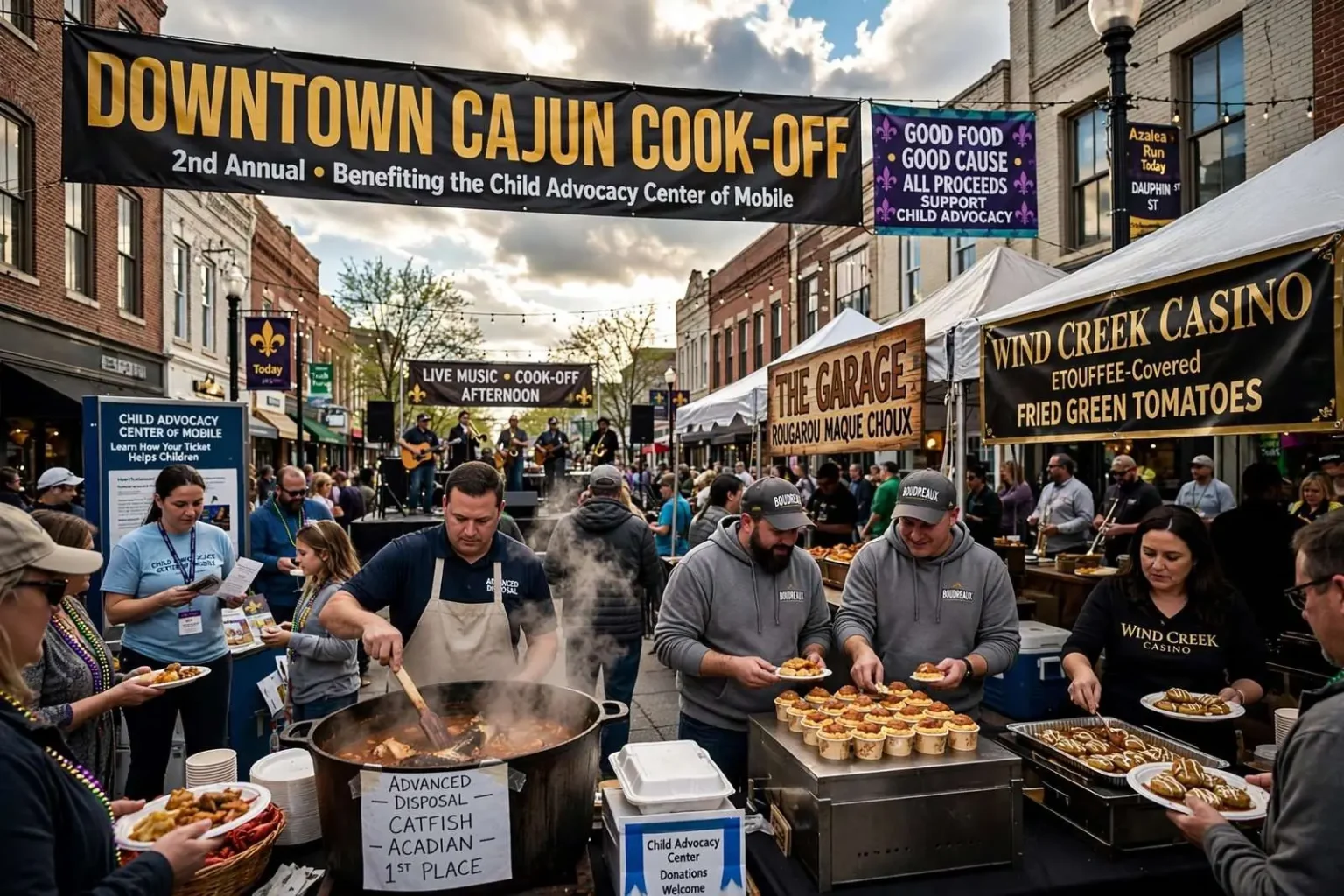
Threatening skies and a busy Saturday calendar weren’t enough to derail this year’s Downtown Cajun Cook-Off, which went on without a hitch despite competing for attention with the Azalea Trail Run and Callaghan’s St. Paddy’s Day street party. The sun broke through long enough to make for a comfortable afternoon as pots simmered and bands played for the crowd that turned out last Saturday. In a city that packs its spring weekends the way Mobile does, the cook-off’s ability to carve out its own crowd against two established events says something about both the drawing power of Cajun cooking and the loyalty the fundraiser has built in only two years.
The scheduling collision was real. The Azalea Trail Run brings thousands of runners and spectators into downtown streets on the same spring Saturday, and Callaghan’s Irish Social Club’s St. Paddy’s Day street party has become one of the neighborhood’s most popular annual traditions. Any event competing against that combination needs a distinct identity and a committed audience. The cook-off had both: the universal appeal of gumbo, etouffee and jambalaya, plus a cause behind the tickets that turns a lunch into a contribution.
The cook-off benefits the Child Advocacy Center of Mobile, meaning every ticket and every bite sold supports the organization’s work regardless of which team takes home the trophy. The Child Advocacy Center serves children who have experienced abuse, bringing together investigators, counselors and support services under a child-first model that spares young victims the trauma of repeating their stories to multiple agencies. Fundraisers like the cook-off supply a meaningful share of the resources that keep those services available to local families at no cost, which is why the event’s success matters well beyond the podium.
That mission shapes the event’s tone as much as the menu does. Competitors spend weeks refining recipes and marshaling teams, but the beneficiary gives the afternoon a shared purpose that softens the scoreboard: everyone eating is giving, and every winning bite is also a donation. The center’s staff typically attend such events as well, giving ticket-buyers a chance to see where their money goes and to hear directly about the children the organization serves — a connection between pot and purpose that keeps the fundraiser from feeling like just another festival.
Children’s advocacy organizations occupy a distinct place in the nonprofit landscape. Rather than offering a single service, they coordinate the response to child abuse across law enforcement, child protective services, medical providers and therapists, so that a child’s experience of the system is as short and as gentle as possible. That multidisciplinary model depends on stable community funding, and events like the cook-off — with their built-in crowds and their family-friendly settings — are a natural match for the center’s mission and its message.
The competition
Still, the competition among the cooking teams was as fierce as ever, and this year produced a few surprises among the winners. Advanced Disposal claimed first place with a Catfish Acadian dish that one rival competitor described as tasting like “an awesome crawfish etouffee with sort of a catfish nugget.” The description captures the kind of Gulf Coast cooking the event celebrates — a dish rooted in Louisiana’s Acadian tradition but built on Alabama’s own catfish, which dominates the state’s aquaculture and appears on plates across the region. A waste services company taking the top cooking prize added its own surprise; corporate teams at charity cook-offs are often dismissed as filler until one shows up with a pot that wins the crowd.
Second place went to last year’s champions, a team known as The Garage, made up of Boudreaux, Boudreaux, Boudreaux and Bennie, for their Rougarou Maque Choux. The team’s name alone is a Cajun Country dictionary: the Boudreaux surname is practically shorthand for south Louisiana, and the rougarou — the Cajun werewolf of bayou legend — gives the dish a mythology to match its maque choux, the smoky corn-and-pepper stew that is one of the cuisine’s most beloved sides. Defending champions rarely hold their crown in a field like this, but a second-place finish by last year’s winners speaks to the consistency of a team that cooks together seriously.
Wind Creek Casino rounded out the top three, taking third with etouffee-covered fried green tomatoes. The dish is a natural crowd-pleaser that bridges two Southern traditions — the fried green tomatoes of the wider South and the etouffee of Louisiana — and a casino hospitality operation knows exactly how to feed a festival crowd. A podium that spans a corporate team, a band of Boudreauxes and a casino kitchen is a fair portrait of the event itself: Mobile’s whole community showing up with a pot.
The Azalea Trail Run connection deserves its own note, since the race is one of Mobile’s signature athletic events, drawing elite and recreational runners alike through downtown streets on a course lined with the azaleas that give the season its name. Events of that scale transform the logistics of any same-day gathering — street closures, parking, hotel occupancy — and the cook-off’s organizers made the collision work rather than fighting it. Downtown Mobile on that Saturday offered, in effect, a triathlon of attractions: run in the morning, eat gumbo in the afternoon, walk to Callaghan’s by evening. Visitors who came for one event had two more waiting.
Organizers and competitors alike described a friendly, supportive atmosphere among the teams despite the stakes, with cooks trading encouragement even as they vied for the podium. Charity cook-offs walk a line between contest and community, and the ones that last are the ones where the rivalry stays at the tasting table. Judges, tickets and trophies supply the competition; shared recipes, borrowed equipment and mutual applause supply the reason everyone comes back.
The judging format itself rewards the kind of cooking Gulf Coast audiences love. Rather than a single celebrity panel, community cook-offs typically weigh tickets sold, crowd favorites and judges’ scores together, so a team’s success depends as much on working the crowd as on the recipe. That structure favors generous sampling, plenty of conversation and second trips to the tent — which is precisely how a cook-off becomes a party, and how a two-year-old event builds the loyal attendance that carries it into a third.
Looking ahead to year three
Event organizers are already looking ahead to a third year of the cook-off, hoping for another stretch of cooperative weather. Weather is the perennial variable for any outdoor Mobile event — spring afternoons can deliver sunshine or a Gulf squall with equal probability — and this year’s threatening forecast that never fully materialized counts as a win in the organizer’s column. With two years of experience, a proven beneficiary and a growing roster of cooking teams, the event enters its third year with the kind of momentum that separates permanent traditions from one-time experiments.
Events like the Cajun Cook-Off have become a fixture of Mobile’s spring calendar, giving local restaurants, caterers and civic-minded businesses a chance to showcase Gulf Coast cooking traditions, from etouffee to maque choux, while raising money for a cause that serves some of the community’s most vulnerable children. Mobile’s spring is crowded by design — Mardi Gras hands off to the Azalea Trail Run, which hands off to festival season — and events that fill out that calendar draw visitors who extend their stays, eat in local restaurants and shop in the districts that surround the venues. A downtown event on a March Saturday puts foot traffic on streets that benefit all weekend long.
The cooking itself carries cultural weight in a city like Mobile. The Alabama Gulf Coast sits at the meeting point of Creole, Cajun, Southern and seafood traditions, and dishes like the ones that filled the pots Saturday — etouffee, maque choux, Catfish Acadian — are living recipes that traveled from Acadiana across the state line and settled into local kitchens. A cook-off is one of the few formats where amateur teams and professional kitchens compete on the same ground, and where a corporate crew can topple a team of Louisiana natives with one well-executed pot.
The presence of live music through the afternoon rounds out the formula that has made the event work two years running. Mobile audiences expect a soundtrack with their festivals, and bands playing while teams serve keep crowds lingering between rounds of tasting — which is good for the beneficiary, since lingering crowds buy more tickets. The combination of food, music and charity has become the default architecture of successful Gulf Coast fundraisers, and the cook-off executed all three elements on a Saturday that gave it every excuse not to.
For the Child Advocacy Center, the afternoon delivered what fundraisers are supposed to deliver: a full crowd, a good story and resources for the year ahead. For Mobile, it delivered another reason the spring calendar keeps filling — a downtown afternoon where the competition is fierce, the kindness is genuine and every ticket is both lunch and a helping hand.