Downtown Mobile Rings in New Decade with MoonPie Drop, Then Kicks Off Mardi Gras
Downtown Mobile welcomed the new year and new decade with a Collective Soul concert and the annual MoonPie Drop, then kicked off Mardi Gras season with a Carnival parade tied to the LendingTree Bowl.
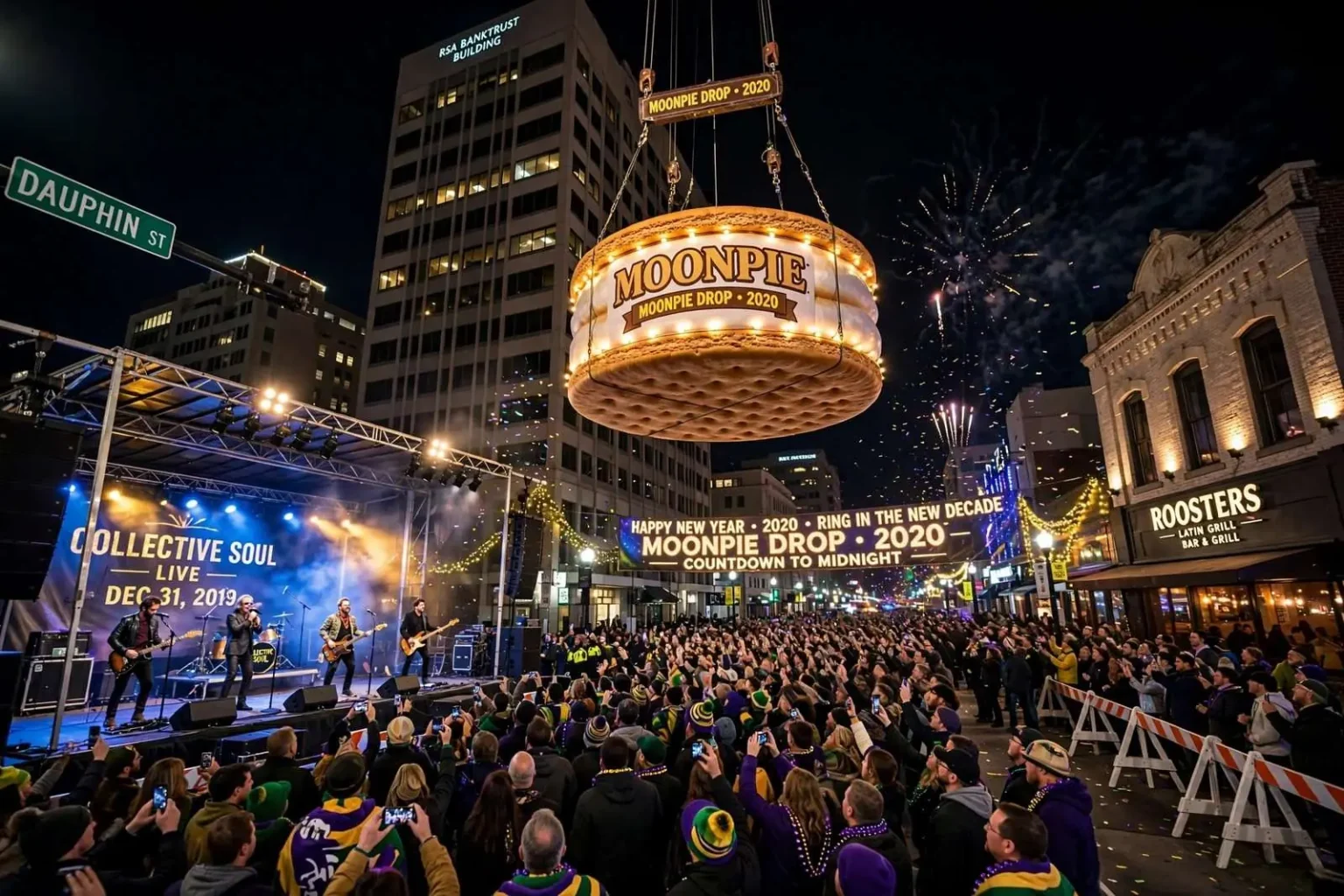
Downtown Mobile drew thousands of revelers on New Year’s Eve as the city marked both the start of a new year and the beginning of a new decade with its signature MoonPie Drop celebration. Crowds gathered along the streets and rooftops of downtown to watch the giant illuminated MoonPie descend from the side of a downtown building at the stroke of midnight, a local twist on the traditional New Year’s Eve ball drop that has become one of the region’s most recognizable holiday traditions.
The oversized confection at the center of it all was built in Chattanooga, Tennessee, hometown of the MoonPie itself, and lowered down the face of a high-rise as the countdown reached zero. The choice of icon is no accident: the marshmallow-and-graham sandwich has been a fixture of Mobile’s Mardi Gras for generations, the treat of choice for masked riders to toss from floats along the parade routes. Bringing one downtown for New Year’s Eve ties the city’s biggest night of the winter to the celebration it is best known for, which follows just weeks later.
Live music anchored the evening. This year’s celebration featured a performance from Collective Soul, the Georgia-based rock band best known for 1990s hits such as “Shine” and “The World I Know.” The band took the stage for the assembled crowd before the countdown, giving the celebration a nostalgic soundtrack as 2019 turned to 2020 — a set of songs that much of the crowd had first heard on the radio in high school and college.
Before the show, members of the band were spotted dining at Roosters, a longtime downtown restaurant known for its Latin-inspired menu. It was a small moment, but a telling one for a downtown that has spent two decades rebuilding its after-dark reputation: touring acts eating within walking distance of the stage is exactly the kind of foot traffic the city’s entertainment district was designed to create.
A Downtown Tradition Grown Bigger Every Year
The MoonPie Drop has grown into one of the Gulf Coast’s largest free New Year’s Eve events since it was launched more than a decade earlier. What began as a quirky marketing idea — drop a giant MoonPie, not a ball — matured into a full production with national touring acts, rooftop parties, street closures and a television audience beyond downtown. Hotels and restaurants around the central business district fill up for the night, and the crowds spill along Dauphin Street and the surrounding blocks for hours before and after midnight.
Not everyone experienced a peaceful transition into the new year, however. Residents across Mobile reported hearing what sounded like automatic gunfire ringing out around midnight, a recurring complaint during New Year’s Eve celebrations in the city. The bursts of shooting — typically strings of rounds fired from pistols and rifles into the sky and sometimes down residential streets — have become an annual accompaniment to the holiday that police and city leaders have tried for years to stamp out.
The dangers are not theoretical. One Oakleigh neighborhood resident discovered a bullet lodged in his front porch in the days following the celebration, a reminder of the real hazards posed by celebratory gunfire. Oakleigh, one of Mobile’s oldest historic districts, sits well away from the downtown festivities — a distance that matters, because a falling round does not need to come from nearby to cause harm.
Discharging firearms into the air to celebrate the new year is illegal in Mobile and across Alabama, and public safety officials routinely warn that bullets fired into the sky must eventually come down, often with lethal consequences. A bullet fired upward climbs until its momentum runs out, then falls back at a speed more than sufficient to pierce a roof, a windshield or a skull. Hospital trauma teams and police departments across the country have documented deaths from falling rounds fired blocks — sometimes miles — away.
The risk registered elsewhere that same night. A woman in Houston was killed by a stray bullet on New Year’s Eve this year, an incident that underscores the danger of the practice even when celebratory in intent. Cases like that one are why Mobile police and fire officials have repeated the same message each December: leave the fireworks and noisemakers to sanctioned displays, and keep firearms out of the celebration entirely.
Local officials have urged residents in past years to celebrate responsibly and to leave the fireworks and noisemakers to sanctioned displays rather than gunfire. The city’s official fireworks and the downtown program are designed to give revelers an outlet — noise, light and spectacle — that does not put anyone’s roof or living room in the line of fire. Enforcement, though, is difficult: by the time rounds are heard, the shooters are gone, and tracing them depends on witnesses willing to come forward.
Carnival Season Right Behind It
Carnival season also followed close on the heels of the holiday, keeping the celebratory mood — and the crowds — in place. Mobile’s Mardi Gras is the oldest in the country, tracing its roots to the early 1700s, and the parades begin rolling in the first weeks of January, building toward their climax on Fat Tuesday in late February. For downtown businesses, the MoonPie Drop is effectively the opening bell: the streets stay busy from New Year’s Eve through Ash Wednesday.
The connection between the two celebrations is more than scheduling. MoonPies thrown from floats are a Mobile signature that dates back decades, favored by riders because the individually wrapped treats are soft enough not to injure anyone they land near — unlike the crates and abuse that earlier generations of throwers hurled. The giant downtown drop simply scales up the tradition, borrowing a symbol from the parades and hanging it off a skyscraper for one night.
The confection itself has an Alabama-adjacent history. The MoonPie was created in Chattanooga in the early 20th century, legend has it after a traveling salesman heard Kentucky coal miners describe the kind of snack they wanted — something as big as the moon — and the treat became a lunchbox staple across the South. Chattanooga bakes it; Mobile throws it. The city’s New Year’s Eve icon is a tribute to a century of Gulf Coast snacking, and the downtown drop has become the confection’s most famous public appearance.
What the Night Says About the New Mobile
For city leaders, the decade-turning celebration doubled as a progress report. Twenty years earlier, downtown Mobile emptied out after office hours; today, the blocks around Dauphin Street hold apartments, condos, restaurants and bars that support a genuine street life. An event capable of pulling thousands of people outdoors on a winter night, with a national recording act on stage and rooftops rented out for private parties, would not have been possible in the downtown of the recent past.
The challenge that comes with growth is managing it. Bigger crowds mean more street closures, more security and more cleanup, and the holiday still brings the perennial problem of celebratory gunfire in the neighborhoods beyond downtown. Officials have balanced the two by expanding the official programming — music, fireworks, family activities — while continuing to warn that the illegal kind of celebration carries consequences that no party can undo.
As 2020 began, Mobile had both reasons to celebrate and a reminder of what vigilance costs. The illuminated MoonPie settled onto the side of its downtown building for another year, Collective Soul’s amplifiers went quiet, and the city pivoted almost immediately to Carnival season. The years would turn again, the crowds would come back, and the same two Mobile traditions would follow each other — one handed down from the 1700s, one built barely a generation ago, both bent on keeping the new year safe enough to enjoy.
Planning for a Big Night Outdoors
Staging an event of this size takes months of coordination. Police plan street closures and pedestrian zones, fire and rescue units position around the crowd, and public works crews handle everything from barricades to the portable facilities thousands of attendees require. The production schedule runs backward from midnight: staging and sound checks in the afternoon, the opening act in the evening, and the timed drop that has to hit the final second of the year exactly.
Weather is the perennial variable. Late December on the Gulf Coast can deliver anything from shirtsleeve warmth to a freezing rain, and organizers build contingencies around forecasts the way parade captains do during Carnival season. A cold snap can thin the crowds; a genuine storm can force changes to the program. This year, the weather cooperated enough for the crowds and the band, and the drop arrived on schedule.
The economic ripple is part of the appeal. Hotel rooms downtown book out for the holiday weekend, restaurants add staff, and the rooftop parties and bar crowds keep registers ringing well past midnight. City officials have pointed to the New Year’s Eve crowd as evidence that investments in the downtown core — streetscape work, the convention center, the entertainment district — pay off when thousands of people choose to spend the night in the city center rather than at house parties in the suburbs.
Those gains coexist with the reminders. The bullet found in an Oakleigh porch was a small piece of metal with an outsized lesson: celebration that endangers neighbors is not celebration at all, and the distance between a rooftop toast downtown and a stray round in a historic district is smaller than most people assume. The city’s task, as a new decade opened, was to keep growing the first tradition while finally ending the second.