Downtown Mobile’s Broad Street Corridor Set for Two-Week Closure as Utility Work Begins
A stretch of Broad Street in downtown Mobile closes June 15-28 for new water main and drainage work. Here are the detour routes and speed limit changes.
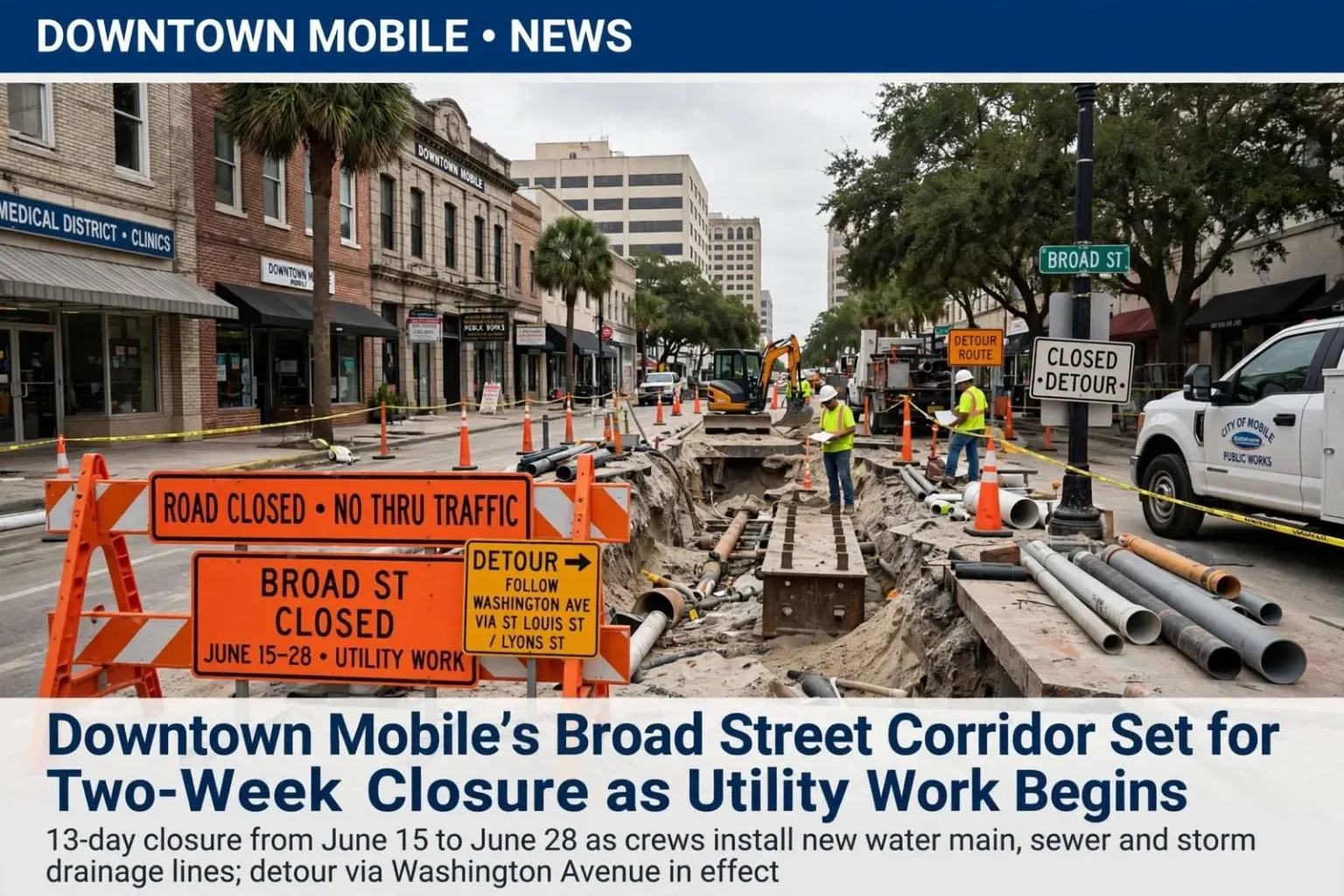
Drivers who rely on Broad Street through downtown Mobile will need to find another route for roughly two weeks this summer. The City of Mobile announced that the stretch of Broad Street between St. Louis Street and Congress Street will close entirely from Monday, June 15, through Sunday, June 28, while crews install new underground utilities. For commuters, deliveries, and anyone cutting across downtown on a daily basis, the closure turns one of the area’s most dependable north-south routes into a detour for the better part of two weeks.
According to city officials, the 13-day shutdown is needed so contractors can put in a new water main along with sanitary sewer and storm drainage lines. Once those lines are in place, the roadway will be rebuilt over the trench work, restoring the street to traffic with new pavement on top of brand-new infrastructure beneath it. The all-at-once approach is standard for this kind of utility project: opening the street once, doing the underground work in a single mobilization, and repaving is faster, cheaper, and less disruptive over time than cutting into the road repeatedly for each separate line.
How Traffic Will Be Rerouted
Northbound Broad Street traffic will be detoured onto Washington Avenue, with drivers routed via St. Louis Street and Lyons Street to get around the closed block. The routing uses the parallel downtown grid to swing vehicles around the work zone with a minimum of turns, and signs will mark the path from the moment drivers approach the closure. Motorists who normally enter Broad Street from side streets during the closure period will need to reach the detour route before their usual turn.
The city is asking motorists to follow the posted detour signs and expect delays during peak travel times. Morning and afternoon rush hours are when the closure will be felt most, since downtown streets that normally carry only local traffic will absorb the volume that Broad Street usually handles. Drivers with flexibility are encouraged to shift their travel times or use alternate crossings altogether until the work is complete.
A reduced speed limit of 25 miles per hour will be enforced throughout the work zone for the duration of the project, and officials are urging drivers to watch for workers and equipment near the travel lanes. Utility work of this kind puts crews in trenches, heavy equipment at the curb line, and flaggers at intersections, all in close quarters with moving traffic. The lowered speed limit gives both workers and drivers more reaction time, and police enforcement in work zones is stricter than on ordinary streets.
Utility projects on this scale are planned months in advance, and the timing of the Broad Street closure reflects an effort to finish the disruptive portion quickly. Crews will work through the closure window to excavate the trench, lay the new lines, make the connections to the existing system, and rebuild the roadway layer by layer — compacted fill, road base, and new asphalt — so that traffic can return as soon as the surface is ready. Compressing all of that into 13 days requires round-the-clock coordination among the contractor, city inspectors, and the utility departments whose lines share the right of way.
Underneath a downtown street, space is crowded. Water, sewer, drainage, gas, telecommunications, and electrical lines all occupy the same corridor, and crews must locate every existing line before digging. That is why full closures are sometimes safer and faster than keeping a lane open: an open trench across a busy street with traffic squeezing past is a hazard for both workers and drivers, and closing the block removes that conflict entirely.
Residents with questions about the project can watch for updates from the city as the work progresses, and drivers are reminded that closure dates can shift slightly if weather or underground conditions force a change. Heavy summer rain is always a factor on the Gulf Coast, and a flooded trench or a washed-out work day can push a schedule back without much warning. Officials say the June 15 through June 28 window is the current plan, and the posted detour will remain in effect until the roadway itself is safe to carry traffic again.
Why Broad Street Matters
The closure affects a busy downtown corridor that connects the medical district and midtown neighborhoods with the central business district. Broad Street runs north-south through the heart of Mobile, carrying commuters into downtown, patients and staff toward the hospitals and clinics clustered around the medical district, and neighborhood traffic between midtown and the riverfront. Businesses along the corridor and on the surrounding blocks depend on that flow, which is why the city has packaged the work into a single two-week push rather than a longer, piecemeal project.
For pedestrians and cyclists, the closed block will also be off limits while the trench work is open, and anyone who normally walks that stretch — including employees heading to downtown offices — should plan around the barricades. Sidewalk closures and lane shifts are common companions to utility trenching, and the safest approach during the project window is to give the work zone a wide berth entirely.
Part of a Larger Infrastructure Push
City crews have scheduled similar utility upgrades along other downtown streets as part of an ongoing effort to replace aging water and sewer infrastructure. Much of the pipe under Mobile’s older streets was laid generations ago, and its age shows in main breaks, sinkholes, and capacity problems that surface during heavy rain. Replacing those lines street by street is a slow, expensive undertaking, but each completed project takes a piece of the system out of the failure column and improves service for the homes and businesses connected to it.
Water mains are only the most visible part of the work. Sanitary sewer lines carry wastewater from downtown buildings to the treatment system, and storm drainage lines handle runoff from the frequent downpours that sweep across the Gulf Coast. When any of the three fails, the consequences range from a boiled-water notice to street flooding to sewage backups, so rebuilding all of them at once — as the Broad Street project does — delivers the most value from a single closure. The new lines also expand capacity, which supports downtown growth and redevelopment on the corridor.
For residents, the practical takeaway is patience and planning. Deliveries scheduled during the closure window may run late, ride-shares and taxis will take the detour automatically, and school and work commutes through downtown should get a few extra minutes of buffer. The city’s announcement of exact dates — June 15 through June 28 — gives everyone who travels the corridor advance notice to adjust, and officials say the street is expected to reopen on schedule once the new lines are buried and the roadway is rebuilt on top of them.
Getting Around Downtown During the Work
Drivers planning routes through downtown during the closure should think in terms of the grid rather than a single substitute street. The detour carries northbound traffic from Broad onto St. Louis Street, over to Washington Avenue, and back down to Lyons Street before rejoining the corridor, so the surrounding blocks will be busier than usual. Motorists who normally cut through that part of downtown for errands or lunch trips may find parking and curb space tighter while the detour is active, since construction staging typically occupies some of the shoulder near the work zone.
Business owners in the affected area are encouraged to remind customers and vendors of the closure dates and to schedule deliveries outside peak hours where possible. Experience from previous downtown utility projects shows that clear communication with customers is the difference between a rough two weeks and a manageable one, and most drivers adapt to a posted detour within a day or two once the signs are up.
The 25-mile-per-hour limit will be posted and enforced through the work zone, and fines in work zones are typically steeper than ordinary speeding tickets, reflecting the heightened danger to crews on foot. Officials repeat the same advice for every project like this one: slow down, put the phone away, and pay attention to flaggers and equipment operators who are working just feet from the travel lanes.
What Happens After the Reopening
When Broad Street reopens on or about June 28, drivers will see fresh pavement over the completed utility lines, and the corridor will return to its normal role carrying traffic between midtown, the medical district, and downtown. The buried work, though invisible, is the real product: a new water main to serve the area reliably, upgraded sanitary sewer lines, and improved storm drainage built to handle Gulf Coast rain.
The Broad Street project is one piece of a longer program. As similar upgrades proceed on other downtown streets in the months ahead, residents can expect more temporary closures, more detours, and the same pattern of short-term inconvenience in exchange for long-term reliability. The city’s practice of announcing closure windows in advance and posting detour routes is intended to keep the disruptions predictable, and travelers through downtown are advised to watch for notices as each subsequent phase is scheduled.
In the meantime, the message from city officials is simple: follow the detour signs, expect delays at rush hour, slow down in the work zone, and plan a few extra minutes into any trip that crosses downtown between June 15 and June 28. The inconvenience is temporary; the infrastructure underneath Broad Street will be new for decades.