Dozens of Tire Blowouts After Nails and Screws Scattered Across I-10 Bridge in Jackson County, Mississippi
Nails and screws across westbound I-10 over the Pascagoula River caused dozens of tire blowouts; the Jackson County Sheriff urged alternate routes.
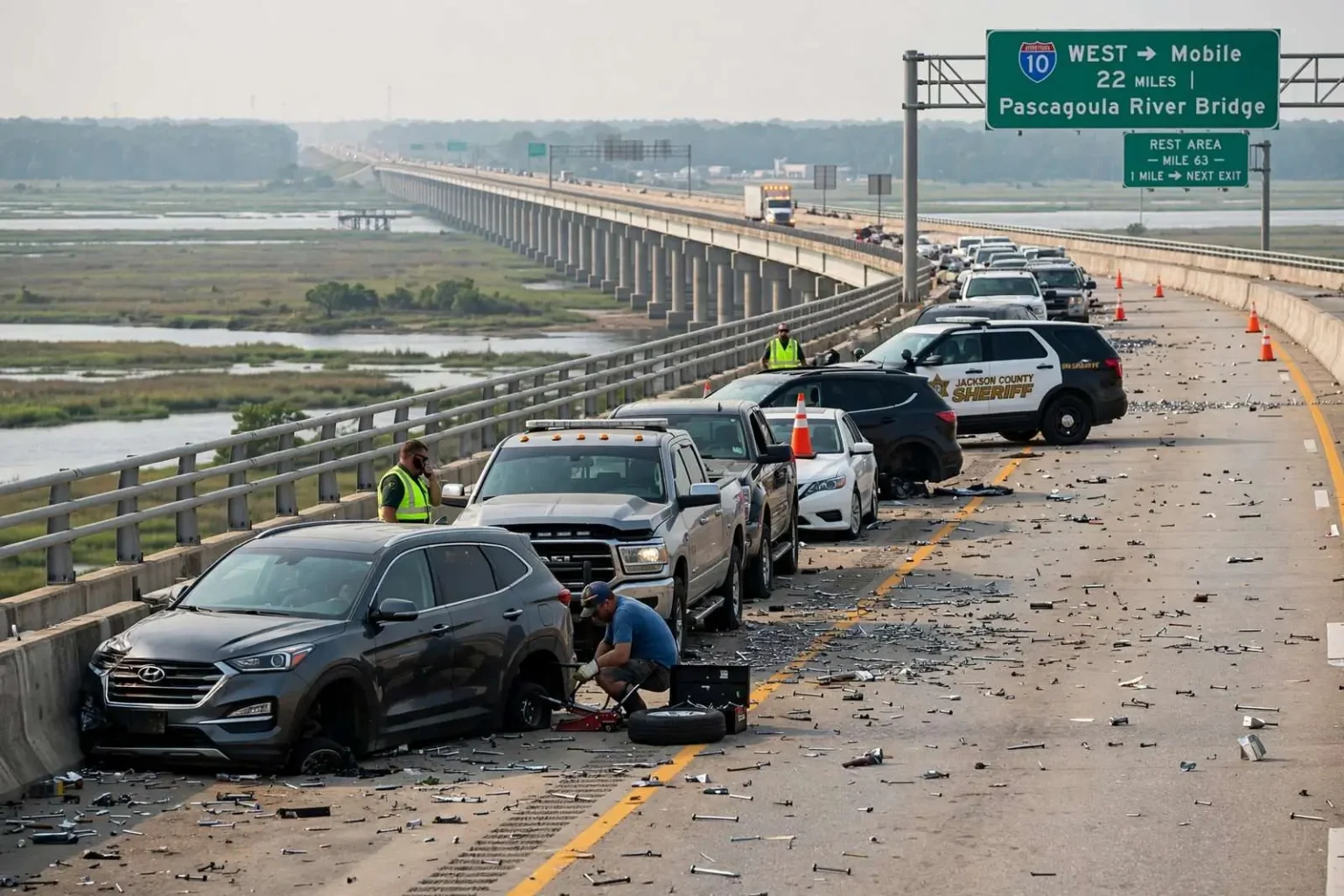
Drivers on westbound Interstate 10 in Jackson County, Mississippi ran into a costly and dangerous surprise when nails and screws were scattered across the interstate’s long bridge over the Pascagoula River, causing dozens of tire blowouts. The Jackson County Sheriff’s Department reported that the debris field stretched across the span, and in the hours after the discovery, dozens of vehicles could be seen pulled over along the shoulder of the interstate with tire damage. Many more drivers stopped at a rest area near mile marker 63 to swap out ruined tires, creating a slow-motion traffic jam of stranded motorists jacking up cars and trucks in the summer heat.
The Pascagoula River bridge carries westbound Interstate 10 across one of the largest unimpeded river systems in the lower 48 states, and the crossing is a critical link for commuters, freight haulers and vacation travelers moving between the Mississippi Gulf Coast and Mobile. Because the bridge runs for miles over marsh and open water, there are few places for a driver to exit once committed to the span, which meant many motorists had no option but to roll over the scattered fasteners before they even knew the hazard existed. Tire shops and roadside assistance services on both sides of the river were quickly overwhelmed with calls.
Sheriff’s Office Urges Alternate Routes
Deputies advised motorists to avoid the westbound span and take alternate routes while crews worked the scene to clear the debris. The warning was aimed especially at commercial drivers and anyone towing a trailer, since a blowout at highway speed on a narrow bridge deck can easily lead to a loss of control. Law enforcement officials in neighboring jurisdictions were notified as well, because traffic that normally funnels onto Interstate 10 began shifting onto U.S. 90 and other coastal routes as word of the hazard spread.
The department did not immediately say whether the debris was dropped accidentally, such as from an unsecured load on a construction or landscaping vehicle, or scattered deliberately. No arrests were reported in connection with the incident. Investigators were left to sort through a difficult question, because the difference between an accidental spill and an intentional act carries very different consequences, from a simple traffic hazard citation to potential criminal charges for endangering motorists.
Debris spills of fasteners are a recurring problem on interstate highways across the Gulf South, where heavy industrial traffic, construction convoys and landscaping trailers share the road with ordinary commuters. Nails and screws that pour onto a roadway do not stay in one lane; tire action and wind scatter them across every lane in both directions of travel, which is what made the bridge crossing so hazardous in this case. Even a single roofing nail can flatten a tire, and a field of them spread over a multi-mile span can disable dozens of vehicles in a matter of hours.
What Drivers Who Sustained Damage Should Do
Anyone who drove the stretch and later discovered tire or vehicle damage was encouraged to document it and contact the Jackson County Sheriff’s Department, both for repair claims and to help investigators establish when and where the debris landed. Deputies asked drivers to keep receipts for tire replacement or roadside service, note the time and direction of travel when the damage occurred, and photograph the damage and the location where it was discovered. That information helps authorities map the debris field and narrow down the window in which the material was dropped.
Motorists who find themselves facing a sudden blowout on a busy interstate are generally advised to grip the wheel firmly, ease off the accelerator rather than brake hard, and steer to the shoulder once speed has come down. On a bridge with narrow shoulders, the safest move is often to continue slowly to the far end of the span before stopping. The images of dozens of vehicles lined along the westbound shoulder of the Pascagoula River bridge were a reminder of how quickly a routine commute across the Coast can turn into an expensive ordeal, and how dependent the region remains on a single heavily traveled corridor for east-west travel.
The Jackson County Sheriff’s Department said it would continue to investigate and provide updates as more information became available. Drivers planning to travel the Interstate 10 corridor through Jackson County were urged to check traffic conditions before departing and to report any remaining debris they spot on the roadway rather than attempting to remove it themselves.
The Pascagoula River crossing is one of the signature structures of the Interstate 10 corridor between Mobile and the Mississippi Gulf Coast. The westbound span runs high above the river and its surrounding wetlands for several miles, linking the Pascagoula area with the communities of Jackson County and funneling traffic toward the Alabama line. On any given day the route carries a mix of local commuters, tourists headed to the beaches of Coastal Mississippi, long-haul truckers moving freight between the Port of Pascagoula, the shipyards and the interstate network, and drivers making the run between New Orleans and the Florida Panhandle. When something goes wrong on the bridge, there is simply no parallel facility that can absorb the load without significant delays.
That geography is what turned the debris field into a regionwide headache. A driver who picks up a nail on a city street can pull into a shop within a few blocks. A driver who picks up a screw four miles out on a river bridge must either continue across the span on a failing tire or stop where the shoulder allows. The rest area near mile marker 63 became an impromptu repair depot, with drivers swapping wheels, waiting on tow trucks and calling family members for rides while deputies directed traffic past the growing line of disabled vehicles.
Sheriff’s deputies and highway crews faced their own logistical challenge in cleaning up the mess. Sweeping thousands of small metal fasteners from travel lanes is slow, methodical work, often done at reduced speed with warning vehicles trailing behind. Crews have to make repeated passes, because nails and screws that bounce off the bridge joints or lodge in cracks can re-emerge into traffic later. Until the full length of the span was cleared, the westbound side remained a live hazard, and the advice to use alternate routes was the only practical protection the department could offer travelers.
The Deliberate Versus Accidental Question
The unresolved question of intent mattered to more than just investigators. If the fasteners came off a single truck in an unsecured load, the case would likely be handled as a cargo-securement failure, with the responsible party facing liability for the wave of damage claims. If the material was scattered on purpose, the conduct could rise to a felony, because intentionally placing obstacles on a highway endangers every vehicle that follows. Debris dropped from an overpass or planted across lanes has led to serious criminal prosecutions elsewhere in the country, particularly when drivers were injured. In this case, with dozens of blowouts but no reported crashes or injuries, authorities treated the scene as both a hazard cleanup and a criminal investigation until the facts pointed one way or the other.
For residents of Jackson County and the surrounding Gulf Coast, the episode also underscored the practical risks of the region’s dependence on a single interstate corridor. Interstate 10 is the spine of Gulf Coast transportation, connecting Mobile Bay, the Pascagoula industrial complex, the casino and tourism districts of Harrison and Jackson counties, and the military installations of the Panhandle. Detours onto U.S. 90 push heavy traffic through small downtowns that were never designed for interstate volumes, and local law enforcement agencies often have to supplement state coverage during prolonged incidents. Motorists who ignored the advice to detour and pressed across the bridge did so at the cost of a set of tires in many cases.
Insurance and repair questions followed quickly. A tire destroyed by road debris is typically handled differently depending on the circumstances: drivers with roadside coverage could get a service call dispatched, while those without it paid out of pocket, often several hundred dollars for a matching pair of tires on a modern vehicle with staggered sizes or tire pressure monitoring systems that must be reset. Documenting the incident became essential for anyone hoping to recover costs, which is why the sheriff’s department emphasized keeping receipts and noting times and mile markers. Claims tied to a debris spill can sometimes be pursued against a responsible trucking company or contractor once investigators identify the source, but only when victims have records linking their damage to the event.
A Reminder for All Gulf Coast Drivers
Transportation safety officials have long urged drivers to treat unsecured loads as a serious hazard. Simple practices, such as tarping loads of scrap, strapping down toolboxes and equipment, and inspecting trailers before highway trips, prevent most debris spills. States along the Gulf Coast enforce load-securement rules for commercial vehicles, and drivers who lose cargo can face citations even when the loss was accidental. The economic toll of a single spill, measured across dozens of ruined tires, hours of cleanup and lost travel time, can reach into the thousands of dollars in a matter of hours.
For the drivers stranded along the westbound span and at the mile marker 63 rest area, the incident turned an ordinary trip into an afternoon of jack stands, spare tires and phone calls. For the deputies who worked the scene, it was a test of traffic control and evidence handling at the same time, on a bridge with limited room to maneuver. And for everyone who regularly crosses the Pascagoula River on Interstate 10, it was a reminder that the shortest route is not always the safest one when something unexpected is scattered across the roadway ahead. The sheriff’s department closed out the incident by thanking drivers for their patience and repeating its request that anyone with damage, photographs or dashcam footage from the affected stretch come forward to assist the investigation.