Driver flown to hospital after single-vehicle crash in Grove Hill
A driver was airlifted to a hospital after a serious single-vehicle crash on Highway 84 in Grove Hill, Clarke County.
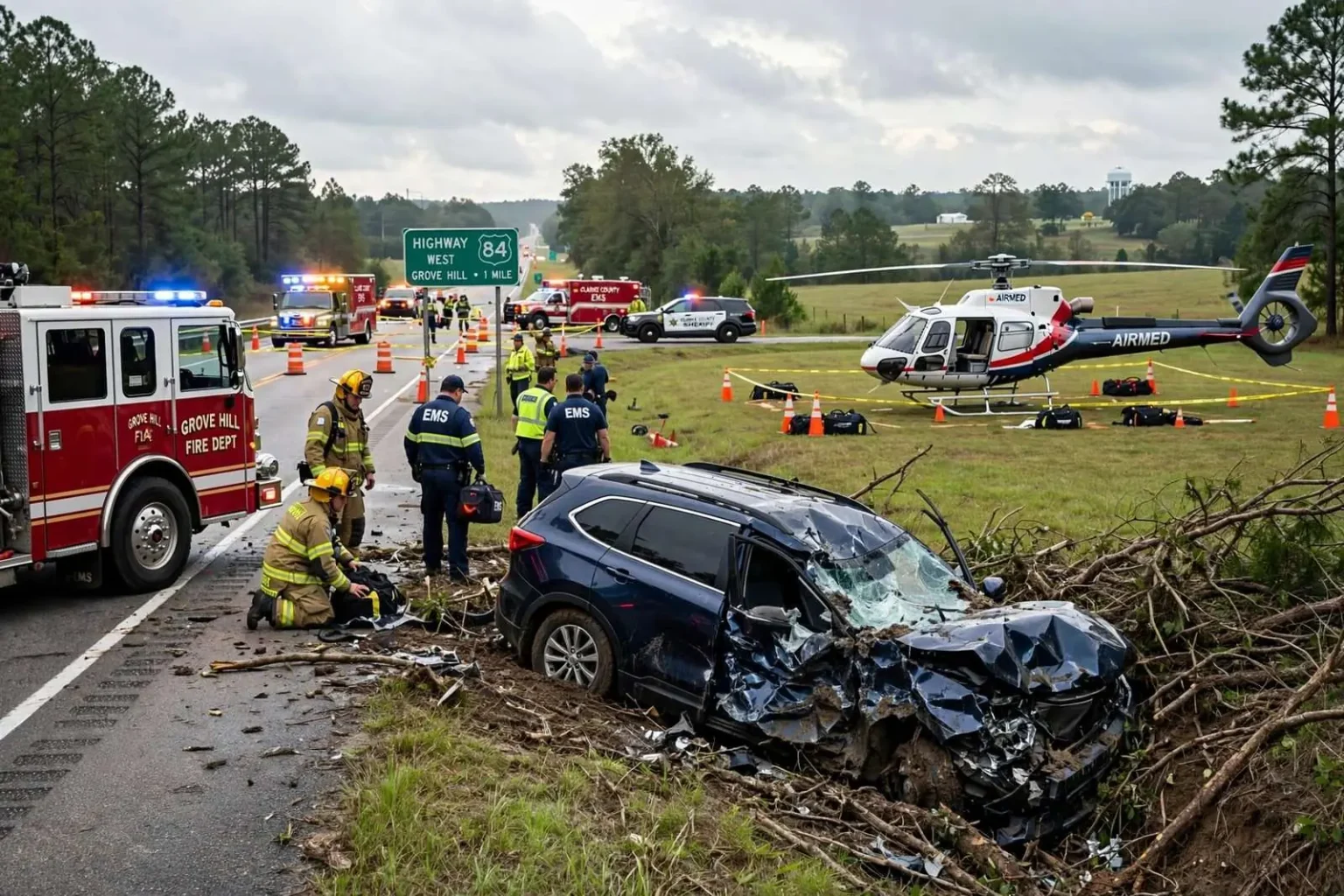
The driver of a vehicle was airlifted to a hospital Wednesday after a serious single-vehicle crash in Grove Hill. The crash occurred on Highway 84 in Clarke County and involved only one vehicle, and the extent of the driver’s injuries was not immediately known. Grove Hill Fire Department shared photos from the scene on its Facebook page, showing the heavy response that the wreck drew to the busy highway corridor.
Emergency crews were dispatched to Highway 84 after reports of a single-vehicle crash, and first responders arriving on the scene found damage serious enough that a helicopter was requested. The driver, the sole occupant of the vehicle, was stabilized at the scene by firefighters and emergency medical personnel before being loaded aboard the aircraft and flown to a hospital for treatment. Authorities did not release the driver’s name or age, and the extent of the injuries was not immediately known.
Grove Hill Fire Department documented the response with photographs posted to its Facebook page, giving residents a look at the scale of the operation — fire apparatus blocking the roadway, medical crews working around the damaged vehicle, and the landing zone established for the helicopter. The department regularly uses social media to share information about serious wrecks in its response area, both to inform the public and to remind drivers of the dangers on area highways.
A Serious Crash on Highway 84
Highway 84 is one of the principal east-west corridors in south Alabama, carrying commuters, commercial trucking, and travelers through Clarke County on its way from the Chattahoochee Valley to the Mississippi line. Through Grove Hill, the highway mixes local traffic with high-speed through traffic, and the combination produces serious wrecks with sobering regularity. Emergency agencies along the route train for exactly this kind of incident, when a crash’s severity calls for transport by helicopter rather than ground ambulance.
Single-vehicle crashes can arise from a range of causes — a driver overcorrecting after drifting onto the shoulder, swerving to avoid an animal, mechanical failure, or the wet pavement that frequent Gulf Coast rain leaves behind. Investigators with state troopers examine the vehicle’s path, the roadway conditions, and any skid evidence to reconstruct what happened, and their findings determine whether any charges are warranted. In serious-injury crashes, that work continues for days after the scene is cleared.
The decision to airlift a patient is made based on the severity of the injuries and the distance to appropriate trauma care. For patients in rural Clarke County, the nearest major trauma centers are a long drive by ground, and helicopter transport can cut that time dramatically. Crews at the scene established a safe landing zone, a task that Grove Hill firefighters regularly train for, since farms, roadways, and school grounds across the county frequently serve as makeshift helipads in emergencies.
Response From Grove Hill Fire
Grove Hill, the county seat of Clarke County, is served by a volunteer-driven fire service that responds to fires, wrecks, and medical calls across the city and surrounding communities. On Wednesday, department members turned out for the Highway 84 crash and worked alongside emergency medical crews and law enforcement to secure the scene, tend to the driver, and manage traffic around the response. The photographs the department later posted illustrated the teamwork that such calls require.
Serious crashes on the highway draw a multi-agency response in Clarke County. Fire departments handle extrication and fire risk, ambulance services provide treatment and ground transport when appropriate, state troopers investigate the crash itself, and deputies or local police assist with traffic control. A helicopter crew completes the chain, and when a patient is flown from the scene, the roadway often remains closed until the aircraft departs and investigators finish their initial documentation.
Motorists passing through the area Wednesday experienced delays as the response unfolded, with traffic backed up while the roadway was restricted. Agencies reminded drivers approaching a crash scene to slow down and move over — not just for emergency vehicles with lights active, but for the personnel working on foot along the shoulder, who face danger from passing traffic at every wreck scene on a highway like 84.
Staying Safe on Rural Highways
The Wednesday wreck in Grove Hill was the kind of incident that safety officials point to when urging caution on Alabama’s rural highways. High-speed two-lane and four-lane corridors like Highway 84 leave little margin for error, and a momentary lapse — fatigue, distraction, or speed carried into a curve — can put a vehicle off the road or into a rollover. Seat belts and updated vehicle safety features make a measurable difference in survivability in exactly these crashes.
As of the latest information, the driver’s condition had not been released, and no further details about the crash had been made public. The investigation will sort out the cause in time, but for the crews who responded, the call was another reminder of the demands placed on small-town emergency services — and for drivers traveling Highway 84 through Clarke County, a visible warning about how quickly an ordinary trip can turn into an emergency flight to the hospital.
Clarke County’s Emergency Network
Emergency response in Clarke County depends on a network of volunteer and career firefighters, ambulance services, and law enforcement spread across a largely rural landscape. Grove Hill sits near the geographic center of the county, and its fire department responds to a wide service area that includes long stretches of Highway 84 and the smaller roads that branch off it. When a serious crash happens, distance and time are the enemy, which is why the department and its counterparts invest heavily in training for rapid scene assessment and helicopter operations.
The county’s location along major transportation routes adds to the challenge. Highway 84 and nearby Highway 43 carry a steady flow of commercial traffic connecting the Port of Mobile region with central and south Alabama, and crashes involving passenger vehicles and heavy trucks alike test the resources of small departments. Mutual aid agreements mean that neighboring departments can be called on for extra manpower, equipment, or water supply when a scene demands it.
Helicopter emergency medical services play a vital role in this system. Air medical crews based in the region can reach rural crash scenes within minutes, and their ability to deliver patients directly to major hospitals has transformed survival rates for serious trauma across south Alabama. For patients like Wednesday’s injured driver, the aircraft is often the difference in receiving specialized care within the critical window after an injury.
Life in Grove Hill
Grove Hill serves as the seat of Clarke County, a community of historic homes, courthouse square commerce, and deep roots in Alabama’s timber and river industries. The town anchors public services for the surrounding county, including the school system and the medical clinics that serve outlying communities. For a town its size, a serious crash on the main highway is felt throughout the community, where residents are connected by family, church, and school.
The fire department’s presence on Facebook reflects how volunteer and combination departments across Alabama now communicate. Photos from scenes, recruiting appeals, safety reminders, and recognition of members’ service all appear on the department’s page, giving residents a window into work that once went unseen. The Wednesday crash photos drew attention and responses from across the community, with residents offering prayers for the injured driver and thanks for the responders.
Community support matters for departments like Grove Hill’s. Funding, membership, and equipment all depend on public engagement, and small-town fire services face persistent challenges in recruiting volunteers amid work and family demands. Every visible response, shared online and discussed around town, helps remind residents of what the department provides — and of the people who leave their dinner tables on a Wednesday to hold a landing zone on Highway 84.
The Investigation Continues
In the aftermath of a crash like Wednesday’s, the investigative work falls to state troopers assigned to the region. They will examine the vehicle, photograph the scene, interview witnesses, and consult any available camera footage from nearby homes or businesses. The crash report that results will document the factors involved, and if a violation contributed to the wreck, charges can follow once the driver’s medical situation is resolved.
Authorities had not released the driver’s name or condition as of the most recent update, and the extent of the injuries remained unknown pending treatment at the receiving hospital. In serious-injury cases, official updates often come only if charges are filed or if a crash becomes part of a broader safety discussion, leaving families and neighbors to wait for word through personal channels.
For now, the scene on Highway 84 has cleared, the traffic has resumed, and the injured driver is in a hospital bed hundreds of miles of highway travel closer to recovery thanks to the helicopter. The photos Grove Hill Fire Department shared tell the story of a community’s emergency machinery working as designed — firefighters, medics, troopers, and an aircrew converging on a stretch of rural highway to give one driver the best possible chance. It is a scene south Alabama knows well, and a reminder of the price paid when a trip on the highway goes wrong.