Eight Mile Man Faces Multiple Domestic Violence Charges
An Eight Mile man identified as Laffiette was arrested and charged with multiple domestic violence offenses after allegedly assaulting a woman.
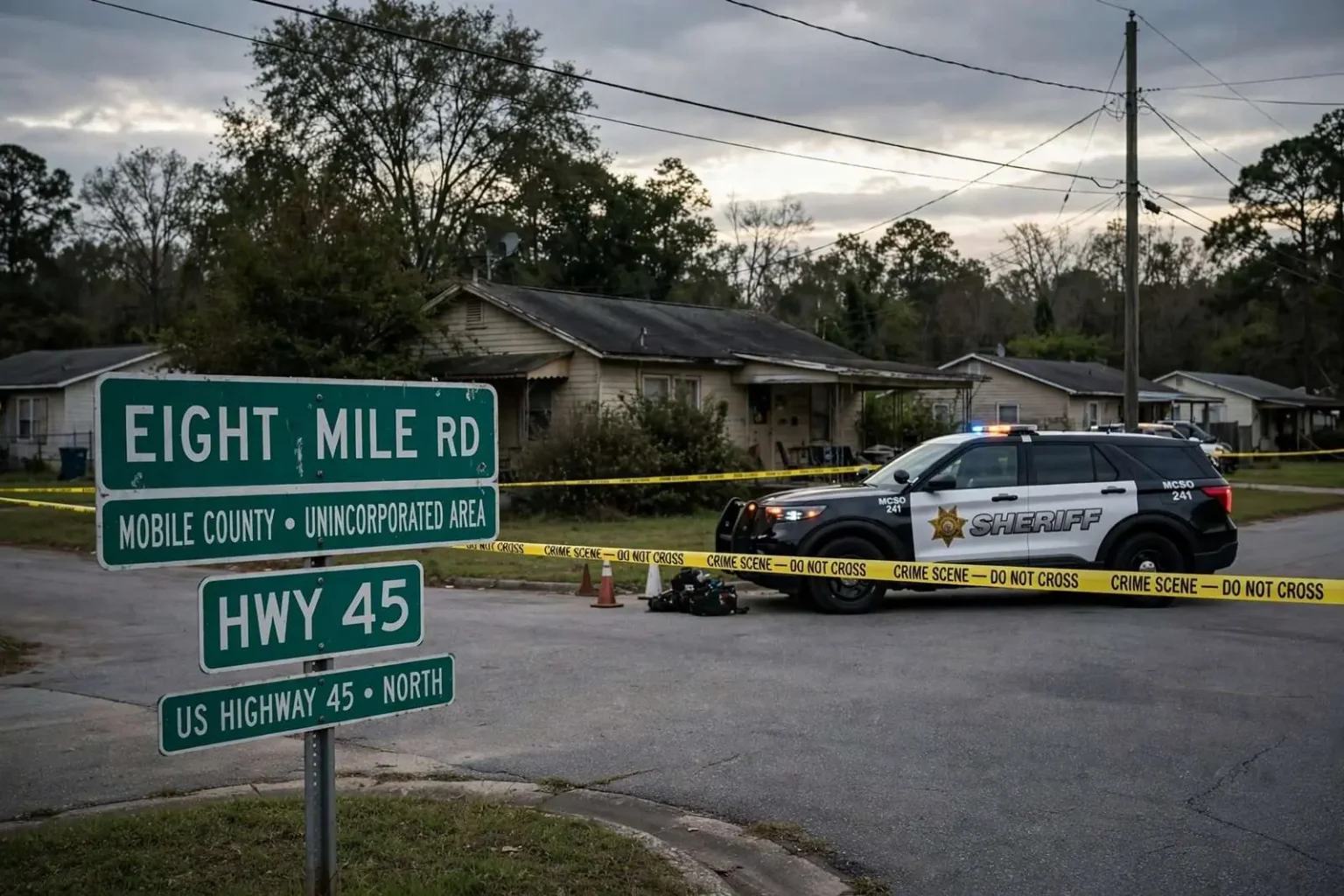
An Eight Mile man is facing several domestic violence charges following an incident detailed in police reports. According to those reports, the man, identified as Laffiette, was cut by a pair of scissors after physically assaulting a woman. Laffiette was arrested and taken to Mobile County Metro Jail, where he was charged with third-degree domestic violence harassment, third-degree domestic violence criminal mischief, and domestic violence strangulation.
The case unfolded in the Eight Mile community, an unincorporated area of northern Mobile County that sits along the U.S. Highway 45 corridor between Prichard and Axis. Deputies and investigators processed the scene, gathered statements, and forwarded the case for formal charging once the allegations were reviewed. The woman at the center of the report was identified in police documents, and her account of the assault formed the basis of the charges that followed.
Booking records at the Mobile County Metro Jail listed each of the three counts against Laffiette, giving prosecutors a clear picture of the conduct alleged in the case. The combination of harassment, criminal mischief, and strangulation charges is common in domestic violence cases where a confrontation escalates from threats and property damage to physical violence. Authorities have not released additional details about what led to the incident.
What the Charges Mean Under Alabama Law
Domestic violence harassment in the third degree, charged here under Alabama’s domestic violence statutes, involves harassment or stalking behavior directed at a person with whom the defendant has or had a domestic relationship. Alabama law treats harassment committed against a household member or dating partner more seriously than the same conduct against a stranger, and third-degree domestic violence charges carry elevated penalties and supervised release conditions.
Third-degree domestic violence criminal mischief typically involves damage to property belonging to the victim or shared property within the household. In domestic disputes, this count often reflects broken doors, damaged phones, destroyed personal belongings, or other property harmed during the course of an altercation. Prosecutors use the count to document the full scope of the incident rather than only the physical assault.
Domestic violence strangulation is the most serious of the three counts. Under Alabama law, strangulation is a felony, and it applies when a person intentionally impedes the breathing or blood circulation of a household or family member by applying pressure to the throat or neck or by blocking the mouth and nose. Medical research has repeatedly linked strangulation in domestic violence cases to a dramatically elevated risk of later lethal violence, which is why prosecutors and courts across Alabama treat the charge as a warning sign requiring firm bond conditions and close monitoring.
The Injury Documented in the Reports
Police reports indicate that Laffiette himself was cut by a pair of scissors during the incident, after he had physically assaulted the woman. Investigators documented that injury as part of the scene, and it did not change the direction of the charges, which focused on the alleged assault against the woman. In domestic violence cases, injuries to both parties are not uncommon, and officers are trained to determine the primary aggressor based on statements, evidence, and the history between the parties.
Eight Mile and Law Enforcement Coverage in North Mobile County
Eight Mile is a long-established community in unincorporated Mobile County, named for its historic distance from the city limits of Mobile. The area is served by the Mobile County Sheriff’s Office for major crimes and by municipal and state agencies depending on where an incident occurs within the corridor. Because Eight Mile sits near the Prichard city line and along a busy stretch of Highway 45, cases from the community can involve several different agencies working together.
Residents of unincorporated Mobile County rely on the sheriff’s office for patrol and investigations, while the Mobile County District Attorney’s Office handles prosecution of felony and misdemeanor cases arising from the area. Domestic violence calls are among the most frequent and most dangerous calls for service in the county, and responding deputies follow state-mandated procedures that include documenting injuries, collecting evidence, and informing victims of their rights under Alabama’s crime victims’ laws.
The Mobile County Metro Jail
The Mobile County Metro Jail, located in downtown Mobile, is the primary detention facility for people arrested in Mobile County and in the municipalities that do not operate their own jails. Arrestees are booked, photographed, fingerprinted, and held pending an initial appearance before a judge. The facility processes thousands of bookings each year, and charges are typically listed publicly once the booking process is complete.
At the initial appearance, a judge reviews the charges, considers the defendant’s criminal history and the circumstances of the arrest, and sets bond conditions. In domestic violence cases, judges in Mobile County routinely impose no-contact orders as a condition of release, prohibiting the defendant from communicating with or approaching the alleged victim. Violating such an order can result in immediate arrest and additional charges.
How Domestic Violence Cases Proceed in Mobile County
After an arrest and booking, the case file moves to the Mobile County District Attorney’s Office, where prosecutors review the reports, witness statements, and physical evidence before deciding how to proceed. Charges can be presented to a grand jury for indictment in felony cases, or resolved through negotiated pleas. Domestic violence strangulation, as a felony, would require grand jury review, while the third-degree counts may be handled at the district court level.
Victims in these cases are notified of key hearings under Alabama’s victims’ rights provisions, and advocates from the district attorney’s office and local victim service organizations help connect victims with protective orders, counseling, and emergency housing when needed. Courts in Mobile County also emphasize risk assessment in strangulation cases, given the documented link between strangulation and future homicide in domestic relationships.
Defense attorneys, meanwhile, review the evidence for issues such as conflicting statements, the circumstances of the defendant’s own injury, and whether each statutory element of the charged offenses is supported. The process from arrest to resolution can take months, and defendants remain subject to bond conditions throughout.
Resources for Domestic Violence Victims on the Gulf Coast
Advocates across Mobile County and southwest Alabama encourage anyone in immediate danger to call 911, and anyone seeking support to contact local crisis services. The Penelope House shelter in Mobile provides emergency housing, safety planning, and court advocacy for victims of domestic violence and their children, and its hotline operates around the clock. Similar regional services operate in Baldwin, Washington, and Clarke Counties for victims in outlying communities.
Statewide, the Alabama Coalition Against Domestic Violence coordinates member programs and maintains referral lines for victims in every county. Under Alabama law, victims can petition courts for protection from abuse orders, which can bar an abuser from a shared home, prohibit contact, and address temporary custody of children. Law enforcement officers are required to provide victims with information about these rights at the scene of a domestic violence call.
National resources remain available as well, including the National Domestic Violence Hotline, which offers confidential support and safety planning by phone and text at any hour. Health care providers in the Mobile area are also trained to recognize signs of strangulation and domestic violence and to document injuries in ways that support later prosecution.
What Comes Next in the Case
Laffiette remains subject to the charges filed at the Mobile County Metro Jail, and the case now moves through the standard sequence of initial appearance, bond review, and prosecution. Court records in Mobile County will reflect hearings as they are scheduled, and outcomes will depend on the evidence presented and the decisions made by prosecutors, the court, and the parties involved. Authorities have not announced any additional arrests connected to the incident.
How Strangulation Cases Are Handled Differently
Strangulation stands apart from other domestic violence offenses in both criminal law and medical practice. Because a victim may show few visible injuries even after a serious assault, first responders in Alabama are trained to ask specific questions about pressure to the neck, loss of consciousness, and difficulty breathing, and to encourage medical evaluation even when the victim declines at the scene. Delayed symptoms from strangulation can appear hours or days later, which makes documentation at the time of the report especially important for both the victim’s health and the prosecution’s case.
Prosecutors across Alabama have also increased training on presenting strangulation evidence to juries, since the offense often leaves little physical proof. Testimony from the victim about the sensation of having breathing restricted, combined with photographs of redness or petechiae and any medical records, forms the typical evidence picture. The charge’s classification as a felony reflects the legislature’s judgment that the conduct itself, regardless of visible injury, carries lethal risk.
For the community in Eight Mile and across north Mobile County, cases like this one underscore the importance of early reporting. Deputies note that many serious domestic violence incidents follow a pattern of escalating conflicts that neighbors and family members witnessed but did not report. Alabama’s mandatory training for law enforcement on domestic violence response emphasizes that the first report in a series is often the best opportunity to interrupt that pattern before it becomes fatal.