Robertsdale Mother and Son Killed in 2008 Elberta Crash
A 2008 WKRG report covered a fatal Highway 98 crash near Elberta that killed a Robertsdale woman and her young son.
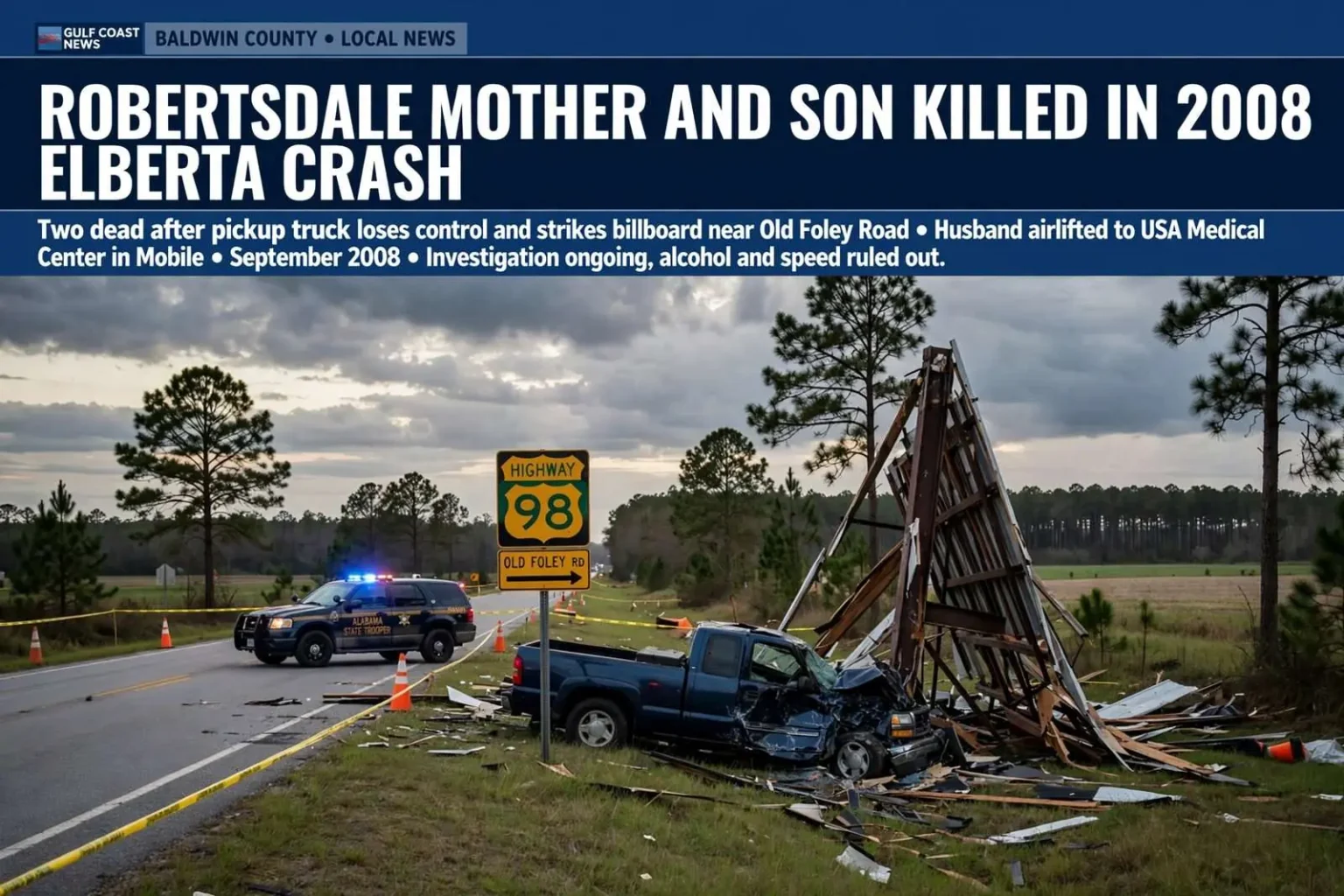
A Robertsdale woman and her five-year-old son were killed in a Highway 98 crash near Elberta in September 2008, according to a local station’s report of the wreck. State troopers said Amy Hogue lost control of her pickup truck and struck a billboard sign post near Old Foley Road, a stretch of the highway that runs through the rural southern Baldwin County landscape of pine stands, small farms and scattered homes. The crash claimed two lives from one family and left a third member fighting to recover.
Her husband, Christopher David Hogue, was also in the vehicle and was airlifted to USA Medical Center in Mobile with injuries that were reported as not life-threatening. The decision to fly the patient reflected the severity of the scene — fatal crashes on two-lane highways in south Baldwin County typically exhaust the nearest ground transport options quickly, and air evacuation to a trauma center in Mobile is often the fastest route to definitive care for a seriously injured patient.
Troopers said the cause of the crash remained under investigation and that alcohol and speed were not considered factors. Investigators in wrecks of this kind work to reconstruct what happened between the last point of control and the point of impact — examining the roadway, the vehicle, the sight lines near the billboard and any mechanical evidence — before a final determination. The report did not announce a conclusion beyond what troopers could confirm in the days immediately after the wreck.
The crash scene along Highway 98
Highway 98 is one of the main east-west corridors through Baldwin County, linking communities from Mobile Bay across the width of the county toward the Florida line. Near Elberta, the road passes a mix of residential driveways and commercial signs, and the intersection areas with crossroads such as Old Foley Road carry local traffic from the smaller communities that fan out around it. Crashes at sign posts, trees and other fixed objects are among the most serious types of single-vehicle wrecks because the energy of the impact is absorbed by the occupants rather than by something that yields.
Elberta is a small town in the southern part of the county, several miles north of the beaches of Gulf Shores, and like many Baldwin County communities it grew rapidly through the 2000s as families moved to the area. The growth brought more traffic to roads that were built for a quieter era, a pattern that county and state officials have contended with across the region as development spread along the Highway 98 corridor.
Pickup trucks are a common sight on Baldwin County roads, and single-vehicle loss-of-control crashes in them mirror a pattern seen across rural Alabama. When a truck leaves the roadway at highway speed, a driver’s instinctive steering correction can make recovery harder, and fixed objects along the right of way — utility poles, sign supports, trees — become the impact points that determine how bad the outcome will be.
USA Medical Center’s role in the region
The hospital troopers referenced, USA Medical Center in Mobile, serves as the region’s primary provider of trauma care for a wide swath of south Alabama and the panhandle of Florida. Patients involved in serious crashes across Baldwin, Mobile and surrounding counties are routinely transported there by ground ambulance or helicopter, because it maintains the surgical specialists and around-the-clock staffing that trauma cases require.
Air evacuation plays a routine part in that system. When a crash occurs in a rural area far from Mobile — and much of southern Baldwin County qualifies — a helicopter can cut transport time substantially, which is why crews called for airlifts in serious wrecks. The injured man’s flight to USA Medical Center followed that standard response, and his injuries were reported as survivable even as the wreck itself turned fatal for his wife and young son.
The aftermath of such a crash extends well past the scene. Families in small communities such as Robertsdale, from which the Hogues came, often have deep local ties, and a wreck that kills a mother and her child in a single afternoon reverberates through churches, schools and workplaces. Robertsdale sits in the central part of Baldwin County, and its residents frequently travel Highway 98 itself for work, school and shopping, making the crash location familiar ground to many who would read about it.
How Alabama troopers investigate fatal wrecks
Fatal crashes in Alabama are investigated by state troopers rather than local municipal police in most unincorporated areas, and Elberta’s surroundings fall into that category. Troopers document the scene in detail — vehicle positions, skid and yaw marks, debris fields, damage patterns and the condition of anything struck — and those records support both the official determination of cause and any later review by prosecutors or coroners.
The statement that alcohol and speed were not factors is significant in any fatal crash report. Those two elements appear in a large share of serious wreck investigations, so their early exclusion narrows the field of likely causes to possibilities such as driver distraction, a medical event, a mechanical failure or roadway conditions. Until troopers completed their work, the public report could say only what had been ruled out, not what had gone wrong.
Baldwin County’s coroner and district attorney become involved in fatal crashes as a matter of routine as well, confirming deaths at the scene and reviewing investigative findings. The local station’s account, preserved as a historical report, reflected the information available in the days after the wreck — a period when families are still being notified and official conclusions have not yet hardened into final findings.
The human toll behind the statistics
A crash that kills a parent and a young child in the same vehicle is among the hardest kinds of news a small community absorbs. Five-year-olds ride in car seats and booster seats along these same highways every day, and the deaths of children in traffic wrecks have long driven both safety engineering and public awareness campaigns — from child passenger laws to the roadside memorial markers that families place at crash sites across rural Alabama.
State law in Alabama requires child restraints appropriate to a child’s age and size, and troopers investigate whether restraints were in use as part of nearly every wreck involving young passengers. The archived report did not address that question, one of the many details that final investigations consider but early accounts leave unspoken.
For the surviving family member, the path forward combined grief with recovery. Patients released from trauma care after a crash that killed their spouse and child face a long procession of practical and emotional burdens — funeral arrangements, insurance questions, and the physical rehabilitation that follows serious injury. Communities in Baldwin County have historically rallied around such families through churches and civic groups, though the archived report did not record those private aftermaths.
Highway safety in Baldwin County over the years
The 2008 crash sits within a longer history of safety work along Highway 98 and other Baldwin County corridors. State and county engineers periodically review segments for turning lanes, shoulders, sight distance and signage, and fixed-object hazards along rural highways are a recurring subject of that review. Billboards, in particular, have long been part of the roadside landscape along Highway 98, and crashes involving sign supports raise familiar questions about placement and protective treatment.
The region has grown substantially since 2008, and with growth has come continued attention to the roads that carry commuters between the county’s communities and the tourist traffic bound for the beaches. Wrecks like the one that took the Hogue family are part of why those reviews continue — each fatal crash enters the record that engineers and officials consult when they weigh where the next improvement dollar should go.
The archived account of the September 2008 crash remains part of the local news record, a historical summary of a report from its time. It records the essential facts: Amy Hogue and her five-year-old son were killed when her pickup struck a billboard sign post near Old Foley Road on Highway 98 near Elberta; Christopher David Hogue was airlifted to USA Medical Center with injuries not considered life-threatening; and troopers, ruling out alcohol and speed, continued their investigation into what caused a family’s drive to end in tragedy.
Remembering through the local record
Archived crash reports like this one serve a quiet but lasting purpose in communities such as Robertsdale and Elberta. Years after the wreck, the details — the names, the location, the findings troopers could confirm — are often all that survives in accessible form, consulted by relatives, researchers and neighbors who remember when the news broke. The record notes that alcohol and speed were ruled out, that the cause remained under investigation, and that a husband and father was flown to Mobile while his wife and son did not survive.
The geography of the wreck explains why the story resonated across the county. Highway 98 near Old Foley Road sits between communities whose residents travel it daily, and a crash scene on a main corridor draws passing traffic through grief in real time — drivers slowing past troopers’ vehicles and the aftermath of a wreck that took two lives from one family. In small towns, that shared passage turns an incident report into common memory.
Local stations that covered the wreck in 2008 reported what could be verified at the time, and this historical summary preserves that account without adding later developments that the original report did not contain. It is retained as part of the local news record for Baldwin County, a region that has documented its share of highway tragedies alongside the growth that has reshaped its towns since.
For drivers who pass the stretch of Highway 98 near Old Foley Road today, the landscape holds few visible reminders of the 2008 crash. But the account of that September afternoon remains a cautionary chapter in the county’s road history — the story of a pickup truck that left the roadway near Elberta, a family from Robertsdale forever changed, and a community that read the names in the paper the next morning and recognized the roads they traveled every day.