
Electronic Adrenaline Brings Community-Focused Cyber Cafe to Mobile
Electronic Adrenaline on University Boulevard in Mobile offers affordable PC gaming, monthly lock-in events and computer repair services.
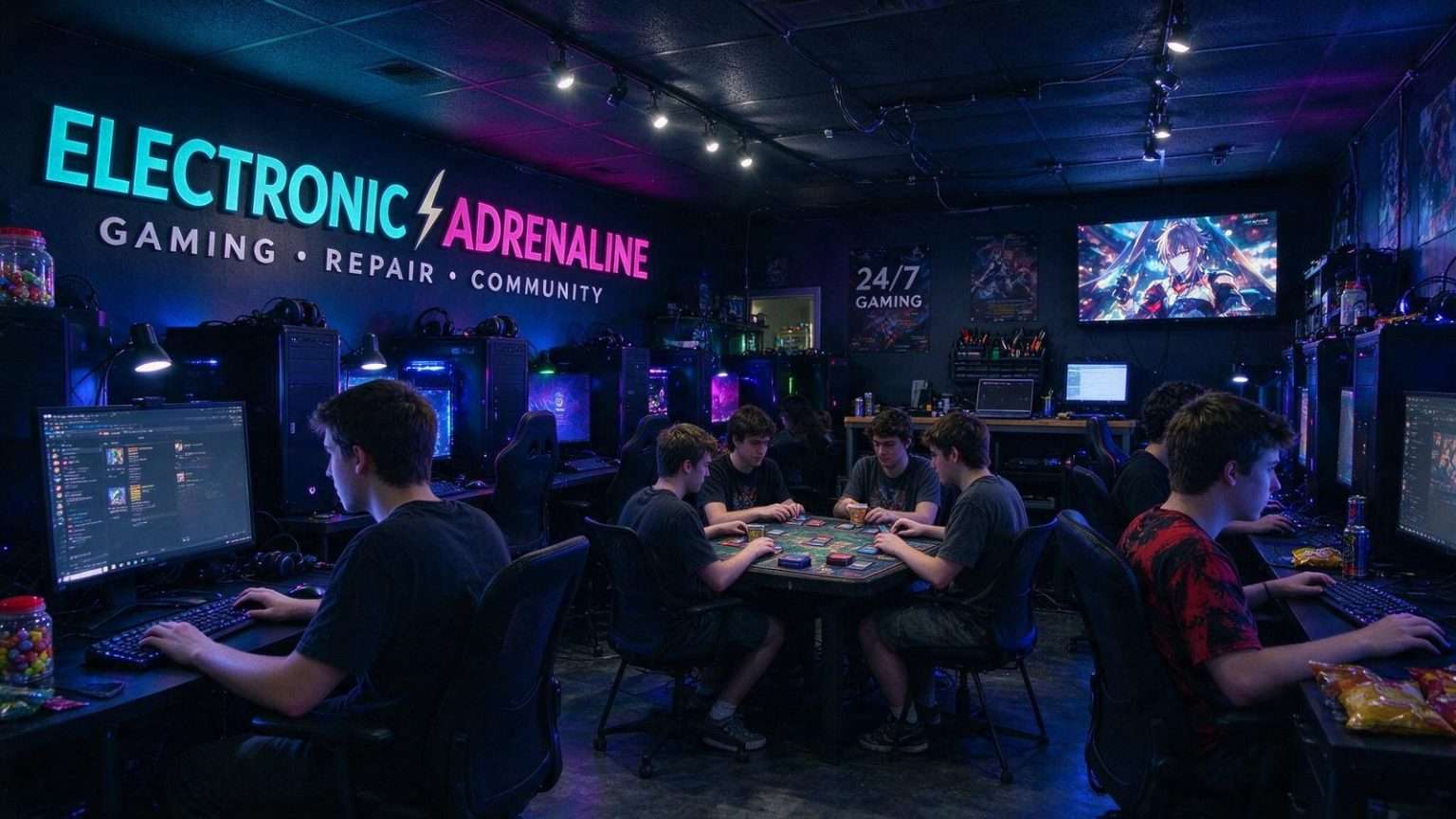
Blacklights, candy, energy drinks, and fluorescent colors might make visitors think they have stumbled into a rave. But at Electronic Adrenaline on South University Boulevard in Mobile, the unmistakable hum of high-powered gaming computers tells a different story. The neon palette and late-night menu are the decor of a serious hobby shop — one built around the idea that gaming is better in company than in isolation.
Owner Tyler Cobb opened Electronic Adrenaline in 2010 as both a computer repair shop and a community-oriented cyber cafe, creating a gathering place for gamers and tech enthusiasts in the Mobile area. The combination is deliberate: the repair bench pays the bills, and the rows of gaming machines give the shop a reason to exist beyond transactions.
A Gaming Hub at an Affordable Price
The cafe features 14 gaming stations equipped with capable hardware, comfortable seating, and a large screen displaying anime and movies in the background. The setup borrows from the LAN-party tradition — the all-night sessions where PC gamers once hauled towers and monitors to a friend’s garage — and makes it permanent: no hauling, no tangled cables, just a seat, a machine and whoever else shows up that night.
For just two dollars an hour, visitors can access any of the cafe’s gaming computers, which run more than 60 titles including popular games like League of Legends, Guild Wars 2, Mortal Kombat, and Saints Row 3. The library spans the competitive multiplayer staples, fighting games and open-world action titles, covering the tastes of both the after-school crowd and the older regulars who settle in for long sessions.
Customers who purchase ten dollars in credit receive an additional hour free, and each player is given a personal account that saves their balance between visits. The account system removes the friction that kills casual visits — no fumbling for cash at a front counter — and quietly rewards regulars, whose hours are waiting for them whenever they walk in.
The cafe also serves a selection of snacks and drinks to fuel late-night gaming sessions, including corn dogs, cheeseburgers, barbecue rib sandwiches, chips, ice cream, and a variety of caffeinated beverages. It is the kind of menu that makes an eight-hour session logistically possible, and it means a guest can settle into a station at dinner time and not leave until closing.
The economics of the hour rate tell the story of the shop’s priorities. At two dollars an hour, fourteen stations cannot come close to covering rent, hardware refreshes and electricity; the machines exist to fill the room, and the room exists to keep people coming through the door. It is the same logic that leads a barbershop to keep a coffee pot on or a bookstore to host a story hour — the low-margin amenity is the marketing.
The games on offer also mark the cafe’s moment in time. League of Legends was in the middle of its rise to global dominance when the shop opened, Guild Wars 2 had just launched, and the Mortal Kombat and Saints Row franchises were between major entries. A rotation like that gives a small cafe the same lineup the big-budget titles everyone is talking about, without requiring customers to own consoles or gaming PCs of their own.
Monthly Lock-Ins Draw Dedicated Crowds
The gaming community that has grown around Electronic Adrenaline proved strong enough for Cobb to launch a monthly lock-in event. For twenty dollars, participants game from 8 p.m. to 6 a.m., and the 14 available spots typically fill up weeks in advance. The lock-in is the purest expression of what the cafe is for: ten uninterrupted hours, a room full of players, and none of the lag, voice-chat noise or distant opponents that come with playing at home.
The appeal goes beyond just screen time. The cafe provides a social outlet for gamers who might otherwise play alone at home, giving them a chance to meet like-minded people, form teams for competitive matches, and build friendships. In an era when most multiplayer gaming happens through headsets and matchmaking queues, the physical room is the feature — the difference between talking to a teammate and sitting next to one.
On any given visit, guests might find tables in the center of the room taken over by fans of the card game Magic: The Gathering, offering a break from the digital action. The card crowd rounds out the ecosystem: tabletop players and PC gamers share the same space, the same snacks and the same tournament-day energy, even when their games look nothing alike.
Repair work itself has changed in ways that favor the independent shop. Manufacturers increasingly seal laptops with glued batteries and soldered components, and big-box chains typically respond with swap-out service and new-machine upselling. An independent bench can still do component-level diagnosis, screen and keyboard replacement, data recovery and honest triage — a technician who can tell a customer whether a machine is worth fixing at all, rather than defaulting to the more expensive answer.
Network setup and troubleshooting rounds out the services list with a job that has become nearly universal. Home networks — routers, streaming devices, game consoles, work laptops, security cameras — now fail in ways most households cannot diagnose, and the same shop that fixes the computer can untangle the network it sits on. For customers, having one local number for all of it is the practical meaning of “community-oriented.”
More Than Just a Cafe
Electronic Adrenaline’s primary business is computer repair, and Cobb said the cyber cafe component is largely a way to give back to the community rather than a major revenue driver. The shop offers competitive rates for desktop and laptop repairs, network setup and troubleshooting, laptop rebuilds, and screen replacements, with both in-house and on-site service available.
“We are building a community here. We are keeping the money in our local economy,” Cobb said. “Corporations and the big box stores, it seems those guys do not have any real interest in the community. The cyber cafe is just another way for us to provide diversity in business, adding value to the experience people receive.”
The argument is a familiar one in small-business circles: a local repair shop keeps money circulating in the community, answers the phone to a person who will remember the machine, and has a stake in how the neighborhood around it fares. Big-box electronics stores and mail-in repair services can undercut on price in some categories, but they cannot replicate the relationship of a shop whose customers also game at its stations, buy its sodas and bring their laptops back for years.
The business also invested in local talent by commissioning University of South Alabama computer programming graduate Chris Gholston to help design their website. The choice fit the shop’s model — hiring a local graduate rather than outsourcing the work — and put a USA degree to work on behalf of a West Mobile storefront.
The lock-in model deserves its own note in that story. All-night gaming events have been a fixture of the hobby since the days when players physically carried their machines to each other’s houses, and the format survives because it solves a real problem: competitive play works best when everyone is on the same connection, awake at the same hours and hungry at the same time. Charging twenty dollars for a reserved seat makes the event sustainable, and filling those seats weeks ahead of time shows the demand was already there.
There is also a generational argument for the shop’s approach. Teenagers and young adults who game heavily still need third places — the sociologist Ray Oldenburg’s term for the cafes, clubs and shops that are neither home nor school — and few such places acknowledge their hobby exists. A room built for gamers gives younger customers a venue where the social hierarchy rewards knowing the games, which is not always true of the places adults design for them.
The Cyber Cafe in a Changed Industry
Cyber cafes occupy an unusual place in American retail. The format flourished in parts of Asia and Europe, where fast home internet arrived late and gaming cafes became cultural institutions, while in the United States the spread of broadband and affordable consoles largely erased the demand. What survived in American cities were the hybrids: shops like Electronic Adrenaline that pair paid gaming stations with another income stream, and that survive not on the hour rate but on everything else the room makes possible.
That model also tracks the broader shift in gaming culture. Competitive gaming has grown into an organized, spectator-driven industry, and players who once met only online now look for local communities where they can practice together. A room of 14 matched machines is a natural home for that: it levels the hardware, keeps the competition honest and gives new players a place to learn the social rules of the hobby without the hostility of anonymous online lobbies.
Finding It
Electronic Adrenaline is located at 328 South University Boulevard in Mobile and is open Monday through Friday from 9 a.m. to 6 p.m. and Saturday from noon to 9 p.m. The South University Boulevard corridor puts the shop within easy reach of students, families and the West Mobile neighborhoods that form its base, with the lock-in crowd arriving after the repair counter closes.
For the price of a fast-food meal, a visitor gets an afternoon of gaming on hardware most households cannot justify, in a room where somebody will explain the rules, save their seat and remember their name the next time they come back. That is the business model, stated plainly: sell the machine time cheaply, and let the community be the thing people cannot get at home.