Elevator Outage Leaves West Pensacola Senior Residents Stranded for Weeks
Residents of Alabaster Gardens Senior Community in West Pensacola say a broken elevator has left wheelchair users and residents with serious health conditions stranded in their apartments for weeks.
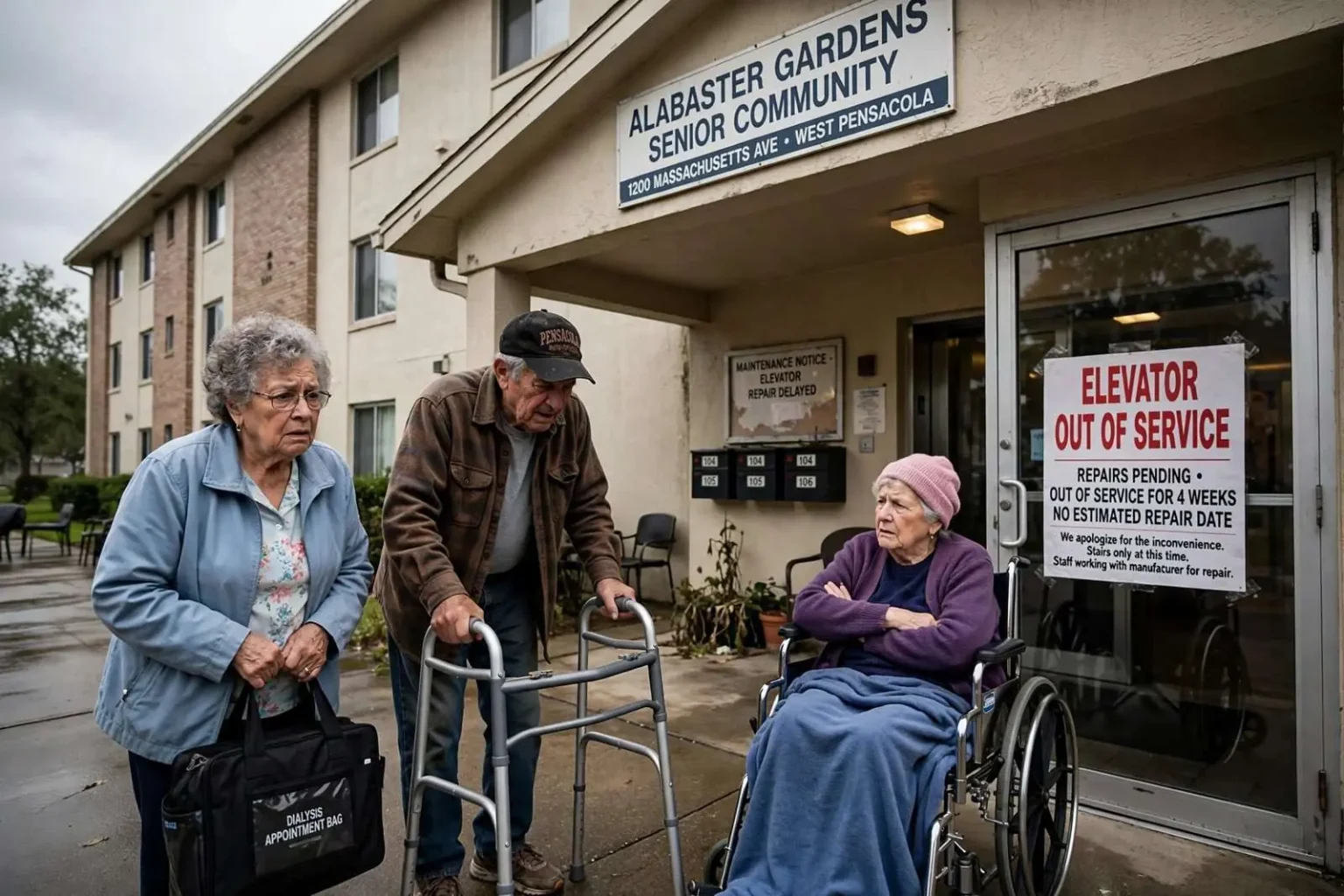
For nearly a month, residents of a West Pensacola senior apartment complex have been climbing stairs, skipping trips outside, or simply staying stuck in their units because the building’s only elevator is broken again.
The elevator at Alabaster Gardens Senior Community on Massachusetts Avenue has been out of service for approximately four weeks, according to residents who live there. It is not the first time. A broken elevator at the same complex made headlines more than two years ago, when the outage was severe enough that some residents had to be temporarily relocated to a local motel while repairs were made.
Many of the people who call Alabaster Gardens home are older adults who use wheelchairs or manage serious medical conditions, making the stairs a daunting or even dangerous obstacle.
‘Common Sense’ Says Fix It Fast
Annie Boykin, a longtime resident who lives on the third floor, is on dialysis. She said the slow response to the outage has been hard to understand.
“Once it broke down, it seemed like common sense would tell them they need to get somebody over here right away,” Boykin said.
A few doors down, her neighbor Herman Fails said he hasn’t seen repair crews at the building since the elevator went out. Both residents shared a letter they received from Alabaster Gardens staff a few weeks ago acknowledging the problem. “I know how much of an inconvenience it is,” the letter read, in part. “I’ll need to get another technician out with the manufacturer.”
Since then, Fails said, promises of a fix have repeatedly slipped.
“It’ll be Monday, it’ll be Tuesday, it’ll be Wednesday, but now they’re going on another Monday and the elevator’s still not fixed,” he said.
Stuck Inside
A visit to the leasing office found little clarity. The community manager said he was unable to provide an update on the status of the repair.
For Fails, the outage has become a daily physical strain. “It makes me feel bad because I got to walk up and down the stairs and my knees be giving out sometimes and I might fall down the stairs,” he said.
He said some of his neighbors have not left their apartments in weeks because they simply cannot manage the stairs.
“You got people in this area that’s in a wheelchair. They cannot walk down those steps with a wheelchair and nothing else,” Boykin said. “They’re just stuck in their apartment.”
Elevator outages at senior and disability housing communities carry outsized risks. Beyond the inconvenience, residents who cannot safely use stairs can be cut off from medical appointments, grocery trips, and social contact, and building managers can face fair-housing scrutiny under the Americans with Disabilities Act and related housing laws when accessibility equipment goes unrepaired for extended periods.
Residents say they hope the renewed attention on the elevator will push Alabaster Gardens management to bring in a technician and finish the repair before the outage stretches any longer.
Why one elevator is a whole building’s lifeline
At a senior community, the elevator is not a convenience; it is the architecture of daily life. When the only lift fails, every floor above the ground becomes unreachable for anyone who cannot climb, and the people most affected are precisely those the building was built to serve — older adults, wheelchair users and residents managing serious illness. Alabaster Gardens sits on Massachusetts Avenue in West Pensacola, and its residents describe exactly that predicament: third-floor neighbors who cannot get down, wheelchair users who cannot get out, and a building that becomes a container rather than a home for the weeks the machine is dark.
A pattern, not a one-off
Residents point out that this is not the first extended outage at Alabaster Gardens. A broken elevator there made headlines more than two years ago, severe enough that some residents were temporarily relocated to a local motel while repairs were made. A repeat, years later, suggests a maintenance and replacement problem rather than a freak failure, and it is the kind of recurrence that draws the attention of housing regulators. When the same equipment fails twice in a way that strands vulnerable tenants, the question shifts from “when will it be fixed?” to “why was it allowed to fail again?”
The legal exposure
Housing for seniors and people with disabilities carries obligations under the federal Fair Housing Act and the Americans with Disabilities Act that go beyond ordinary landlord duties. An inaccessible building can amount to a denial of a dwelling to a person with a disability, and an elevator left unrepaired for weeks can draw complaint to the U.S. Department of Housing and Urban Development or the Department of Justice. Managers who acknowledge the problem in writing — as Alabaster Gardens staff did in the letter residents shared — have, in effect, documented that they knew of the barrier, which raises the stakes if the delay continues. None of that guarantees a fast fix, but it changes the leverage residents and advocates can bring.
The human cost of the delay
The residents’ own words capture what the legal framework cannot: Annie Boykin, on dialysis, cannot easily get to treatment; Herman Fails feels his knees giving out on the stairs; neighbors in wheelchairs have not left their units in weeks. Medical appointments slip, groceries go un bought, and the isolation of being stuck indoors compounds whatever health conditions already exist. For a population whose mobility is fragile, a month without the elevator is not an inconvenience to be endured but a contraction of life itself, and the residents’ hope is simply that attention forces the repair before the outage stretches any longer.
What residents can do
Tenants who find themselves stranded by an extended elevator outage have several roads open: documenting each promised and missed repair date, contacting local aging-services or disability-rights organizations, and, where applicable, raising the issue with a housing authority or fair-housing agency. Public attention, of the kind this story brings, often concentrates a manager’s mind faster than a letter. The broader lesson for West Pensacola is that senior housing depends on equipment that someone must maintain relentlessly, and when that maintenance lapses, the people with the least ability to climb are the ones who pay.
West Pensacola’s aging housing stock
The Alabaster Gardens outage is a local instance of a regional reality: much of the Gulf Coast’s senior housing was built decades ago, and its mechanical systems are aging at the same time its residents are living longer and needing more support. An elevator that fails is the most visible symptom, but the underlying issue is whether owners are funding preventive maintenance and eventual replacement, or waiting for breakdown. West Pensacola, with its mix of older apartment communities, will keep facing these questions as its population ages, and the Alabaster Gardens case is a prompt for residents and advocates to ask how other buildings are maintaining the equipment their tenants depend on.
Who is accountable
When an elevator strands seniors for a month, accountability runs through several doors: the property manager who schedules repairs, the ownership that funds them, the maintenance contractor that supplies the technician, and the regulators who can compel action. Residents in West Pensacola have named the manager’s lack of clarity and the slipping promises, but the fix depends on whether the owner authorizes the manufacturer’s technician the letter referenced. Public reporting like this story is often what forces that authorization, because no operator wants a months-long outage on the record during a fair-housing inquiry. The residents’ hope — a finished repair soon — rests on that pressure holding.
The neighbors who cannot leave
Boykin and Fails are the faces of the outage, but the residents they describe — wheelchair users who have not left their apartments in weeks — are its silent majority. For them, the elevator is not about convenience or even errands; it is about whether the world is reachable at all. A month indoors means missed church, missed family, missed fresh air, and for some, missed care. The residents’ account of slipping repair promises is the kind of detail that turns a maintenance complaint into a record of neglect, and it is that record — more than any single plea — that tends to produce the technician and the finished fix.
What a fast fix would look like
Residents have asked the obvious question — why a broken elevator takes a month — and the honest answer usually involves parts, not will. Elevator components are specialized, manufacturers control the supply, and a needed part can sit in a queue behind other repairs nationwide. But a month suggests the bottleneck is coordination as much as hardware: the manufacturer’s technician, the letter, the slipping Mondays. A faster path would be a standby service contract with guaranteed response times, or a reciprocal agreement with a nearby building’s maintainer. Until something changes, Alabaster Gardens’ residents will keep measuring the outage in stairs climbed and doors not opened, hoping the renewed attention finally brings the repair.