Enviva opens world’s largest wood pellet plant in Lucedale, shipping through Pascagoula
Enviva's $140 million Lucedale wood pellet plant is now near full operation, with 90 employees and rail shipping to the Port of Pascagoula.
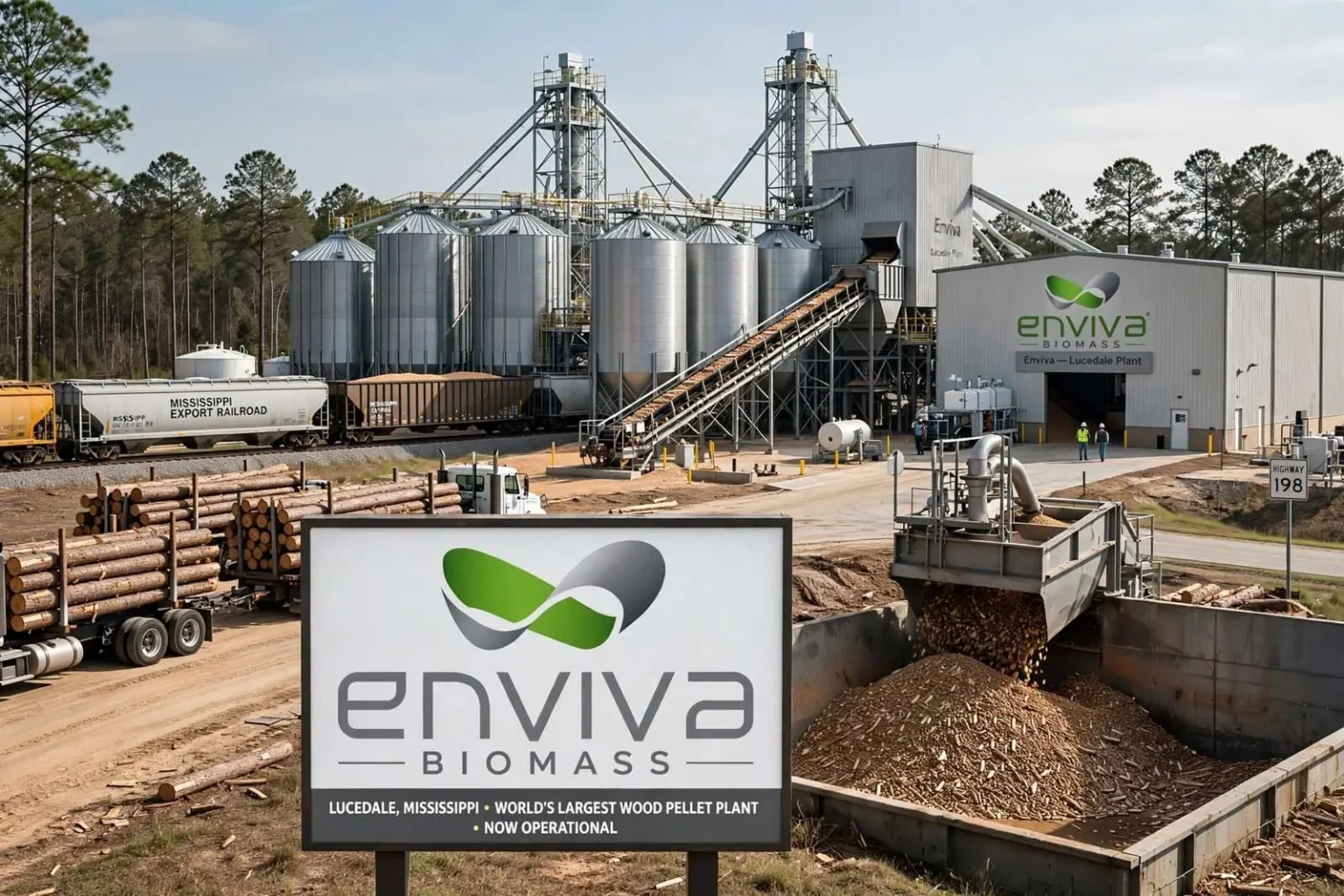
A wood pellet plant billed as the largest of its kind in the world is now close to full operation in Lucedale, capping a construction effort that drew money from county, state and federal governments and tied George County’s timber economy to overseas power markets. The facility is owned by Enviva Biomass, a Maryland-based producer of industrial wood pellets, and its opening marks the most significant industrial arrival in the George County seat in years.
The company said it has hired 90 full-time employees to run the Lucedale operation. Enviva put the construction cost at $140 million and said the project supported roughly 400 cumulative jobs after breaking ground in October 2019. Beyond the direct payroll, the company projects an annual regional economic impact of $250 million, much of it flowing to landowners, loggers and trucking firms that supply and serve the plant.
Those figures explain why so much public money followed the project. Wood pellet plants consume enormous volumes of timber and convert a regional forest products economy into an export business, and communities across the Gulf South have competed to land them. George County, with its pine forests and rail access to the coast, fit the model.
A long list of public partners
A ribbon-cutting ceremony drew dozens of local and state elected officials to the site, a turnout that reflected how many government bodies had a hand in the project. George County Board of Supervisors President Frankie Massey credited a chain of utility and legislative partnerships for making the plant possible.
“The county worked closely with our utility partners — electric, water, and natural gas — to provide the resources for this plant to operate. We worked with our state and federal legislative partners to help funded these vital expansions,” Massey said. “Our partnership with Enviva has brought this state-of-art facility to our Industrial Park providing new jobs, enhancing our infrastructure, and improving our property tax base.”
The public investment came in layers. George County supervisors approved a 10-year tax abatement worth roughly $13 million to attract the construction, a standard but significant incentive in a county where industrial prospects are rare. The Mississippi Development Authority put in $4 million so the county could upgrade wastewater service and other industrial park infrastructure, improvements that remain in place for whatever follows the pellet plant into the park.
About $1.7 million in state legislative appropriations and grants, plus roughly $50,000 from the county, paid to extend the Mississippi Export Railroad line behind the plant, giving pellets a rail route to the Port of Pascagoula. The U.S. Economic Development Administration contributed another $1.4 million to widen Highway 198 for the roughly 200 log trucks expected to reach the site, an infrastructure upgrade that also benefits every other business along the route.
How the pellet trade works
The Lucedale facility sits at the end of a supply chain that begins in the woods. Loggers deliver pine timber — much of it low-value wood that has limited use in sawmills — to the plant, where it is debarked, chipped, dried and compressed into dense pellets roughly the size of rabbit feed. The pellets are then loaded onto rail cars for the trip to the Port of Pascagoula, where they are transferred to oceangoing bulk vessels.
Most of the product is destined for power stations in Europe and Asia, where utilities burning biomass to meet renewable energy mandates have created a durable export market for American wood pellets. That demand is what allowed a Maryland-based company to build the world’s largest pellet plant in a small south Mississippi county, and it is why the facility’s fortunes are tied to energy policy on another continent as much as to conditions in George County’s forests.
For local landowners, the plant adds a buyer for thinnings and woody material that historically had few markets, which can improve the economics of keeping timberland in timber. For the county, the operation broadens a tax base long dominated by small business and agriculture. And for the Port of Pascagoula, pellet shipments add tonnage to a port portfolio that already includes paper, forest products and cargo for the shipbuilding industry.
What the operation means for Lucedale
Lucedale, the George County seat along U.S. Highway 98, has seen its share of economic ups and downs, and residents have watched young people leave for jobs on the coast and in Mobile over the decades. A plant employing 90 people at industrial wages, in the county’s own industrial park, changes the daily calculus for some of those families. The construction phase alone, supporting roughly 400 cumulative jobs since groundbreaking in October 2019, brought spending to local businesses that had little reason to expect it.
The infrastructure built for the project also outlasts it. The wastewater upgrades funded through the Mississippi Development Authority, the extended Mississippi Export Railroad line, and the widened Highway 198 all remain in the community’s asset column, available to the next manufacturer that considers the industrial park. Economic developers in rural counties routinely point to that ripple effect when justifying the incentives, and George County’s package — the tax abatement, the state grants, the federal highway money — illustrates the full stack of public tools a rural community must now assemble to land a major plant.
A regional pattern
Enviva’s Lucedale operation is part of a broader build-out of wood pellet manufacturing across the Gulf South, with major facilities operating or announced in Mississippi, Alabama, Louisiana and the Florida panhandle over the past decade. The concentration is no accident. The region combines fast-growing pine plantations, an established logging and trucking workforce, deepwater ports, and rail lines connecting the two — the exact inputs the pellet industry requires.
That geographic logic extends across the state line into south Alabama, where the same pine belt runs through Washington, Mobile and Baldwin counties, and where readers follow the industry closely because it shapes timber prices and logging employment on both sides of the border. A plant the size of the Lucedale facility draws wood from a wide radius, and trucks hauling to it travel roads that Alabama loggers and landowners use as well.
The debate around biomass
The industry’s growth has not been without controversy, and communities considering pellet plants usually hear both sides. Supporters point to the jobs, the rural tax base and the market for low-value timber, and they note that the fuel displaces coal in some European power stations. Critics question the carbon accounting of burning wood for electricity, raise concerns about air emissions from the drying process, and worry about the long-term pressure on forests around large plants.
Those debates are largely playing out at the state and federal policy level, but the practical questions land locally: how many trucks a road can carry, whether a plant’s emissions controls meet expectations, and how a rural county balances a single large employer against its rural character. George County’s supervisors made their judgment in approving the abatement and the infrastructure spending, and the ribbon-cutting — with dozens of officials in attendance and the plant near full operation — suggests the county sees the bet as paying off.
A long way from the woods
Scale is the defining feature of the operation. Pellet plants are measured by tons per year, and a facility described as the largest of its kind in the world moves commodity volumes that would have been unimaginable in the wood products trade a generation ago. Handling that volume requires the full chain that has been assembled in George County: timber buyers who contract with landowners across the region, logging crews that harvest and truck raw wood daily, the drying and pelletizing equipment on site, the rail spur behind the plant, and the port terminal in Pascagoula where bulk vessels take on cargo. Every link in that chain represents local or regional spending, which is how a plant with 90 direct employees produces an economic footprint projected at $250 million a year.
That multiplier is also why rural counties compete for these facilities despite the incentive packages they require. An employer whose supply chain is anchored to the surrounding landscape cannot easily relocate, and its spending recurs every year as long as the plant operates. For George County, the wager is that a steady industrial anchor in the park will attract additional suppliers and service businesses to the area over time.
What comes next
The measure of the project will come over years, not months. If the plant sustains its 90-person payroll, keeps log trucks moving, and delivers the projected $250 million in annual regional economic impact, it will stand as one of the more successful rural industrial recruits in south Mississippi in recent memory. The 10-year tax abatement means the county’s full property tax benefit arrives later, but the infrastructure and the employment begin immediately.
For now, the world’s largest wood pellet plant is running behind an industrial park in Lucedale, its product rolling by rail toward the Port of Pascagoula and from there to power markets across the Atlantic. It is a long way from the pine forests of George County to a European power station, and the chain of public investments that made the trip possible — local, state and federal — now has a working facility to show for it.