Labor Day weekend brings 51% jump in Mississippi traffic citations
Mississippi Highway Patrol issued 51 percent more citations during the 2022 Labor Day weekend than in 2021, a 3,391 increase.
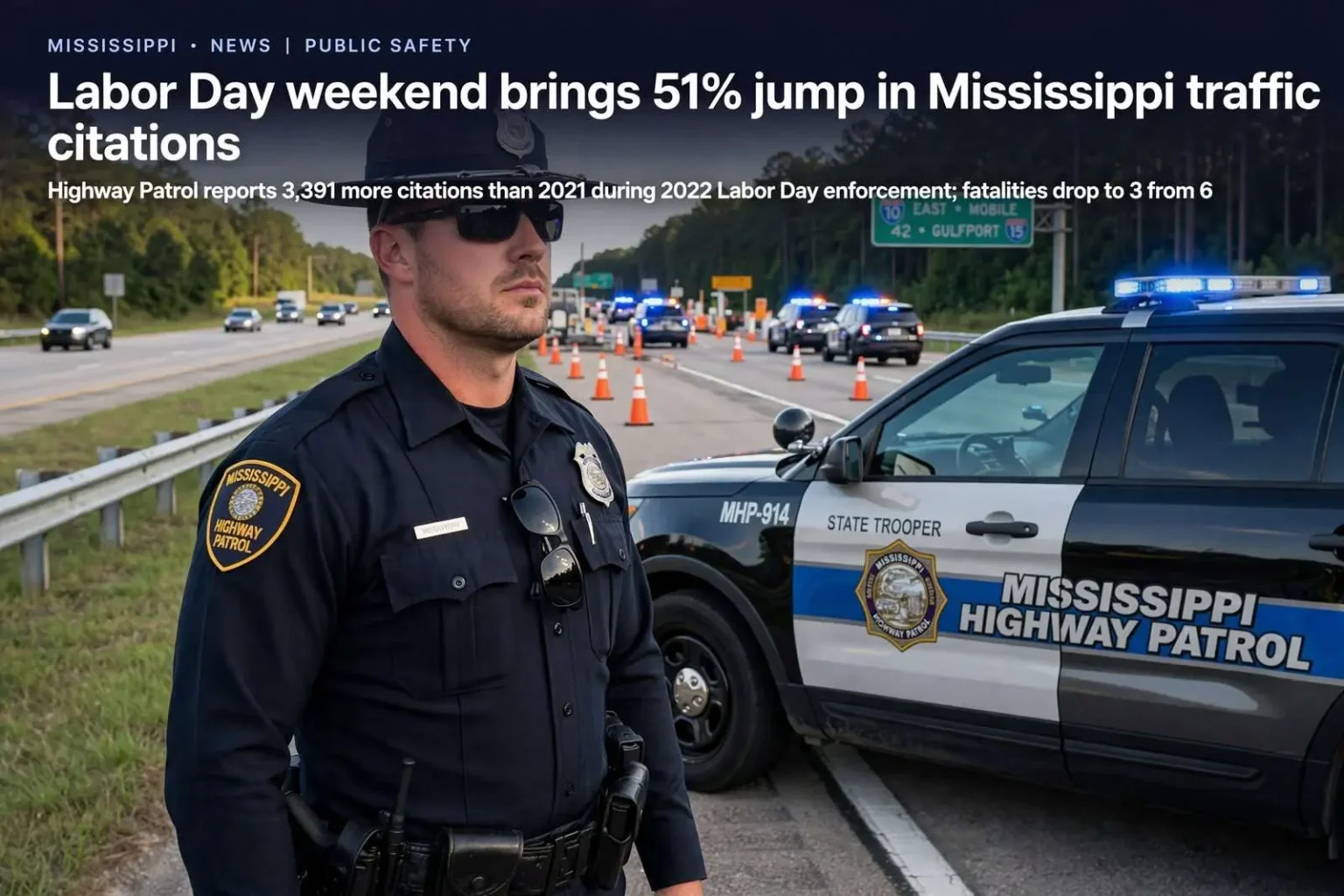
Mississippi Highway Patrol’s increased enforcement over the 2022 Labor Day weekend resulted in 3,391 more citations than the same period in 2021, a 51% increase that reflected one of the largest holiday mobilizations the agency had run in recent years. The numbers, released after the long weekend, showed a deliberate push to put more troopers on more miles of Mississippi roadway during one of the year’s heaviest travel periods.
The stepped-up patrols began at 6 a.m. Friday and ran through midnight Monday, covering the full arc of the holiday weekend from the first outbound trips of Friday morning to the last returns of Monday night. That schedule requires substantial staffing — troopers working overtime shifts across all nine of the patrol’s districts, with enforcement focused on the behaviors that statistics say drive holiday crashes: speeding, impaired driving and unrestrained occupants.
Overall, the number of crashes and fatalities was slightly down compared with the previous year, but citations for driving under the influence and for improper seatbelt or child restraint use were both up. The mix of numbers tells the story enforcement campaigns aim for: more contacts, more violations caught, and fewer deaths on the road — the outcome that justifies the overtime budget and the extended shifts.
The regional breakdown
The MHP region covering George, Hancock, Harrison, Jackson County, Pearl River and Stone counties recorded the fewest citations of the state’s nine regions, with 841 issued. The region includes the Mississippi Gulf Coast — Hancock, Harrison and Jackson counties front the water — along with the pine-belt counties inland, and its roads carry a heavy mix of holiday beach traffic, local driving and cross-border travelers moving between the coast and Mobile to the east.
The Meridian region was next lowest with 874, while the highest total, 1,564, came from the northeast region covering Corinth, New Albany and Tupelo. Regional totals reflect more than enforcement intensity; they track population, traffic volume and the highway miles each district patrols. A region anchored by a metro area like Tupelo, where major corridors converge, generates more traffic contacts than a coastal district whose troopers may be spread across a wider, more rural network.
For coastal residents, the low citation count in the six-county district did not necessarily mean light enforcement — troopers in holiday mobilizations work targeted waves, saturating specific corridors at specific hours. But the numbers gave the region the quietest enforcement profile in the state for the weekend, whatever the reasons behind it.
Fatalities down, one crash at a time
Three fatal crashes occurred over the holiday weekend in George, Lauderdale and Washington counties, down from six fatalities in 2021. The three deaths were scattered across the state — George County on the Alabama line in the state’s southeast, Lauderdale in the east-central corridor around Meridian, and Washington along the Mississippi River in the west — a reminder that fatal crashes follow traffic, not just metro areas.
Each number in that sentence represents an investigation, a family and a stretch of road closed while troopers reconstructed what happened. Holiday fatality counts are the metric patrol leadership watches most closely, because they measure the campaigns’ ultimate purpose: whether the added enforcement — the visible patrols, the saturation details, the checkpoints where they are legally conducted — changes outcomes rather than merely writing tickets.
The drop from six fatalities to three over a single holiday weekend is small in statistical terms and enormous in human ones. Safety officials in Mississippi and across the country frame it that way deliberately: every avoided fatality is a family that did not receive the worst phone call of its life, and seatbelt and DUI enforcement exist because those are the two factors most likely to decide whether a crash is survivable.
Labor Day and the travel surge
Labor Day weekend reliably produces one of the heaviest traffic loads of the American late summer. The holiday marks the unofficial end of the season, and on the Gulf Coast that means a final surge of beach travel, college students returning to campuses, and families squeezing in one more trip before school routines harden. Mississippi’s interstates — running east-west between Atlanta and Dallas, north-south between the Midwest and the coast — carry much of that flow through the state.
Enforcement campaigns timed to the holiday are built on that predictability. The Highway Patrol announces its mobilization in advance, a choice safety officials say is intentional: the publicized presence of extra troopers is meant to deter speeding and impaired driving before it happens, reaching drivers who might never see a patrol car but hear the warning on the news.
The Friday-to-Monday window also shapes who is on the road. Holiday travel mixes commuters off their normal schedules with long-haul drivers pushing through overnight hours, and fatigue becomes a factor alongside alcohol and speed. Troopers on the detail look for the drifting lane lines and inconsistent speeds that flag a drowsy driver, another of the behaviors that holiday statistics consistently tie to serious crashes.
The 51% jump in citations suggests the deterrence was partial at best — plenty of drivers still chose to speed, drive impaired or skip the belt, and the troopers were there to record it. For the patrol, that is the job working as designed: enforcement visible enough to change many minds, staffed enough to catch many of the rest, and evaluated afterward by the numbers that matter most — crashes down, fatalities down, and a holiday weekend that ended with most travelers home safe.
Why seatbelt and DUI numbers move together
The increases in DUI and seatbelt citations were not separate trends; they are the two halves of a single enforcement strategy. Troopers working holiday details are trained to look for the impairment cues at the wheel and the restraint violations visible through the windshield, and both violations are easy to document during a traffic stop. A campaign that puts hundreds of additional trooper-hours on the road will reliably produce more of both, which is what Mississippi’s numbers showed.
The emphasis on child restraints carries particular weight in holiday enforcement. Crashes are the leading danger to children on road trips, and a correctly used car seat or booster transforms survival odds in a collision. Restraint citations are written not because troopers enjoy them but because unbuckled occupants — adult and child — are overrepresented in fatality statistics across the Southeast, a region that has historically lagged national seatbelt use.
DUI enforcement, meanwhile, follows the holiday calendar’s social pattern. Long weekends mean more evening and late-night driving, more celebrations that include alcohol, and more of the impaired drivers who account for a large share of fatal crashes on holiday periods. The citation increase over 2021 shows both more drivers testing the limits and more troopers positioned to stop them.
Reading the nine regions
The Highway Patrol divides Mississippi into nine enforcement regions, each responsible for the highways and traffic of its territory. The structure matters when reading holiday statistics, because comparing regions side by side reveals how differently traffic behaves across the state: the northeast’s Tupelo-centered corridors topped the citation count at 1,564, the Meridian region posted 874, and the six southern counties of the coastal district produced the state’s lowest total at 841.
Those figures are best read as a snapshot of holiday travel rather than a safety ranking. A region with more interstate miles, denser traffic and more convergence points will generate more stops per hour of patrol time, while a district whose troopers cover long rural stretches may log fewer contacts even at full staffing. Safety outcomes, ultimately, are measured against crashes and fatalities — where the 2022 weekend showed improvement statewide.
What it means for Gulf Coast drivers
For residents of the coastal counties — George, Hancock, Harrison, Jackson, Pearl River and Stone — the weekend’s numbers carry a practical message for future holidays: the patrol treats every region as a full-coverage zone during mobilizations, and the absence of a citation wave in the coastal district does not imply a lighter touch. Drivers crossing the state line toward Mobile’s beaches or heading up the corridors toward Hattiesburg and Jackson should plan on the same saturation patrols wherever the weekend takes them.
The advice that enforcement campaigns always attach to the statistics bears repeating each holiday: buckle up on every trip, however short; plan a ride before the first drink; slow down in unfamiliar, congested holiday traffic; and expect the unseen trooper. The 2022 Labor Day numbers suggest Mississippi’s roads were safer for the effort — three fatal crashes instead of more, a holiday weekend that closed with the state’s highway deaths trending down rather than up.
Further mobilizations were expected with the next holiday travel surge, as the patrol repeats the formula it refined here: announce the campaign, staff the roads, and let the before-and-after numbers tell the story of whether Mississippi’s holiday weekends are getting safer.