Leakesville man arrested after allegedly fleeing George County deputy at high speed
A Leakesville man was arrested in George County Mississippi after allegedly fleeing a deputy at speeds over 90 mph.
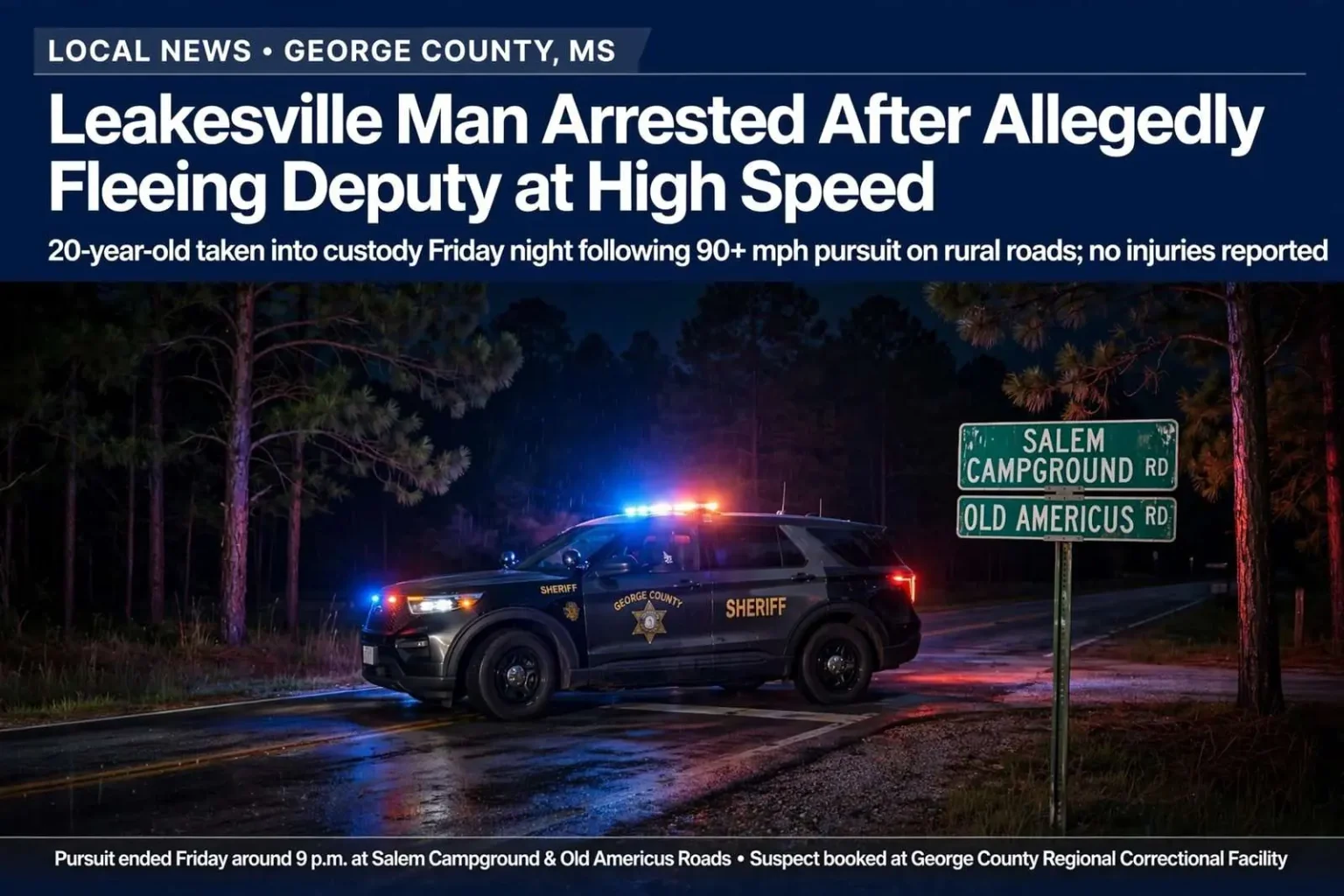
A Leakesville man was arrested after allegedly fleeing from deputies in George County, Mississippi, authorities said, in a Friday-night pursuit that reached speeds of more than 90 mph before ending without reported injuries. Robert Stone, 20, was arrested Friday after a deputy tried to pull over his vehicle on Salem Campground Road in the Barton community around 9 p.m., according to the sheriff’s office. Stone allegedly fled instead, and the chase ended at Salem Campground and Old Americus roads, where he was taken into custody on a charge of fleeing law enforcement in a motor vehicle.
Details of the episode as reported paint the standard arc of a rural traffic pursuit: an attempted stop, a refusal, a high-speed run down dark county roads, and an arrest at an intersection where the driver’s options ran out. Stone was transported to the George County Regional Correctional Facility following his arrest. Court records added a notable postscript: Stone had bonded out of jail earlier in the day on a Lucedale Municipal Court warrant, meaning the alleged flight occurred within hours of his release from a previous jail stay.
How the night unfolded
The sequence began around 9 p.m., when a George County deputy attempted a traffic stop on Salem Campground Road in the Barton community, a rural crossroads in the central part of the county. The reason for the attempted stop was not the focus of the sheriff’s office account; what followed was. Rather than pulling over, the driver allegedly accelerated away, reaching speeds over 90 mph on county roads — velocities that, on the narrow, unlit roads that thread George County’s pineywoods, carry obvious dangers to the driver, pursuing deputies and any resident or motorist in the path of the chase.
The pursuit ended at the junction of Salem Campground and Old Americus roads, where Stone was arrested, according to the sheriff’s office. Deputies booked him on the charge of fleeing law enforcement in a motor vehicle, and he was taken to the George County Regional Correctional Facility, the county jail that serves the sheriff’s department and municipal agencies in the area. No injuries were reported in the account of the incident, an outcome that pursuits of this kind cannot take for granted.
The detail that emerged from court records gave the night an added dimension. Stone had bonded out of jail earlier that same day on a Lucedale Municipal Court warrant, authorities noted, meaning the alleged high-speed flight took place within hours of his release. For the sheriff’s office, that timeline underscored the kind of pattern officers describe when arguing for firm handling of traffic and warrant cases; for prosecutors, it becomes part of the record a judge considers at bond hearings.
George County and its roads
George County sits in southeastern Mississippi, along the Alabama state line, with Lucedale as its county seat and Leakesville — Stone’s hometown — a short drive south in neighboring Greene County. It is rural country: pine forests, creeks, small farms and communities like Barton that consist of a church, a store and a network of county roads. Salem Campground Road and Old Americus Road are exactly the kind of two-lane routes where a vehicle traveling more than 90 mph becomes a hazard far out of proportion to the offense that prompted a stop.
That geography shapes how rural deputies police pursuits. County agencies weigh the seriousness of the underlying offense against the danger a chase poses, and modern pursuit policies generally direct deputies to terminate chases when speeds and conditions make the risk to the public unacceptable. In this case, the pursuit concluded with an arrest rather than a crash, and the sheriff’s office publicized the outcome both as a matter of record and as a warning that drivers who flee face charges that compound whatever prompted the initial stop.
The charge Stone faced — fleeing law enforcement in a motor vehicle — is treated seriously under Mississippi law, and the felony-or-misdemeanor character of such charges depends on the circumstances, including speeds reached, injuries and prior record. A pursuit at more than 90 mph, allegedly initiated hours after the defendant had bonded out on an earlier warrant, presented the kind of fact pattern that courts weigh when setting bonds and sentencing in these cases.
Why drivers flee — and why it fails
Law enforcement agencies have studied the question of why drivers flee traffic stops for decades, and the answers cluster around panic, impairment, outstanding warrants and the belief that escape is possible on familiar roads. In rural counties like George, drivers know the network of farm roads and connectors intimately, and some gamble that a deputy will break off a pursuit before it endangers the public. The gamble rarely works: radios, license-plate readers and coordination with neighboring agencies mean a fleeing vehicle is usually identified even if the immediate chase ends.
The consequences of a failed flight are severe and compounding. The original reason for the stop remains on the record; the flight adds a new charge; the pursuit report — speeds, duration, road conditions — becomes evidence; and the defendant’s bond status takes on new weight. In Stone’s case, authorities’ mention of the same-day bond release on a Lucedale Municipal Court warrant illustrated exactly how flight converts a minor legal problem into a serious one: a pending municipal matter became, within hours, a new arrest on a charge of fleeing law enforcement, plus whatever the underlying warrant involved.
Rural pursuits also expose the public to risks that urban chases do not. George County’s roads carry school buses in the morning, farm equipment in the afternoon and little lighting at night; a vehicle running 90 mph on Salem Campground Road at 9 p.m. threatens every mailbox, driveway and oncoming headlight along the route. This is why the sheriff’s office account of the incident stressed the speeds and the endpoint, and why agencies across Mississippi and Alabama publicize fleeing arrests as deterrents.
The county justice system
The institutions named in the case map the machinery of rural Mississippi justice. The George County Sheriff’s Office patrols the unincorporated county roads where the stop and pursuit occurred. The George County Regional Correctional Facility holds arrestees for the county and for contracting municipalities. Lucedale Municipal Court handles the city-level warrants and minor offenses that, as in this case, can precede larger trouble. And the circuit court system of the state’s judicial districts stands behind the felony process if charges escalate beyond the municipal level.
Bond is the pivot of that machinery for defendants like Stone. Bonding out on a municipal warrant frees a defendant pending court, but the release comes with expectations of lawful behavior; an arrest for fleeing law enforcement hours later jeopardizes future releases and adds charges that carry their own penalties. Judges setting bonds weigh exactly this kind of recent history — the same-day sequence of release and alleged flight becomes part of the record at the next hearing.
For the residents of the Barton community and the roads between Salem Campground and Old Americus, the night’s events ended the way such nights usually do: with patrol cars gathered at an intersection, a young man in handcuffs, and the county’s courts left to sort out the consequences. The sheriff’s office’s account — the attempted stop at 9 p.m., the alleged flight over 90 mph, the arrest at the crossroads, the booking into the regional facility, and the note of the earlier bond release — stands as the public record of a Friday night in George County that began with a traffic stop and ended with a 20-year-old from Leakesville back in jail.
Public safety and the pursuit decision
Every pursuit forces a split-second weighing of interests. Deputies are sworn to enforce the law, but their training and their agencies’ policies also instruct them to weigh the danger a chase creates against the seriousness of the offense being pursued. High-speed runs through rural communities create risks — to deputies, suspects, other drivers, pedestrians and property — that sometimes outweigh the value of an immediate arrest. That is why pursuit policies distinguish between serious felonies and minor infractions, and why deputies are trained to call off chases when speeds climb beyond safe thresholds.
In this case, the account indicates the pursuit continued until the suspect was boxed in at the intersection of Salem Campground and Old Americus roads, an outcome that reflects both the deputy’s persistence and the geography of the area: rural road networks have limited exits, and a fleeing driver unfamiliar with every connector eventually meets a dead end or a blocking position. When the pursuit ended, deputies took Stone into custody without reported injuries — the best available outcome of a dangerous decision.
The charge he now faces is designed to deter exactly that decision. Fleeing law enforcement in a motor vehicle carries penalties that grow with the circumstances of the flight, and a conviction record affects bond decisions, insurance and employment for years. Combined with the circumstances authorities noted — a 90-mph chase through a rural community hours after bonding out of jail on a Lucedale warrant — the case presents the courts with the full picture of the risks the alleged flight created.
For George County, the incident was one entry in the ordinary caseload of a rural sheriff’s office: a traffic stop that escalated, a pursuit that ended safely, an arrest that moved into the jail and the courts. But it also illustrates the pattern deputies and prosecutors emphasize to the public — that fleeing a stop never ends well, that the roads of communities like Barton are shared by everyone, and that a moment’s decision to accelerate away from a patrol car’s blue lights can turn a minor encounter into a lasting legal problem.