Lawsuit continues a year after George County Highway 26 washout that killed three
A lawsuit continues on behalf of victims of the 2021 George County Highway 26 washout that killed three people after Hurricane Ida.
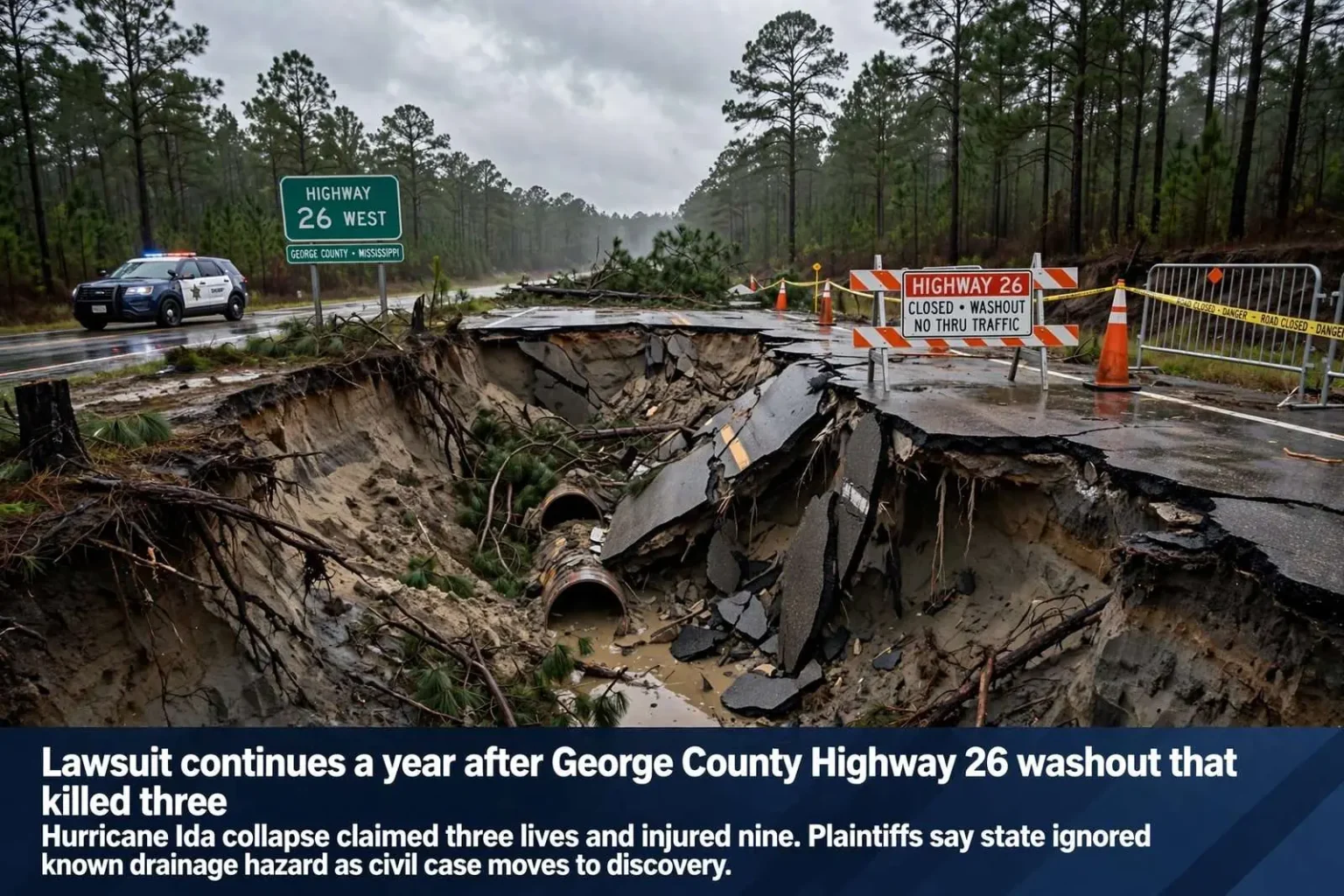
A lawsuit on behalf of five victims of the 2021 Highway 26 washout in George County, Mississippi, is still moving through the courts a year after the collapse, keeping alive the legal reckoning over a road failure that turned a routine stretch of state highway into one of the region’s deadliest weather-related disasters.
Three people died and nine others were injured after Hurricane Ida dumped 14 inches of rain on the region, causing part of the road to collapse into a crater about 50 feet long and 20 feet deep. The collapse swallowed vehicles traveling the highway in the dark as the storm’s remnants soaked southeast Mississippi late that August.
The Night of the Washout
Hurricane Ida made its historic landfall on the Louisiana coast in late August 2021, but its reach extended far beyond New Orleans. As the storm’s remnants pushed inland, bands of torrential rain swept across the Mississippi Gulf Coast and the piney woods counties to the north, falling on ground already saturated from a wet summer.
In George County, along the Highway 26 corridor west of Lucedale, the water found a weakness. An underground flow that had been undermining the roadway gave way under the deluge, and the pavement dropped into a chasm roughly 50 feet long and 20 feet deep — invisible to drivers until it was too late, in darkness made total by the storm.
Emergency responders from across the county converged on the scene through the night, working in continuing rain to reach victims, recover vehicles and close the highway. The images that emerged in the following days — a road simply gone, trees and asphalt dangling into the hole — became defining pictures of Ida’s inland toll across the Gulf South.
The victims included drivers and passengers with no connection to one another, thrown together by a stretch of highway each had traveled countless times before. In the weeks that followed, funerals were held in Wiggins, Lucedale and beyond, and the crater on Highway 26 became a lasting landmark of grief for the families involved.
The Lawsuit
The family of 39-year-old Amanda Williams of Wiggins is suing the state after her death. The lawsuit, filed in April, represents Williams’ estate, an unborn child she was carrying, and her 16-year-old daughter, who was injured in the crash. The claims seek to hold the state responsible for a roadway condition the family argues was known and preventable.
A separate case filed in July by Harvy Shows of Covington, Louisiana, who was injured in the washout, and his wife, Paula, was combined with the others, consolidating the victims’ claims into a single track before the court. The combination is a procedural step common in disaster litigation, allowing shared evidence and testimony to move together.
Greenwood attorneys Charles Swayze Jr. and Charles Swayze III represent the plaintiffs. The consolidated cases put a year of investigation, records requests and expert work into position for the discovery phase, where the plaintiffs intend to press their central claim about what the state knew before the collapse.
For the families, consolidation also carries a human dimension. The five plaintiffs — the estate of Amanda Williams and her unborn child, her injured 16-year-old daughter, and the injured Louisiana couple — are represented in a single proceeding that will weigh the same evidence of the road’s condition, the same records of the state’s inspections and the same account of the storm that night. A case that began as separate grief now moves as one.
The Core Dispute
The plaintiffs argue the Mississippi Department of Transportation knew about a dangerous condition tied to an underground water source that contributed to the collapse but failed to maintain the road or warn the public. In their telling, the highway failed in a place and a manner that engineering inspection should have flagged long before Hurricane Ida ever formed.
In its response, MDOT’s attorney argued the injuries were caused solely by the extreme weather. The defense frames the washout as an act of nature without precedent — a storm of historic proportions delivering rainfall that no ordinary maintenance program could have anticipated or withstood.
That framing dispute — preventable infrastructure failure versus unforeseeable natural disaster — is now the central question of the case. It will be argued through engineering reports, maintenance records, inspection histories and hydrological evidence, with experts on both sides likely to offer competing accounts of what the roadway and the groundwater were doing before the collapse.
The stakes run beyond the five plaintiffs. Roads across southeast Mississippi cross the same kind of sandy, spring-fed terrain that undermined Highway 26, and the case has drawn attention from local officials and residents who want to know whether the state’s inspection and drainage practices are equal to the region’s geology.
Suing the State
Litigation against a state transportation department moves under special rules in Mississippi. Claims against state agencies proceed under the state’s tort claims framework, which sets specific procedures, notice requirements and limits that do not apply to lawsuits between private parties — one reason the case has taken shape over months rather than weeks.
Those procedural guardrails shape every phase of the litigation, from how the claims were framed at filing to what remedies are available if the plaintiffs prevail. The attorneys for the families have navigated the statutory framework while pursuing the records they argue will show the dangerous condition was documented long before the storm.
Discovery has begun to reach into the emergency response as well. Subpoenas were issued in August to the George County Emergency Management Agency, the Sheriff’s Office and the Mississippi Highway Patrol, seeking records and testimony that document what happened on the night of the collapse and what agencies knew about conditions on the roadway in the hours and days beforehand.
Highway 26 and the Community It Carries
Highway 26 is a working road for the people of George County. It links communities across the county and connects them to the larger corridors that carry commuters, freight and school traffic through southeast Mississippi. The stretch that failed sat on a route families used daily, which is why the disaster touched so many households so directly.
George County itself is a rural county of small towns and pine forest, a place where the state highway system is not an abstraction but the practical thread between homes, jobs, schools and hospitals. The loss of the road severed that thread for months, forcing detours that added miles and minutes to ordinary trips while the crater sat as a wound in the landscape.
Rebuilding took the better part of a year, with crews stabilizing the site, redesigning the crossing and reconstructing the roadway through terrain that had revealed itself to be less stable than anyone assumed. The reopened highway returned to daily use, but the litigation ensures the question of responsibility has not been laid to rest with the asphalt.
Ida’s Wider Toll
The washout remains one of the deadliest inland consequences of Hurricane Ida, a storm remembered mostly for its catastrophic landfall in Louisiana. Ida’s remnants tracked northeast across the Gulf South, spinning off tornado warnings, flash flooding and infrastructure failures from Louisiana through Mississippi and into the Mid-Atlantic, where catastrophic flooding followed days later.
For the communities along the Mississippi coast and its inland counties, Ida was the second time in sixteen years that a named storm had tested the region’s infrastructure to failure. The comparison to Hurricane Katrina, which devastated the same part of Mississippi in 2005, was made by residents and officials alike in the days after the collapse.
Each such event renews a regional conversation about drainage, culverts, roadway inspections and the cost of preparing rural infrastructure for storms that are arriving with more water than the systems were designed to handle. Highway 26 has become the case study cited in those discussions — concrete evidence of what can happen when the ground beneath a road gives way.
What Comes Next in Court
No trial date has been set, and the case now moves into the long middle phase of civil litigation: written discovery, depositions of engineers and agency employees, and the expert reports that will frame each side’s account of the collapse. Given the complexity and the number of parties, the process is likely to extend well beyond the second anniversary of the washout.
For the families involved, the anniversary marked a year of grief punctuated by court filings. The 16-year-old daughter who survived, the estate of Amanda Williams and her unborn child, and the injured Louisiana couple whose claims were consolidated alongside them — all are now bound together in a case that will help determine how Mississippi answers for the roads it maintains.
However it ends, the lawsuit has already done one thing: it has kept the story of Highway 26 in the public record, preserving for future inspection the details of a night when 14 inches of rain turned a routine drive home into a catastrophe for three families and a county that watched it happen.