Two 18-wheelers collide, close Highway 57 at Highway 26 in George County
A collision involving two 18-wheelers at the Highway 57 and Highway 26 intersection in George County, Mississippi, closed both lanes and left injuries.
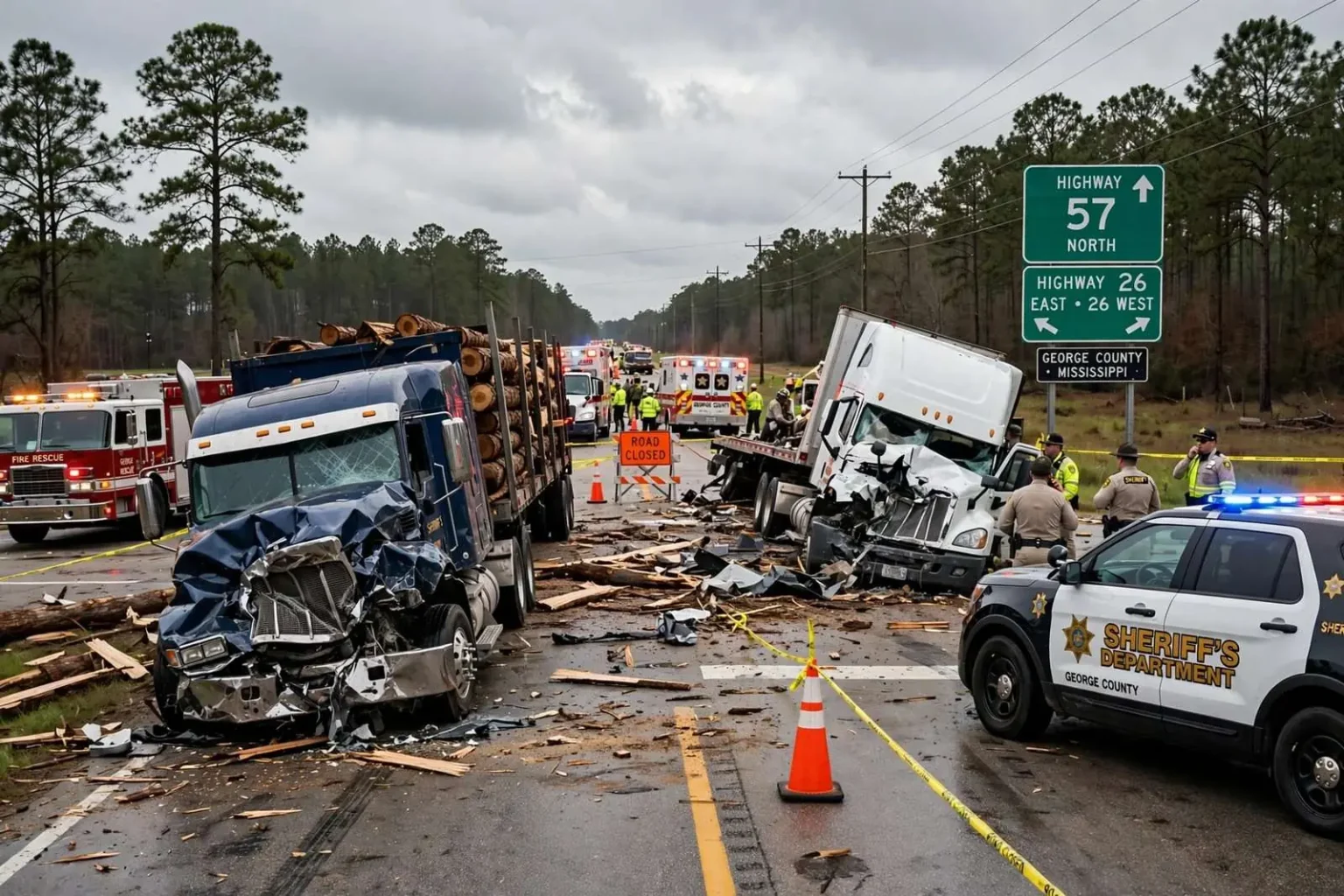
GEORGE COUNTY, Miss. — Two 18-wheelers collided at the intersection of Highway 57 and Highway 26 in George County, according to the George County Sheriff’s Department, triggering a full closure of the crossing in both directions while emergency crews worked the scene. Deputies confirmed that there were injuries in the crash, which brought commercial traffic and local commuters alike to a standstill on one of the county’s busiest crossroads. The wreck closed both lanes of traffic, and a wrecker was called to the scene to clear the heavy vehicles, a process that can stretch for hours when big rigs are involved.
Traffic reporter Kenny Fowler reported that deputies confirmed injuries in the collision, relaying the information to drivers monitoring conditions in the area. The confirmation that the crash involved injuries raised the stakes of the response, bringing additional emergency resources to the intersection alongside the deputies and tow operators already on scene. Officials did not immediately release details about the number of people hurt or the extent of their injuries, and the investigation into how the collision happened remained in progress as crews worked.
The intersection of Highway 57 and Highway 26 is a key junction in George County, where the two highways meet and form a crossing point for traffic moving between the Mississippi Gulf Coast region and the interior. Highway 57 runs north-south through the county, connecting communities and providing a route that carries a steady mix of passenger vehicles and commercial trucks. Highway 26 crosses the county east-west, serving travelers moving between towns in southeast Mississippi. When both lanes close at that junction, drivers lose one of the area’s principal crossings and must find their way around on a network of smaller rural roads.
Heavy impact on local travel
Sheriff’s officials urged motorists traveling through the area to expect significant delays and to consider alternate routes while cleanup and investigation continued. For a rural county like George County, where residents routinely drive long distances between home, work, and shopping, the closure of a major intersection is more than an inconvenience — it can add substantial time to daily trips and divert heavy truck traffic onto roads never designed for it.
Large-truck crashes present challenges that ordinary car wrecks do not. An 18-wheeler can weigh tens of thousands of pounds when loaded, and recovering wrecked commercial vehicles requires heavy-duty wreckers and trained operators. Spilled fuel, scattered cargo, and damage to the roadway itself all have to be addressed before lanes can safely reopen. Deputies typically keep a scene like this one secured until the vehicles are removed, any hazards are cleared, and investigators have documented what they need, which is why full closures at truck crashes so often last for hours rather than minutes.
Drivers approaching the closure were advised to build extra time into their trips or to reroute entirely. Local knowledge of the county’s secondary roads becomes valuable in these situations, and residents generally know which alternates can absorb detoured traffic. Emergency officials ask drivers who must travel through storm-damaged or crash-affected areas to slow down, watch for emergency personnel, and follow directions from officers directing traffic around the scene.
What happens after a truck crash
In the hours after a collision involving commercial vehicles, the response typically unfolds in stages. First, injured parties receive medical care, with ambulances transporting those hurt to hospitals in the region. Deputies then work the crash scene — measuring, photographing, and reconstructing how the vehicles came together — while fire personnel handle any fire or hazardous-materials concerns and tow crews begin the delicate work of righting and removing the trucks.
Commercial vehicle crashes also draw attention from regulators and insurers. Trucking companies are normally notified promptly when their equipment is involved, and investigators may examine factors such as driver hours, vehicle maintenance, and cargo loading as part of a thorough review. The results of such investigations, along with any charges or findings, are typically made public through official channels later, once the work is complete. Until then, details from the scene remain preliminary, and officials caution against drawing conclusions before the investigation has run its course.
For George County, located north of the Mississippi Gulf Coast in the state’s southeastern corner, the crash was a reminder of how heavily its road network depends on a small number of highways. The county seat, Lucedale, sits at the heart of that network, and traffic between the coast, the pine-belt interior, and the state line funnels through crossings like Highway 57 and Highway 26. Any disruption at the junction ripples outward quickly.
Drivers with plans to pass through the area were encouraged to check updated conditions before departing and to remain patient as crews completed their work. The Sheriff’s Department said information about the reopening of the highway would be released once the scene was cleared and the roadway was safe for travel.
The presence of two 18-wheelers in the collision underscored the volume of freight that moves through rural southeast Mississippi every day. Highways like 57 and 26 carry timber products, construction materials, fuel, and consumer goods between the Port of Gulfport, the Interstate 10 corridor, and communities across the pine belt. Logging trucks and long-haul rigs are a constant presence on these roads, and residents are accustomed to sharing the pavement with them — but when two of the big vehicles collide at a highway junction, the scale of the damage and the length of the closure dwarf what a passenger-car wreck would produce.
Safety officials have long urged extra caution at rural highway intersections, where high-speed roads meet cross traffic and sight lines can be limited by trees, terrain, and weather. Crashes at such junctions often involve vehicles pulling into or crossing the path of oncoming traffic, and the speed differential between a truck moving at highway speed and a vehicle turning across its lane leaves little margin for error. Investigators in cases like this one typically work to establish which vehicle had the right of way, what each driver saw, and whether any mechanical or environmental factors played a role.
Getting word to drivers
The speed with which news of the crash reached the public reflected the modern information network that surrounds rural emergencies. Traffic reporters monitor law-enforcement scanners, social media posts, and official channels to flag closures as they develop, and drivers increasingly expect to know about a blocking wreck within minutes of it happening. Local stations and online outlets pass along sheriff’s office confirmations, as happened here when deputies confirmed that injuries were involved in the Highway 57 and Highway 26 collision.
That information flow serves a safety purpose beyond convenience. Drivers who learn of a closure before they leave can reroute entirely, keeping themselves out of the way of emergency vehicles and reducing the backup that builds behind a blocked highway. Every car that avoids the closed intersection is one less vehicle for deputies to manage and one less potential complication for ambulances that may need to run injured parties out to hospitals.
Emergency managers in rural counties regularly remind travelers that backups behind a closure can themselves become dangerous, particularly if visibility is poor or if drivers grow impatient and attempt to pass lines of stopped traffic. The standard advice is straightforward: slow down as you approach the back of a backup, leave following distance, keep an eye on mirrors for approaching emergency vehicles, and never drive around barricades or into a closed scene.
Patience during the cleanup
As the afternoon wore on, tow operators and deputies continued their work at the junction. Clearing wrecked 18-wheelers is slow, methodical labor — cargo may need to be offloaded before a trailer can be moved, and wrecked tractors often have to be winched onto recovery equipment. Deputies remained on scene managing traffic flow around the closure and continuing their investigative work, and the Sheriff’s Department maintained its advisory that through traffic should seek other routes.
Residents and businesses along the affected stretch of highway felt the disruption in small ways throughout the day. Deliveries were delayed, commutes lengthened, and the steady hum of truck traffic that usually defines the junction gave way to the quiet of a blocked road. For a community accustomed to the rhythms of rural highway life, the closure was a temporary but keenly felt interruption.
The George County Sheriff’s Department said it would release additional details about the crash, including information about those injured and any findings from the investigation, as they became available. In the meantime, officials thanked drivers for their patience and repeated the standing advice that applies on any day a major highway goes dark in George County: expect delays, take an alternate route if you can, and let the crews work.