Names Released in Deadly Chain-Reaction Wreck on Highway 112 That Killed Florida Fire Chief
Alabama State Troopers have identified the drivers involved in a chain-reaction crash on Highway 112 in Baldwin County that killed a motorcyclist and a Florida district fire chief who stopped to help.
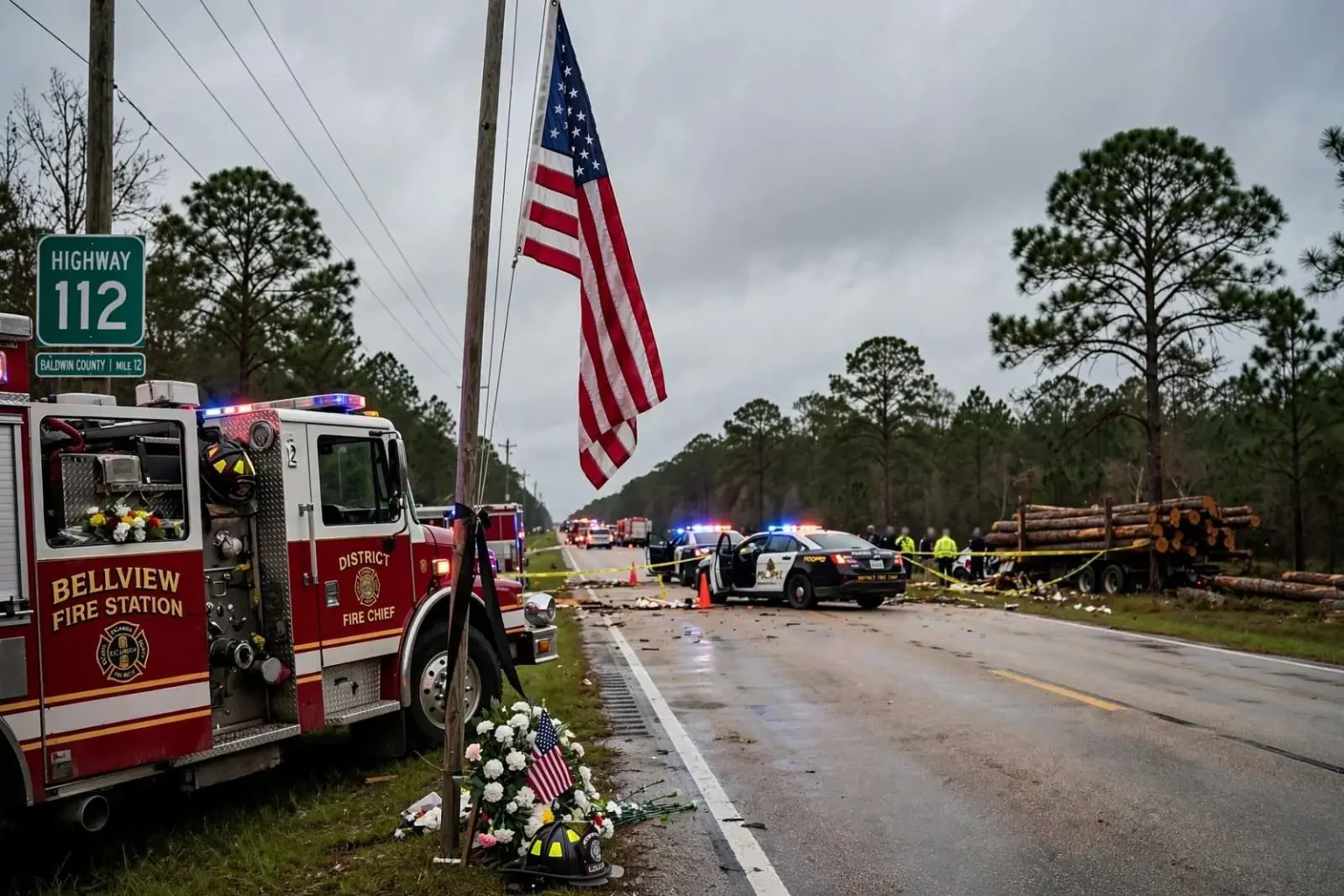
Alabama State Troopers have released the names of the drivers involved in a chain-reaction wreck on Highway 112 in Baldwin County that claimed the life of a Florida firefighter and a motorcyclist earlier this week.
Investigators say the crash began when a motorcycle traveling west on Highway 112 collided with an eastbound log truck driven by 52-year-old Patrick Bankester of Bay Minette.
As emergency crews and troopers worked the scene of that initial collision, a second log truck, driven by 59-year-old Clifton Harrison of Mobile, approached and drove through the crash site. Troopers say Harrison’s truck struck two unoccupied vehicles that were already parked at the scene before leaving the roadway and striking District Fire Chief Dwain Bradshaw, who was working to help at the site of the first crash.
Bradshaw was airlifted to Sacred Heart Hospital, where he was later pronounced dead. He served as a volunteer with the Bellview Fire Station and was well known in the nearby community of Beulah, where the flag was lowered to half-staff in his honor following news of his death.
The name of the motorcyclist killed in the initial collision has not been released.
A Community Mourns Its Fire Chief
Escambia County, Florida administrator Janice Gilley issued a statement honoring Bradshaw following the crash.
“The Escambia family lost a true hero and dedicated public servant today,” the statement read in part. “Our hearts go out to Dwain Bradshaw’s family, loved ones and all of the men and women of Escambia County Fire Rescue who are grieving the loss of their colleague and friend.”
Neighbors who live near the crash site on Highway 112 described a harrowing scene that stretched on for hours as investigators worked to piece together what happened. One nearby resident, Donna Nelson, said watching the aftermath unfold outside her home left her shaken. She called the loss of two lives in the span of one crash “senseless,” adding that the deaths of both men have weighed heavily on the small community.
Bradshaw’s death struck the region’s volunteer fire community with particular force. Rural fire service in northwest Florida and south Alabama depends heavily on volunteers — residents who leave their jobs and families at a moment’s notice to answer calls — and a district chief occupies a leadership role earned through years of response work rather than a career appointment. The Bellview Fire Station, where Bradshaw volunteered, serves one of the communities west of Pensacola, and the response to his death reached from fire stations to county government within a day.
The half-staff flag in Beulah reflected the way small communities mark such losses: visibly, immediately, and collectively. Beulah sits along the Baldwin County line, close enough to the crash site that many of its residents use Highway 112 daily, and the wreck scene was familiar ground to the people now mourning the man who died on it.
How the Chain-Reaction Unfolded
Chain-reaction crashes of this kind pose a documented hazard for responders working roadside scenes. The initial collision brought troopers, firefighters and emergency medical crews to the highway, along with the parked vehicles that accompany any serious response. A second vehicle approaching at speed — in this case a loaded log truck — has little margin for error if it fails to slow or change lanes, and the secondary impacts spread danger to people and equipment that were never part of the first crash.
Troopers with the Alabama Law Enforcement Agency investigate fatal crashes on state highways in Baldwin County, and the work at a scene like this one continues for hours: documenting vehicle positions, measuring skid evidence, interviewing witnesses and coordinating with coroner officials before the roadway can fully reopen.
Highway 112 and the Log Truck Corridor
Highway 112 cuts through the rural northern reaches of Baldwin County near the Florida state line, a two-lane road that carries a steady mix of local traffic, commuters heading toward the Pensacola area, and the logging trucks that serve the pine plantations covering much of the county’s interior. Baldwin County is among Alabama’s largest by land area, and its timber industry keeps heavy trucks on rural routes like this one throughout the week.
Log truck traffic has long been a point of concern for rural residents across south Alabama, where the trucks’ size, braking distances and schedules collide with school buses, farm equipment and passenger cars on narrow roadways. The presence of two log trucks at this crash scene — one struck by a motorcycle, one plowing through the emergency scene — underscored the traffic mix that defines highways like 112.
The road’s proximity to the Escambia County line explains why the day’s losses fell on both sides of the state border. Bradshaw’s fire station and the community of Beulah lie just across the line in Florida, while the crash itself and the investigation belong to Alabama authorities. Families in the area cross the state line routinely for work, school and worship, and the grief over Bradshaw’s death moved across it without friction.
Bay Minette, home to the first truck’s driver, serves as the county seat of Baldwin County and sits at the hub of several highways that thread the county’s northern half. Mobile, home to the second driver, lies to the west. The spread of the drivers’ home communities reflected the regional reach of the logging industry, which draws trucks and drivers from across the central Gulf Coast.
What Investigators Will Examine
Troopers’ investigation of a chain-reaction fatal crash typically moves in stages. The first task is reconstructing the initial collision between the motorcycle and the eastbound log truck — establishing speed, sight lines, point of impact and any contributing factors. The second is the secondary sequence: how the second truck approached the scene, whether it reduced speed, and how it came to strike the parked vehicles and the fire chief.
Answers to those questions matter for the families, for the drivers involved, and for any potential charges, which troopers may present to a district attorney once the reconstruction is complete. Fatal crashes involving commercial vehicles also draw scrutiny of hours-of-service records, vehicle maintenance and load securement, standard elements of any investigation where heavy trucks are involved.
The released names — Bankester and Harrison — identified the truck drivers but not the motorcyclist, whose identity authorities had withheld pending notification of family. Such withholding is customary, and updates typically follow once next of kin have been reached.
For the emergency responder community, the crash renewed the familiar warnings about roadside scene safety: slow down, move over, and give working crews room. Alabama’s move-over law, like Florida’s, requires drivers to change lanes or reduce speed when passing emergency vehicles on the roadside, and responders’ lives depend on compliance — a lesson this crash wrote in the hardest terms on a Baldwin County highway.
Honoring a Volunteer Chief
The tributes that followed Bradshaw’s death traced the shape of a life spent in service. Volunteering with the Bellview Fire Station placed him among the ranks of northwest Florida’s responder community, where district chiefs coordinate training, answer calls at all hours, and mentor the newer volunteers who staff rural engines. His presence at the Highway 112 crash — across the state line, helping at a scene where he had no jurisdictional duty — reflected the mutual-aid habits of small-town fire service, where crews assist neighboring departments without hesitation.
Escambia County’s statement, signed by the administrator who speaks for county government, elevated the loss to an institutional one. Fire Rescue personnel across the county knew Bradshaw as a colleague, and the expression of grief from county leadership acknowledged what volunteer departments everywhere know: when one of their own falls, the loss runs through every shift and every station.
In Beulah, the flag at half-staff told the local version of the same story. The community along Highway 112 and the state line is tight-knit enough that a district chief is a familiar figure rather than a title, and residents lowered the flag not for an abstract hero but for someone they knew.
Nelson’s account of the aftermath — hours of investigation outside her home, emergency lights replacing the ordinary quiet of a rural highway — captured the collision of tragedy and daily life that fatal crashes bring to small communities. Her word for the loss of two lives in one crash, “senseless,” is the word neighbors reach for when a chain of events ends in a double death on a road they drive every day.
Roadside Scenes and the Move-Over Law
Responder safety has become a growing emphasis for highway agencies across the country, and secondary crashes — vehicles striking scenes already worked by emergency crews — are among the deadliest manifestations of roadside risk. Firefighters, paramedics and troopers work inches from live traffic on two-lane roads where shoulders are narrow and visibility can be limited by curves, hills and the emergency vehicles themselves.
Both Alabama and Florida enforce move-over statutes requiring drivers to shift away from stopped emergency vehicles or, when they cannot, to slow substantially. Enforcement campaigns follow tragedies like this one, and departments in both states have buried responders whose deaths produced little change in driver behavior. The warnings after the Highway 112 crash carried the added weight of a fire chief among the dead — a man struck while doing the work the law’s warnings are meant to protect.
The two unoccupied vehicles Harrison’s truck struck before it left the roadway were part of the emergency response or the original crash’s aftermath, and their empty state was the thin margin that kept the secondary toll from climbing further. Investigators will map the second truck’s path across the scene to reconstruct those final seconds.
As the investigation proceeds, the communities on both sides of the state line await the findings — and in Beulah and Bellview, the flags and the fire stations remain the visible signs of a loss that will not be measured by a crash report alone.