Lucedale gets its first electric vehicle charging station
A new electric vehicle charging station has opened at a Lucedale credit union, giving George County drivers a free place to charge without leaving town.
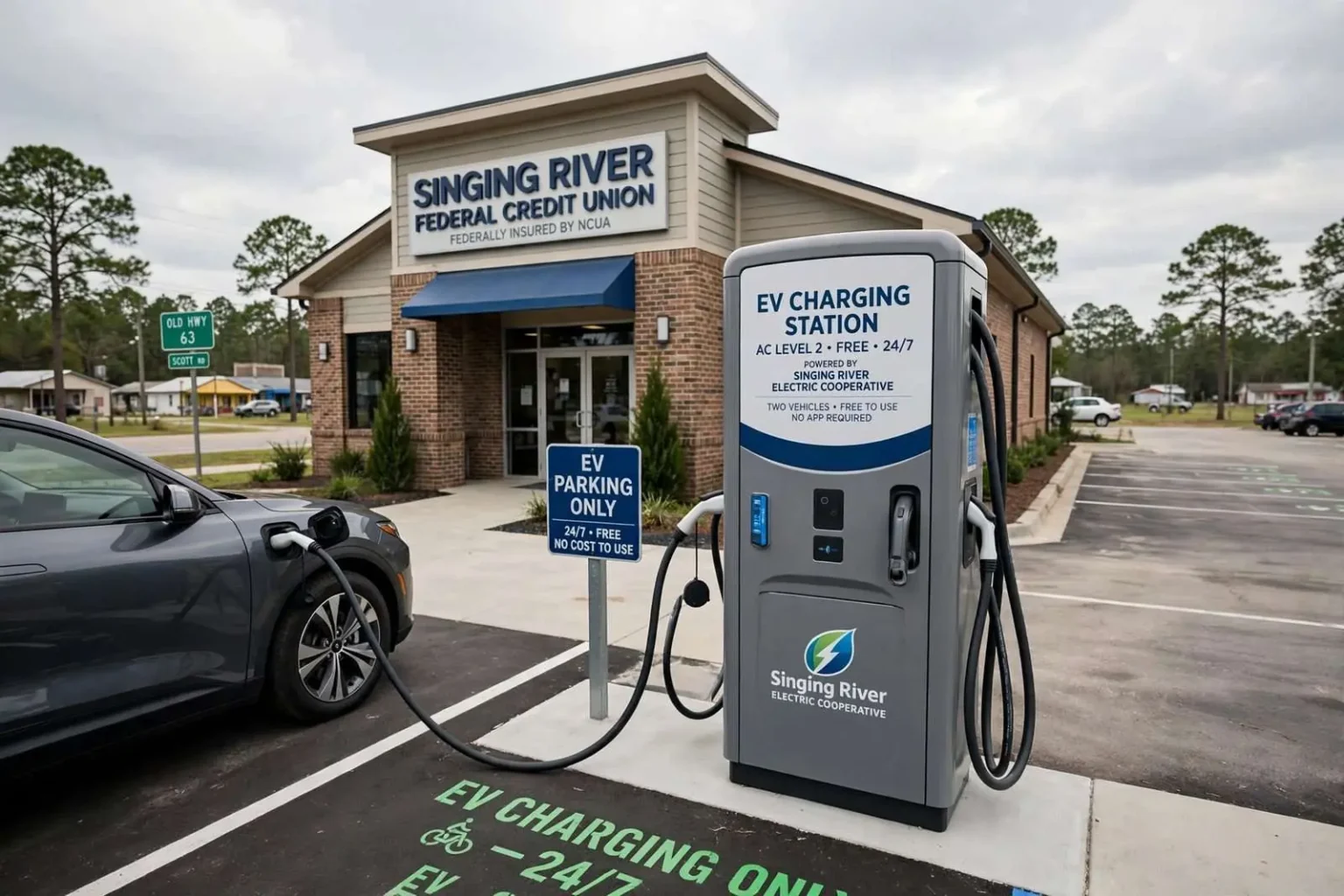
LUCEDALE, Miss. — Drivers in George County now have a new place to charge an electric vehicle without leaving town. A charging station has opened at the Singing River Federal Credit Union branch on Old Highway 63 and Scott Road in Lucedale, giving local EV owners and travelers passing through the county seat a reliable stop that did not exist here before. The unit is free to use, operates around the clock in the branch parking lot, and marks the first public charging point of any kind inside Lucedale city limits.
The installation is an AC Level 2 charger, the most common category of public charging equipment in the United States. Unlike the fast chargers found along interstate exits, a Level 2 unit draws standard alternating current and feeds it to the vehicle through the car’s onboard equipment, making the hardware far less expensive to buy and install. The Lucedale unit can power two vehicles at the same time, so two drivers can plug in side by side rather than waiting in line, and the credit union is offering use of it at no cost to drivers — a decision that makes the stop effectively the cheapest fueling option of any kind in George County.
The station is supported by Singing River Federal Credit Union and Electric Cooperative, the wholesale power provider for Singing River Electric and more than a dozen other electric cooperatives across the state. The pairing is a natural one for a member-owned financial institution: credit unions on the Gulf Coast have long positioned themselves as community anchors, and hosting a charging station in the branch lot puts a visible piece of new infrastructure where members already go each week. For the cooperative side, the project is part of a coordinated push to place chargers in the small towns its member systems serve, rather than concentrating equipment in the state’s largest cities.
Working with rural member systems
“We are working with our 11 member systems trying to put charging in areas that can help draw business to town,” said Sara Peterson, corporate communications manager for Electric Cooperative. “This is an opportunity to bring people into these rural areas and really get to experience the communities that we serve.”
That framing matters for a town like Lucedale. George County sits between the Mississippi Gulf Coast and the Pine Belt, along a stretch of south Mississippi where the nearest population centers are Hattiesburg to the northwest, Pascagoula and Moss Point to the south, and Mobile just across the state line. The county’s economy has historically been rooted in timber and small manufacturing, and like most rural counties in the region it has watched retail and services concentrate along the bigger highway corridors. A charging station by itself will not reverse that pattern, but it changes the calculus for electric-vehicle drivers deciding where to stop, shop and eat on a trip between the coast and Hattiesburg.
The math of a Level 2 charger also explains why placement matters. One hour of charging on the unit can add an estimated 10 to 20 miles of range, which is perfect for a driver sitting down to lunch in Lucedale or shopping at a store across town, but far too slow for a driver rushing between cities. That means the people who use it are likely to spend time — and money — in Lucedale while their vehicles charge, which is precisely the behavior Peterson described. For a town the size of Lucedale, even a handful of additional stops per day translates into a meaningful stream of customers for businesses along Highway 98 and Old Highway 63.
Filling a charging gap in south Mississippi
Until now, the nearest charging stations to Lucedale were in Mobile, Moss Point and Wiggins, according to the credit union. That put George County in the middle of a triangular gap of roughly 40 to 60 miles between public chargers — a gap big enough to make electric vehicle ownership impractical for many rural residents who could not count on charging at home and could not risk a detour when battery levels ran low. Range anxiety of that kind is one of the most frequently cited reasons rural buyers give for sticking with gasoline vehicles, and it is exactly the problem the cooperative’s program is designed to chip away at.
The free-use model also lowers another barrier. Public charging in larger markets is typically priced per kilowatt-hour or per minute, and drivers often need a smartphone app or membership card from a private charging network before a unit will even start. By making the Lucedale station free and easy to access, the credit union and Electric Cooperative have removed the payment friction entirely, which is a genuine advantage in a rural market where many drivers are encountering public charging for the first time.
A broader buildout is coming
The local project comes as Mississippi prepares to expand EV infrastructure more broadly. The state is set to receive about $50 million in federal funding over five years to build out an alternative fuel corridor, a program that directs money to states for charging installations along designated highway routes. Federal planners have described the goal in simple terms: eliminate the range-anxiety problem for long-distance travel by placing charging stations roughly every 50 miles along interstate highways, so that a driver in an electric vehicle can cross the country with the same confidence a gasoline driver has today.
The investment is part of a national effort of the same design, and Mississippi’s share reflects both the length of its interstate mileage and the federal commitment to making sure rural states are not left behind in the transition to electric transportation. For years, charging networks have followed population density, which meant the Northeast and the West Coast filled in first while large stretches of the Deep South remained sparse. Corridor funding is intended to correct that by subsidizing installations in the small towns and highway junctions that private companies would otherwise skip.
There are complications, though. State planners have warned that equipment shortages could slow construction, with transformers, charger components and electrical hardware all facing supply-chain delays that have stretched project timelines across the country. The warning matters for communities like Lucedale, because a delay that pushes a planned installation back a year or more can mean the difference between a town having charging available now or waiting out the transition on the sidelines. Building through existing partnerships — as the credit union and Electric Cooperative have done here — is one way to move faster than the grant cycle alone would allow.
What it means for George County drivers
For residents, the practical picture depends on how they drive. An EV owner in Lucedale who charges at home overnight now has a safety net for the days when an unplanned trip pushes past the battery’s range. A traveler between Mobile and Hattiesburg has a free stop in the middle of that stretch rather than pressing on to the coast or the Pine Belt with an eye on the gauge. And a visitor coming through town for a ballgame or a family gathering no longer has to rule Lucedale out because of the charger map.
The station also serves the growing number of fleet and business vehicles on the road. Electric pickups and delivery vehicles are increasingly common across south Mississippi, and commercial drivers plan their routes around available charging just as carefully as private motorists do. A free Level 2 stop in the county seat makes George County a more workable territory for those vehicles, which is the kind of quiet economic advantage rural counties compete for.
For the credit union, the project is also a statement about the role member-owned institutions can play in local development. Rather than waiting for a national charging network to add Lucedale to its map, two local institutions identified the gap themselves and filled it with equipment on their own property at their own expense. It is a model other small towns across the cooperative’s 11-member footprint will be watching as the statewide buildout continues.
“We just see it as a good service that is needed now but is going to be needed much more in the future,” Peterson said.
That expectation — that today’s trickle of EVs becomes tomorrow’s steady traffic — is what separates this project from a one-off convenience. The credit union and the cooperative have positioned Lucedale ahead of the curve at a moment when most towns its size still appear as dead zones on charging maps. As the state’s $50 million corridor buildout moves forward and more electric vehicles reach south Mississippi roads, the station on Old Highway 63 stands as both a working amenity for current EV drivers and an early sign of how rural communities intend to stay part of the region’s transportation future.