Inside the George County Courthouse Dome: A Century of Craftsmanship Gets New Life
Lucedale's 1911 George County Courthouse got a $689,000 dome and roof overhaul after Hurricane Zeta, revealing craftsmanship over a century old.
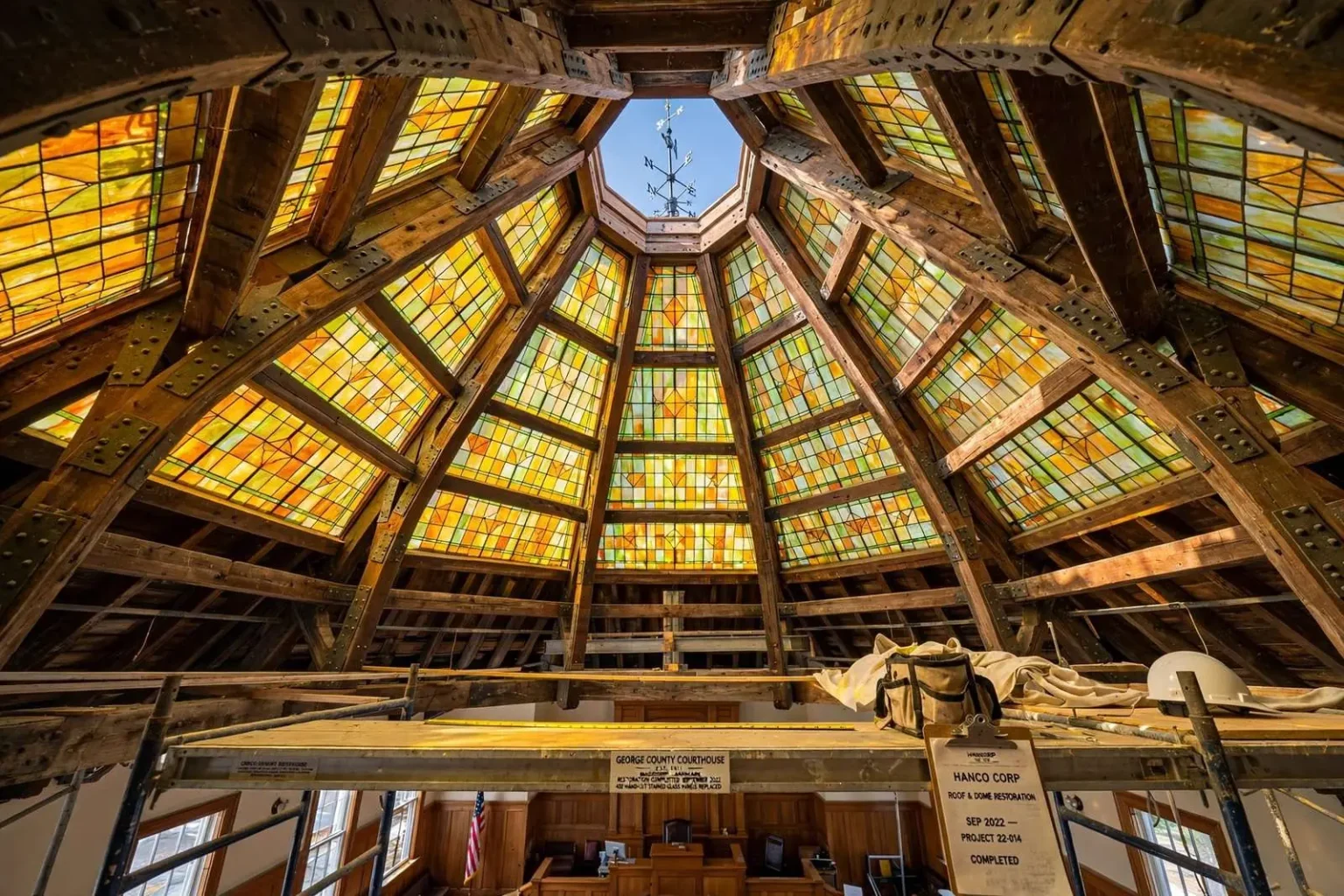
Repairs to the roof and dome of the historic George County Courthouse in Lucedale were nearly finished in September 2022, closing out a summer of work on one of the most recognizable buildings in south Mississippi. A look inside the structure, perched 30 feet above the courtroom below, revealed craftsmanship that has held up for more than a century, even as crews replaced nearly everything visible from the street outside.
The courthouse was built in 1911 for roughly $12,000, just one year after George County was founded. Over the following 111 years it weathered repeated storms and several rounds of renovation, surviving as the working center of county government while communities across the Pine Belt and the coastal counties rebuilt around it again and again. Few public buildings in the region have remained in continuous use for as long, and fewer still have kept their original form while doing it.
The list of past updates reads like a history of the region’s worst weather. Stained glass was added to the dome in the 1970s, giving the interior its signature warm light. Second-story brick and windows were repaired after Hurricane Katrina battered the area in 2005, when wind and debris damaged buildings across Lucedale and the surrounding county. The Spanish clay tiles at the very top of the structure were replaced in 2012, a project that preserved the roofline residents have known for generations.
Zeta Damage, Hand-Cut Glass
Hurricane Zeta in 2020 delivered the latest blow, blowing out window panes in the dome and damaging the roof and weather vane. The storm cut a path across southeast Louisiana and coastal Mississippi in late October of that year, and it prompted the latest round of repairs, which began in June 2022. Despite the visible damage, structural damage to the dome itself remained minimal, a testament to the building methods of 1911.
By the time work wound down, the full roof had been replaced while the dome was inspected, cleaned and repainted. All 432 stained glass panels were new, and each one was cut by hand, replicating the look that had topped the courthouse since the 1970s while giving the dome a fresh start against future storms. The scale of the glazing work alone set this project apart from routine roof repairs.
Hanco Corp. of Hattiesburg served as contractor on the $689,000 project, coordinating trades ranging from roofing to specialized glasswork on a building that could not simply be shut down. County offices and courtrooms stayed in use while crews worked overhead, a common challenge on courthouse restorations where the building must keep serving the public throughout construction.
Octagon Frame, Riveted Braces
Inside, the dome’s frame forms an octagon that tapers through progressively smaller octagons to its tip, built from wood more than 200 years old. The design steps inward as it rises, a construction approach that gives the structure its strength without the steel skeletons modern buildings rely on. Visitors who make the climb see geometry laid out in timber, every joint cut to fit by workers who learned their trade on job sites rather than in classrooms.
The original contractors fashioned the metal braces underneath with rivets, using no power tools and no modern scaffolding. Every connection was made by hand, with iron shaped and pinned the way structural workers did at the dawn of the twentieth century. That labor shows in what has survived: more than a century of Gulf Coast hurricanes, including some of the strongest storms ever recorded in the region, and the frame has never failed.
The dome spans most of the main courtroom, where a skylight once carried its light down to the proceedings below. Before air conditioning, clerks cracked windows downstairs and in the dome to pull a draft through the building, a simple trick of airflow that kept juries, lawyers and county clerks working through south Mississippi’s punishing summer humidity. The building was designed with its climate in mind long before mechanical systems made such considerations optional.
District 2 Supervisor Kelly Wright, who has overseen six rounds of updates since taking office in 2004, said he was amazed by what early craftsmen accomplished. “This thing has withstood every storm since 1911,” he said. For Wright and other members of the county’s governing board, the dome is both a working part of the courthouse and a measuring stick, since every modern repair is judged against work done with hand tools more than a hundred years ago.
A Landmark Under State Watch
Because the courthouse is a Mississippi Landmark, designated in 1989, every update must be approved by the state Department of Archives and History. The designation places the building among the most significant historic properties in the state and means decisions about materials, colors and methods are reviewed by preservation specialists in Jackson, not just by county officials. The process adds time to any project, but it also ensures the courthouse’s historic character is documented and protected through each round of work.
That oversight was on display during the earlier tile replacement as well. When the clay tiles were replaced in 2012, the work proceeded with an eye toward keeping the roof’s historic appearance intact, matching the profile and finish that had defined the building for decades. The 2022 project followed the same discipline, with the state agency reviewing plans before crews ever climbed onto the roof.
County leaders say the goal of each review cycle is to avoid the fate that has befallen historic courthouses elsewhere in Mississippi, where deferred maintenance forced expensive emergency repairs or, in some cases, the loss of original features entirely. By pairing local oversight with state review, George County has kept its dome structurally sound through four major hurricane strikes since 2005 while preserving the octagon frame, the riveted braces and the courtroom views that make the building worth protecting. The $689,000 investment of 2022 fits squarely into that pattern of steady, documented care rather than dramatic rescue.
For residents of George County, the courthouse dome is more than an architectural curiosity. It anchors the square in Lucedale, appears in local photographs and milestones, and serves as the backdrop for the county’s civic life, from property transactions to jury duty. Each repair cycle draws attention to just how unusual it is for a rural county of this size to retain its original courthouse in full working order.
The courthouse’s endurance also carries a practical lesson for county leaders weighing future maintenance. Roof systems, glazing and paint on a historic structure demand periodic attention, and the pattern of the last three decades shows a steady rhythm of assessment and repair rather than crisis-driven fixes.
Inside the dome, the cleanup also gave preservationists a rare extended look at details that had not been closely examined since the 1970s glazing went in. Crews documented the octagon frame, photographed the riveted brace connections, and confirmed that the 200-year-old timber remained sound from base to tip. Those records now sit with the county and the state archives, giving future contractors a precise baseline for whatever work the next storm demands.
Contractors familiar with courthouse work note that projects like this one differ from standard commercial roofing in nearly every phase. Access requires scaffolding and rigging around an active building, materials must often be custom fabricated to match historic profiles, and each stage of the job passes review before the next begins. The 432 hand-cut glass panels illustrate the point: no catalog order could supply them, so each panel was produced to fit its opening in the octagon above the courtroom.
The result, as the summer of 2022 ended, was a courthouse that looks much as it did when it opened but is better prepared for the storms ahead. The new roof system, the repainted and reglazed dome, and the repaired weather vane close out the damage Zeta left behind, while the 111-year-old frame underneath continues doing quietly what it has always done: holding everything up.
Preservation officials often point to courthouses like George County’s when explaining why landmark designations matter. A county courthouse is usually the oldest continuously used public building in a rural county, and it is the one structure nearly every resident has a reason to enter at some point, whether for a marriage license, a land record or jury service. Keeping the original building in service, rather than replacing it with new construction, preserves both the history and the daily habit of civic life around it.
George County, founded in 1910 and carved from neighboring counties in the rolling pine woods north of Pascagoula, has grown around its courthouse ever since. Lucedale, the county seat, remains a small city where the courthouse square still functions as the community’s front porch. The dome above it, now cleaned, repainted and reglazed, will mark its next anniversary the way it marked all the others: by simply being there, above the courtroom, letting the light in.