Mississippi Export Railroad marks 100 years connecting George County to the Port of Mobile
The Mississippi Export Railroad marked 100 years serving George County, shipping freight from Lucedale to the ports of Mobile and Pascagoula.
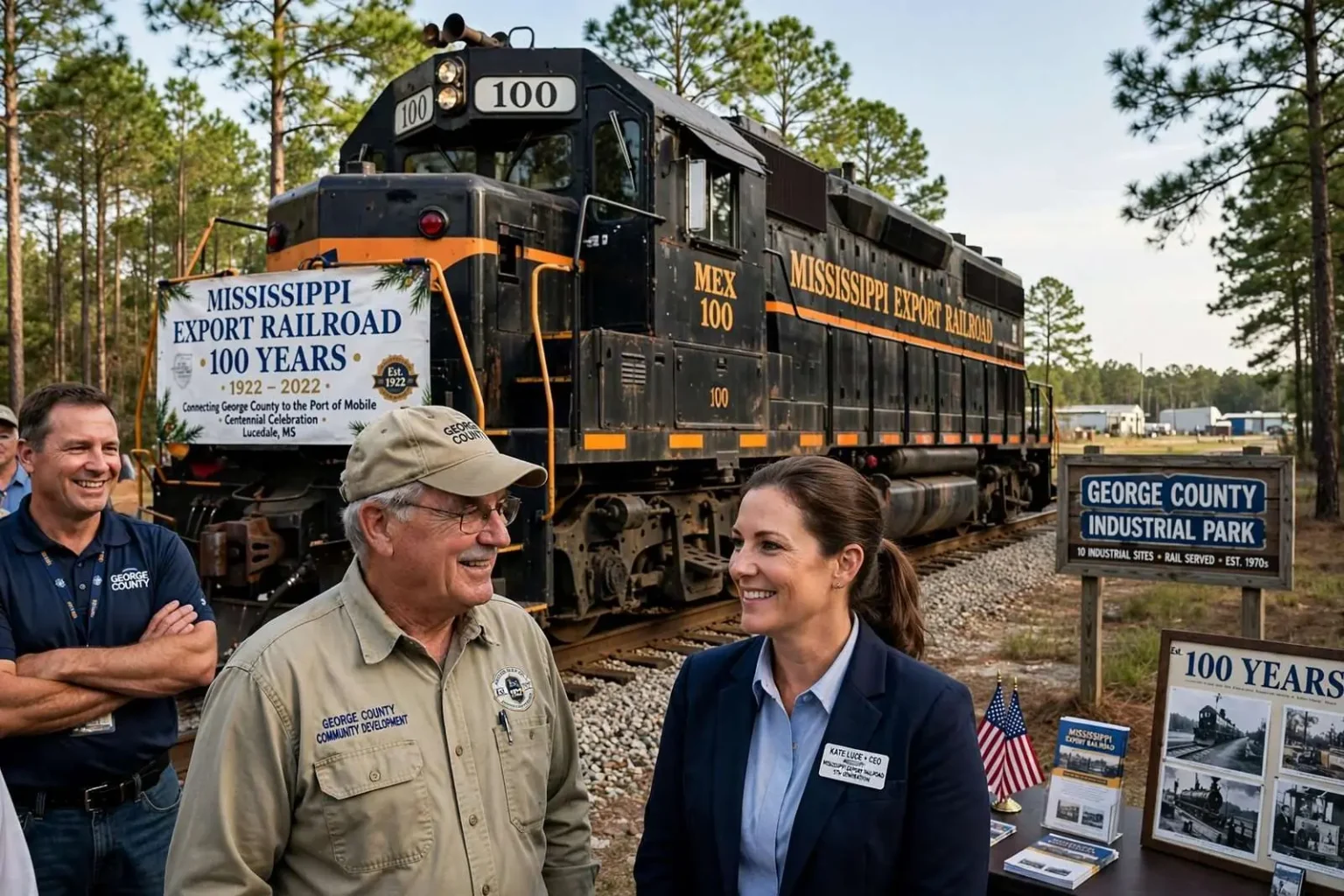
LUCEDALE, Miss. — Community leaders gathered in Lucedale on Thursday to mark the 100th anniversary of the Mississippi Export Railroad, founded in 1922 by Gregory Luce to serve his mill and lumber operations. A century later, the same shortline still runs through the pine belt of southeast Mississippi, connecting small towns and industrial sites to the deepwater ports that move the region’s products to the world. The centennial brought together company officials, county leaders and the families whose businesses have depended on the line across generations.
The railroad’s early decades tracked the evolution of the south Mississippi economy itself. By 1935, the railroad carried freight for cotton gins, bag and canning factories, naval stores, lumber mills and shipbuilding plants along a route from Lucedale to Pascagoula. Those industries rose and fell with the times, but the rail line remained the constant that let rural George County participate in markets far beyond its borders — first in naval stores and sawmill products, later in the diversified industrial freight that defines the line today.
A Fifth-Generation Operation
Today the 42-mile shortline runs through 10 industrial sites in George and Jackson counties, shipping products to the ports of Mobile and Pascagoula. That footprint makes the Mississippi Export Railroad a quiet but essential link in the logistics chain of the central Gulf Coast, feeding cargo to two of the busiest port systems on the northern Gulf. Shortline railroads like it handle the first and last miles of freight movement that big Class I railroads are not positioned to serve, gathering cars from rural customers and handing them to the larger carriers and ports.
“It’s a great place to do business. People want to work,” said Kate Luce, the company’s fifth-generation CEO. “We have terrific, smart, hard-working people here. The government is very business friendly and there are those real public-private partnerships.” Her comments tied the railroad’s longevity to the character of the communities along the line, where the Luce family name remains part of the local landscape a full century after the founder laid out the route from his mill.
Building the Industrial Park
The George County Industrial Park took shape in the 1970s through state, county and private collaboration. Tenants such as American Tank and Vessel, TriState Pole and Piling and Vulcan Materials now operate there, drawing on both rail service and highway access to move raw materials and finished products. The park became the model for how a rural county could attract industry: assemble land, extend utilities, and — critically — make sure a railroad spur could reach the sites.
Ken Flanagan, the county’s community development director, said the railroad’s early planners “really laid the foundation for what the industrial park is now.” His assessment reflects how development officials in George County view the line: not as a relic of the lumber era but as infrastructure that continues to determine what kind of employers the county can recruit. Companies weighing a location in rural south Mississippi look first at how freight will reach market, and the rail connection to Pascagoula and Mobile answers that question before it is asked.
From Sawmills to Wood Pellets
One recent expansion added 3,000 feet of county-owned rail to reach Enviva’s wood pellet plant, tying the railroad’s lumber roots to its current business. The extension brought a new generation of forest-products freight onto a line that was built a century ago to haul sawmill lumber. Enviva expects to move about 24 railcars of pellets a day to Pascagoula for shipment to Europe and Japan, a volume that would have been unimaginable to the railroad’s founders but that follows the same logic they worked from: get the region’s wood products to a port.
The wood pellet trade has become one of the most significant new freight flows on the Gulf Coast, with pellets produced from timber harvested across the Southeast loaded at Gulf ports for power plants and industrial customers overseas. For George County, the plant and its rail link mean steady daily traffic on the line and a durable anchor tenant in the industrial park. For the railroad, the expansion demonstrated the flexibility that has kept the company alive through a century of economic change — the commodity changes, but the direction of the freight, from the piney woods to the port, stays the same.
What the Line Means to George County
Lucedale leaders say the track also serves as a draw for future industry in the park. In rural economic development, a working railroad is among the scarcest assets a small county can offer, and recruiters can present sites that already have rail as ready-made for manufacturers who ship heavy or bulky goods. George County’s position between the Hattiesburg area and the Pascagoula coast places it along a corridor where industrial growth has been steady, and the rail line gives the county a claim on that growth that neighboring counties without rail service cannot match.
The centennial celebration also served as a reminder of how unusual the railroad’s continuity is. Shortlines across the country have been abandoned as industries closed and trucking took over short-haul freight, but the Mississippi Export Railroad survived by adapting its customer base — from cotton gins and naval stores to tank fabricators, piling manufacturers, aggregates and wood pellets. The route from Lucedale to Pascagoula remains the spine of that business, just as Gregory Luce planned it when he built the line to serve his mill in 1922.
As the company begins its second century, the questions facing it are the ones familiar to every shortline: maintaining track and equipment, competing for new industries and keeping the cost advantage of rail relevant against trucks. But the fundamentals that leaders celebrated on Thursday — a dedicated workforce, business-friendly local government and a port connection 42 miles long — are the same ones that carried the railroad through the Depression, the decline of the timber boom and every economic shift since. The freight has changed; the connection has not.
Rail and the Gulf Coast Ports
The two ports the railroad serves anchor its value. The Port of Pascagoula, at the mouth of the Pascagoula River, handles cargo ranging from forest products to project cargo for the shipbuilding industry, while the Port of Mobile across the state line ranks among the largest ports on the Gulf of Mexico and continues to expand with deepened channels and new terminal capacity. A shortline that can deliver freight to either port gives its customers flexibility that a single-destination line cannot, and it ties George County industry into the same global trade routes served by the region’s largest employers.
That dual-port access also reflects the geography of the Gulf Coast’s industrial corridor. Jackson County, which the railroad crosses on its way to Pascagoula, is home to shipbuilding, chemical and energy operations that generate their own freight demands, and the shortline’s interchanges allow local shippers to plug into the national rail network through connections at the coast. For cargo moving between south Mississippi and overseas markets, the trip by rail to the port is often the most economical leg of the journey, particularly for heavy commodities like pellets, aggregates and fabricated steel.
A Century of Local Partnership
The collaboration that built the industrial park in the 1970s set a pattern that continues today. The 3,000-foot county-owned rail extension to the Enviva plant shows the same formula at work: local government investing in infrastructure, a private company bringing jobs and production, and the railroad providing the connection that makes the project viable. Officials in Lucedale point to that history when they talk about future projects, noting that the partnership between the railroad and the county has outlasted the individual companies and industries that came and went along the line.
Rail officials and county planners alike note that the line’s anniversary arrives at a moment of momentum for shortline freight in the Southeast. Manufacturers seeking to avoid highway congestion and long-haul trucking costs have renewed interest in sites with direct rail service, and federal infrastructure programs have put new money behind track rehabilitation and grade-crossing improvements for small carriers. For a 42-mile railroad with a proven customer base and a fresh connection to the pellet trade, the centennial doubled as something of a sales pitch — a demonstration to prospective tenants that the county’s rail infrastructure is not just historic, but active and growing.
For the Luce family, the milestone was a chance to reflect on how a mill railroad became a regional freight lifeline. The company founded in 1922 to serve one man’s lumber operations now serves ten industrial sites and two ports, run by the founder’s descendants and employing people from the same communities the line was built through. Kate Luce’s remarks about hard-working people and public-private partnerships could as easily have described the railroad’s first decades as its current ones, and the centennial audience of local leaders appeared to take the point: the line’s second century will depend on the same collaboration that carried it through the first.