Mississippi Gulf Coast Animal Shelters Face Too Many Animals and Too Few Workers
Mississippi Gulf Coast animal shelters face overcrowding and staffing shortages, with Jackson County weighing euthanasia of adoptable dogs.
Animal shelters across the Mississippi Gulf Coast are grappling with a difficult combination: more animals coming in than they can house, and not enough staffers or volunteers to care for them. The squeeze has been building across the region for months, and at two of the Coast’s busiest facilities it has now reached a point where leaders are openly warning about the consequences of running out of room. What was once a seasonal ebb and flow of intakes has hardened into a sustained crisis that touches every corner of shelter operations, from the kennel floor to the front office.
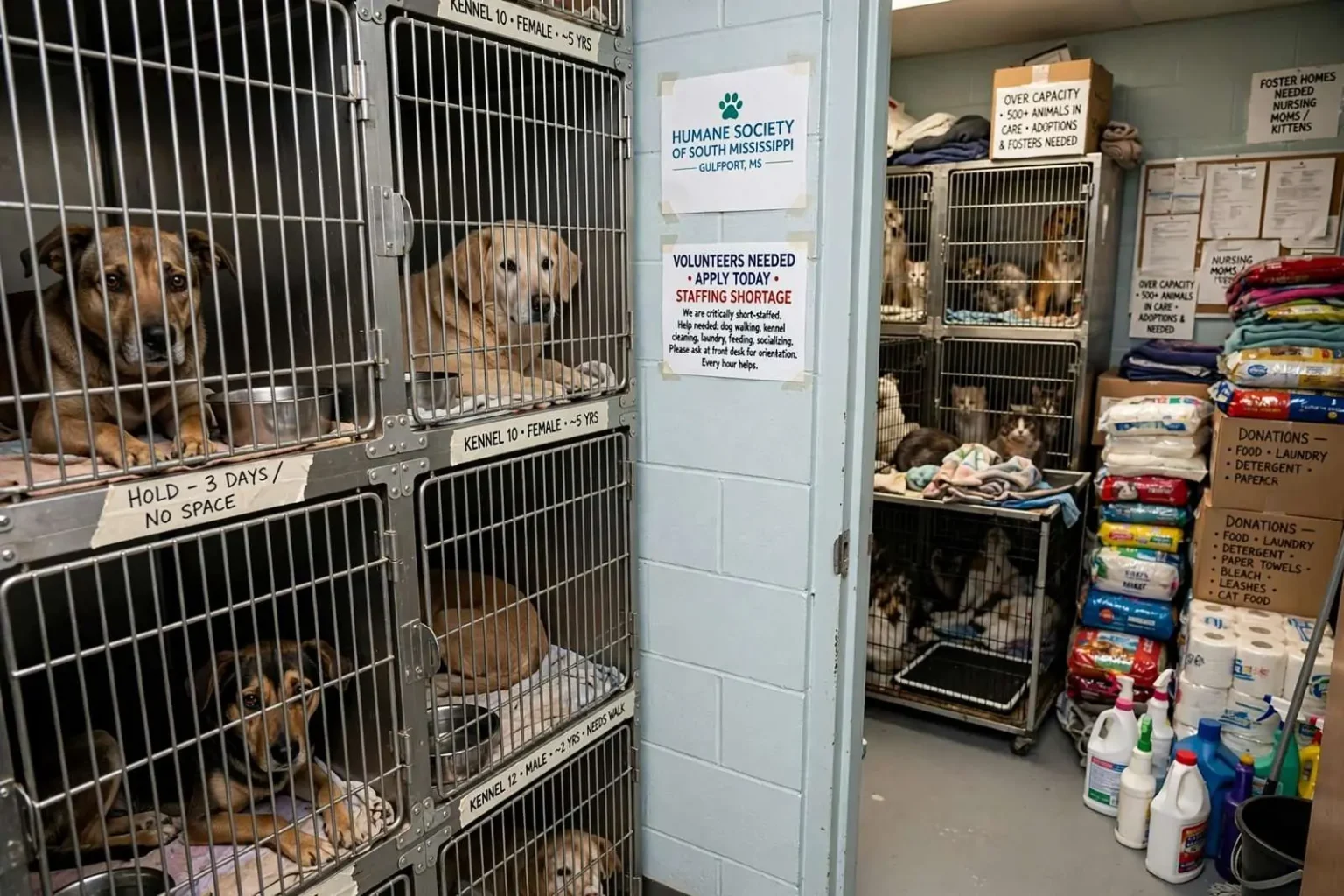
The clearest example sits in Gulfport, where the Humane Society of South Mississippi has been working to absorb wave after wave of new arrivals. The organization, long one of the largest animal welfare operations on the Mississippi Coast, had roughly 500 animals in its care recently — more than the shelter could handle as designed. Kennels are stacked on top of one another in hallways and intake areas, holding dogs of every age, size and breed, and staff members have had to get creative simply to find a safe place for each animal to sleep each night. Cats crowd into whatever overflow space can be converted, from meeting rooms to portable enclosures set up wherever there is floor space.
“It’s a capacity crisis,” said Katie King, the shelter’s development director. The phrase captures what shelter workers across the region describe as the new normal: intake numbers that outpace adoptions week after week, leaving little breathing room for the animals already in the building and none at all for emergencies such as a hoarding case or a storm-related intake surge.
A labor market that will not cooperate
Like many organizations along the Coast, the Humane Society has struggled to fill job openings in a tight labor market. Animal care work is demanding both physically and emotionally, and the wages shelters can offer rarely compete with other employers in the region that are also short-handed and raising pay to attract workers. Positions that would normally be filled quickly can sit vacant for weeks, leaving existing staff to cover longer shifts and heavier workloads while the intake desk keeps ringing.
The shortage extends well beyond paid positions. Volunteers have historically padded the gap between what shelters can afford and what hundreds of animals actually need — walking dogs, scrubbing kennels, socializing cats, photographing adoptable pets and helping at weekend adoption events. When volunteer ranks thin out, that gap widens quickly, and the daily grind of feeding, cleaning and medicating falls on fewer and fewer shoulders.
The consequences are practical and immediate. Fewer hands mean fewer walks, slower kennel turnover, longer waits for animals to be photographed and listed online, and less of the one-on-one handling that keeps shelter dogs from deteriorating emotionally behind bars. Shelter leaders say even modest gains in staffing or volunteer turnout translate directly into cleaner kennels, better-behaved animals and faster adoptions, which is why the public appeals have been so persistent.
Jackson County runs short of runway
The squeeze is similar at the Jackson County Animal Shelter, where staff have been forced to consider euthanizing healthy, adoptable dogs to make room. That outcome is one municipal shelters normally work hard to avoid, and leaders there have been unusually direct about how close the facility has come to crossing that line.
When the shelter reaches capacity, it can already euthanize animals deemed unadoptable because of aggression or illness too severe for its veterinarians to treat. That has long been the grim arithmetic of public sheltering: kennel space is finite, and animals that cannot be placed for serious behavioral or medical reasons are the ones that make way for new arrivals. Under ordinary conditions, that category is large enough that adoptable animals are rarely the ones at risk.
“But we are running short on animals that are not adoptable and we are fearful that we will have to do some that are to make space,” shelter director Joseph Barlow said. His warning points to what makes the current crunch so unusual: the category of animals shelters have traditionally relied on to free up space — those that cannot safely be adopted — has itself run thin, leaving healthy, adoptable dogs exposed purely because there is nowhere left to put them.
Barlow’s remarks underscore how badly the normal flow has backed up. Shelters plan around a predictable cycle: animals come in, some are reclaimed by owners, some are adopted, some are transferred to rescue partners, and some are euthanized for grave medical or behavioral reasons. When adoptions slow while intakes keep rising, that cycle jams, and the backlog has to go somewhere — usually into hallways, overflow kennels and, eventually, into the hardest decisions a shelter staff can face.
Why intake keeps climbing
Shelter workers along the Coast point to a familiar set of pressures driving the numbers upward. Economic strain is a recurring factor: when families lose housing or face a tight month, pets are among the first casualties, and surrendered animals arrive at the intake desk with little warning. Rental housing that restricts or prohibits pets adds another layer, forcing owners who move to give up animals they would otherwise keep.
Unaltered pets compound the problem. Litters born to animals that were never spayed or neutered often end up at shelter doors within months, and each unaltered animal that leaves a shelter without a fix-it plan can quietly generate the next wave of intakes. Regional spay-and-neuter programs exist across the Coast, but demand for low-cost appointments routinely outstrips the slots available.
Stray populations add steady pressure as well. Dogs and cats running loose along rural roads in Jackson County and the neighborhoods around Gulfport are picked up by animal control or Good Samaritans and brought in, and many are never reclaimed. Every stray that arrives unclaimed occupies a kennel that would otherwise be available for a surrendered pet or a transfer from an overcrowded partner shelter.
Seasonal patterns make the peaks worse. Warm months along the Gulf Coast bring what shelter workers call kitten season, when litters arrive in waves, and the same stretch of calendar brings more community events, more visitors, and more animals out and about — which means more loose animals, more accidental litters and more intakes landing at exactly the time when facilities have the least room to absorb them.
What the shelters are asking for
Both shelters put out calls for volunteers as well as donations of cleaning supplies, food, treats and other items. The requests are deliberately practical: laundry detergent, bleach, dish soap, paper towels, hoses and spray nozzles, sturdy leashes and collars, and unopened bags or cans of dog and cat food all go straight onto the kennel floor, where they offset costs the organizations would otherwise pay out of tight operating budgets.
Volunteer help is valued for the same reason. An afternoon spent walking dogs or folding laundry does work that would otherwise consume paid staff time, and every hour a volunteer contributes is an hour a technician can spend on adoptions, medical care or intake processing. Shelters typically orient new volunteers quickly and let them start on low-barrier tasks, so the barrier to entry is far lower than most residents assume.
Adoption as the pressure valve
For residents considering a pet, shelter leaders say adoption is the single most useful step a member of the public can take. Every dog or cat that leaves through an adoption frees a kennel, shortens the wait for the next animal in line, and gives the care team a little more slack. Adopters along the Coast can browse available animals online before visiting, and staff at both shelters can match families to animals whose temperament and energy level fit their households.
Fostering offers a middle path for people who cannot make a permanent commitment. A foster home takes one animal — often a nursing mother with puppies, a heartworm-positive dog in treatment, or a shy cat that struggles in a kennel environment — and houses it for weeks or months until it is ready for adoption. Each foster placement opens a kennel at the shelter and gives the animal a calmer setting in which to recover and show its true personality to potential adopters.
Prevention matters just as much on the back end. Keeping identification tags current and microchips registered dramatically raises the odds that a lost pet is reclaimed rather than adopted out, which in turn keeps a kennel open. Spaying and neutering cuts off the flow of accidental litters before it starts, and residents who find a stray are urged to hold or network the animal for a few days before assuming no owner is looking — many lost pets are reunited within hours of a social media post.
Local rescue groups and transport partners also play a role in easing the crush. When a shelter can move a healthy, adoptable animal to a rescue with space or to a partner organization in another region where adoptable dogs are in shorter supply, it buys breathing room for the animals still waiting in the building. Those transfers depend on volunteers who can drive and on rescue partners with open slots, both of which are themselves stretched thin during periods of high intake.
What comes next for the Coast’s shelters
For now, the immediate math is unchanged: hundreds of animals need care every day, and the people and supplies to care for them remain in short supply. Shelter directors say the appeals for adopters, volunteers and donations will continue for the foreseeable future, and they are asking residents who cannot adopt to consider sharing adoption listings with friends and family who might be in the market for a pet.
The alternative is the outcome Barlow and his counterparts are working hardest to avoid — a shelter so full that healthy, adoptable animals are euthanized not for anything they have done, but for a lack of space. Shelters across the Mississippi Gulf Coast have managed through difficult stretches before, but they have rarely done so without the community stepping up alongside them.
Residents who want to help can contact the Humane Society of South Mississippi in Gulfport or the Jackson County Animal Shelter directly to ask about current volunteer orientations and donation drop-off hours. Both organizations have stressed that help does not have to be large or long-term to matter: a single bag of dog food, a single Saturday shift, or a single adoption can be the difference between a kennel that opens up and one that does not.