Escambia County Opens New ADA-Accessible Kayak and Canoe Launch at Perdido Bay Park
Escambia County has added a free, ADA-accessible kayak, canoe and paddleboard launch at Perdido Bay Park and Boat Ramp on Lillian Highway.
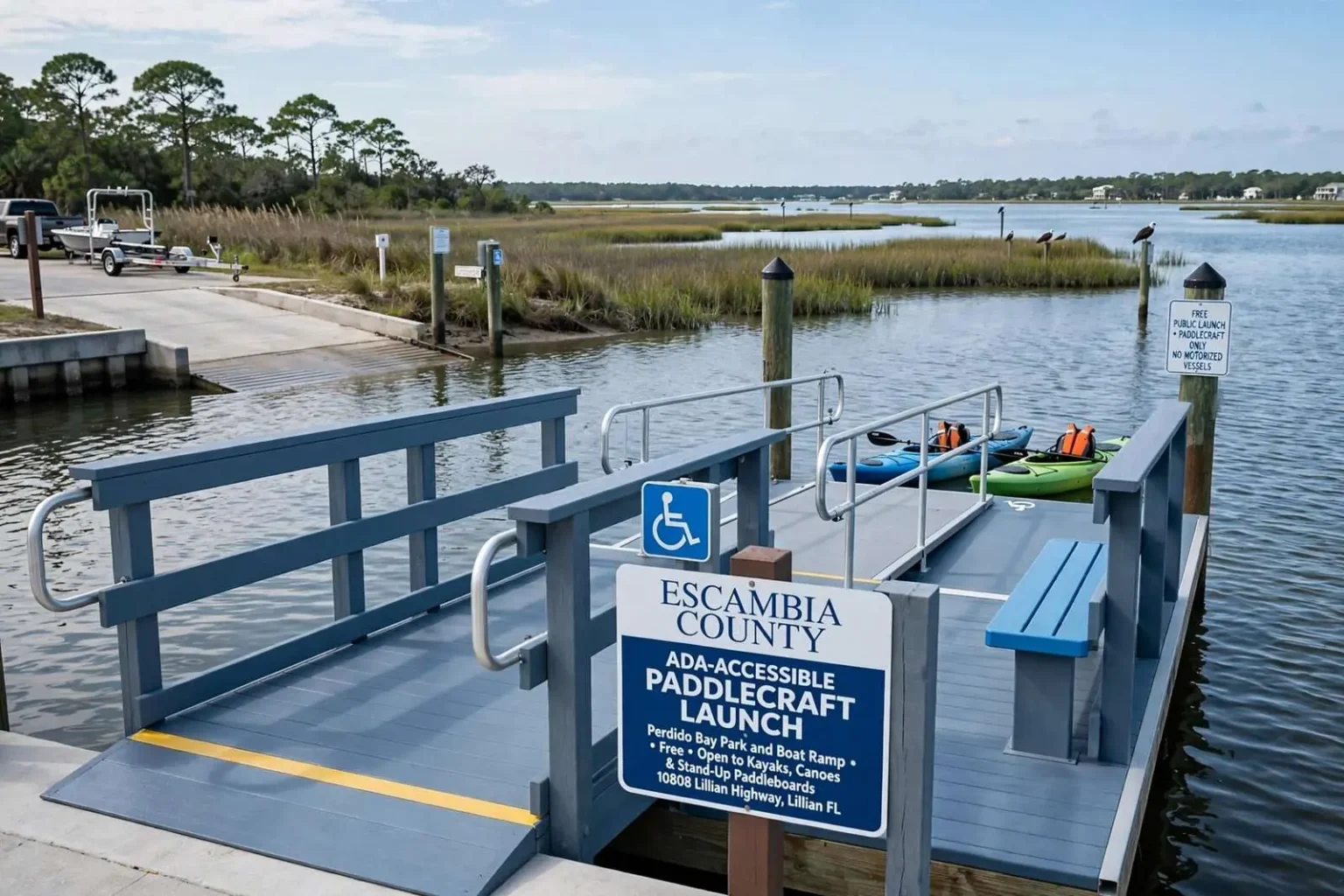
Escambia County has unveiled a new paddlecraft launch at Perdido Bay Park and Boat Ramp, giving kayakers, canoeists and paddleboarders an easier way to get on the water along Perdido Bay. The addition converts what was previously a motorboat-centric ramp area into a full-service water access point, answering a demand that has grown as paddling has surged across the Gulf Coast.
The launch is free to use and was built to accommodate a range of small, human-powered watercraft, including kayaks, canoes and stand-up paddleboards. Rather than sending paddlers down the same concrete ramp used by fishing boats and ski craft, the dedicated launch gives them their own entry point — safer for them, and easier for boaters backing trailers at the same time.
Built for Accessibility From the Ground Up
County officials designed the structure to be ADA accessible, making it one of the few paddlecraft entry points in the area open to visitors with mobility limitations. Standard kayak launches assume the user can step down into a boat from a dock or rock hop from a shoreline, which excludes many older paddlers and people with disabilities. Accessible launch designs use transfer benches, graded entries, and stable boarding platforms so that a paddler can move from a wheelchair into a kayak or canoe with dignity and safety — or simply get to the water’s edge to fish or launch a paddleboard.
Accessibility features of this kind remain rare along the Alabama and Florida coasts, where most public launches date from an era when paddlecraft were an afterthought. Escambia County’s decision to build the new launch to accessible standards from the start makes the Perdido Bay site a destination for paddlers who have few other options, including veterans’ kayaking programs, adaptive sports groups, and older residents who gave up paddling when launches became too difficult to manage.
Perdido Bay’s Waters
The new launch sits alongside the park’s existing boat ramp, allowing paddlers to park and access the water in the same general area as motorized boat traffic. Perdido Bay itself is one of the Gulf Coast’s most storied bodies of water, stretching along the Alabama-Florida line where the Perdido River system drains toward the Gulf. Its shallows, marsh edges, and tidal creeks make it productive paddling water: anglers work the grass flats for speckled trout and redfish, birders follow the herons and ospreys along the shoreline, and recreational paddlers loop the coves that motorboats rarely reach.
The bay’s western shore in Alabama and its eastern shore in Florida frame a waterway that has long anchored life in the communities around it, from the historic mill and fishing settlements to today’s residential corridors. Public access points, however, have been unevenly distributed — a gap the county’s new launch addresses directly.
What the Launch Adds to the Park
Perdido Bay Park is located at 10808 Lillian Highway, along the Alabama-Florida state line near Lillian and Innerarity Point. The park has long served as the area’s practical water access point, with the boat ramp handling the trailer traffic that comes with the bay’s fishing reputation. The paddlecraft launch now sits alongside that ramp, letting a family with kayaks and a neighbor with a fishing boat share the same parking area and water access without getting in each other’s way.
Lillian Highway runs through one of the fastest-growing corridors of unincorporated Escambia County, connecting Pensacola’s western suburbs to the waterfront communities at the state line. As the population along the route has grown, so has the pressure on the park’s facilities — and the county’s investment in the new launch reflects a management approach that treats paddlers as a core user group rather than an occasional visitor.
The Growing Push for Paddlecraft Access
Across the Gulf Coast, communities have been retrofitting and building paddlecraft launches as kayaking and paddleboarding have grown into mainstream recreation. Sales of kayaks have climbed for years, rental outfits have appeared along bays and rivers from Mobile Bay to Pensacola, and paddling clubs organize outings where bass boats once ruled. The bottleneck is access: a paddler needs a safe place to park, unload, and enter the water, and shoreline along popular bays is often privately held or designed exclusively for trailered boats.
A dedicated, free launch solves that equation for local residents. It also opens the water to visitors — tourists staying along Perdido Bay or passing between Pensacola and the Alabama beach communities — who might otherwise drive past without a place to put in. For a bay whose flats and marshes reward quiet, shallow-draft exploration, accessible entry points translate directly into use.
Free Access, Low Cost, Wide Benefits
The addition is expected to give area residents and visitors another low-cost option for enjoying Perdido Bay, which has long been popular for fishing, boating and other water recreation along the Gulf Coast. Free access matters in a region where boat ramps and park amenities are increasingly funded by user fees, and where a family’s day on the water can otherwise carry a price tag before anyone casts a line. For paddlers, whose equipment costs run from a few hundred dollars for a basic kayak to little more than a swimsuit for a paddleboard, a free launch keeps the barrier to entry where it belongs.
The economic logic for the county is straightforward as well. Water access points draw visitors who buy fuel, bait, and groceries in nearby communities, and they raise the appeal of the residential corridors around them. An accessible launch multiplies that draw by adding users — paddlers with disabilities, older adults, and adaptive programs — whom conventional ramps never served.
Paddling Perdido Bay Safely
Paddlers new to the bay should keep its character in mind. Perdido Bay is open water with a wind fetch that can build a chop quickly when the breeze turns onshore, and its channels carry genuine boat traffic from the ramp the new launch shares. Life jackets, visibility flags for paddleboards, and an eye on the forecast are the standard precautions local paddlers preach. Early mornings and evenings offer the calmest water and the best wildlife viewing, when the bay’s dolphins, wading birds, and jumping mullet are most active.
From the launch, paddlers can explore the marsh edges and coves along both shores, fish the grass flats that make the bay a favorite of light-tackle anglers, or simply drift with the tide on a summer evening. The variety of water within a short paddle of the ramp is the bay’s quiet advantage — and now, with an ADA-accessible, free launch at Perdido Bay Park and Boat Ramp, that variety is open to nearly everyone who wants to reach it.
Escambia County’s Park Investments
The new launch fits into a broader pattern of Escambia County investment in its park and boat ramp network, which stretches from the Perdido River east to the Pensacola Bay system. County crews maintain ramps, piers, and parks that serve both the local population and the visitor traffic that flows through the Panhandle each year, and paddlecraft access has moved up the priority list as demand has grown. Perdido Bay Park’s upgrade puts the county alongside the growing number of Gulf Coast governments treating paddle launches as basic public infrastructure — the way boat ramps were treated a generation ago.
The location amplifies the value. Waterfront land suitable for public access is scarce along the bay, where residential development lines much of the shore, and a park that already owned ramp parking and water frontage was the natural site for the addition. By building there rather than hunting for a new parcel, the county delivered the launch at a fraction of the cost of a standalone facility — and put it where users already go.
Exploring the Lillian and Innerarity Point Shoreline
Paddlers launching from the park sit minutes from some of the most interesting shoreline on the bay. Innerarity Point, at the tip of the peninsula toward the state line, offers views across the intracoastal passage, and the marsh fringes nearby hold the wading birds, jumping fish, and quiet coves that make bay paddling rewarding. To the north, the bay opens toward the Perdido River delta, where the water narrows into a labyrinth of marsh and the influence of the river itself becomes visible in the darker, tannin-stained water.
Fishermen launching kayaks and canoes work the same waters trailered boats reach, with the advantage of silence and shallow draft — sliding over flats where a propeller would spook everything in sight. For photographers and birders, the launch turns a morning tide into a moving gallery of herons, pelicans, and ospreys. All of it, now, begins at a free, accessible launch on Lillian Highway — the kind of modest public investment that quietly multiplies the ways a community can use the water in its own backyard.