Escape of convicted killer from Mississippi prison prompts warning about giving rides to strangers
The escape of convicted killer Michael Wilson from a Mississippi prison prompted a warning about giving rides to strangers after he traveled 70 miles.
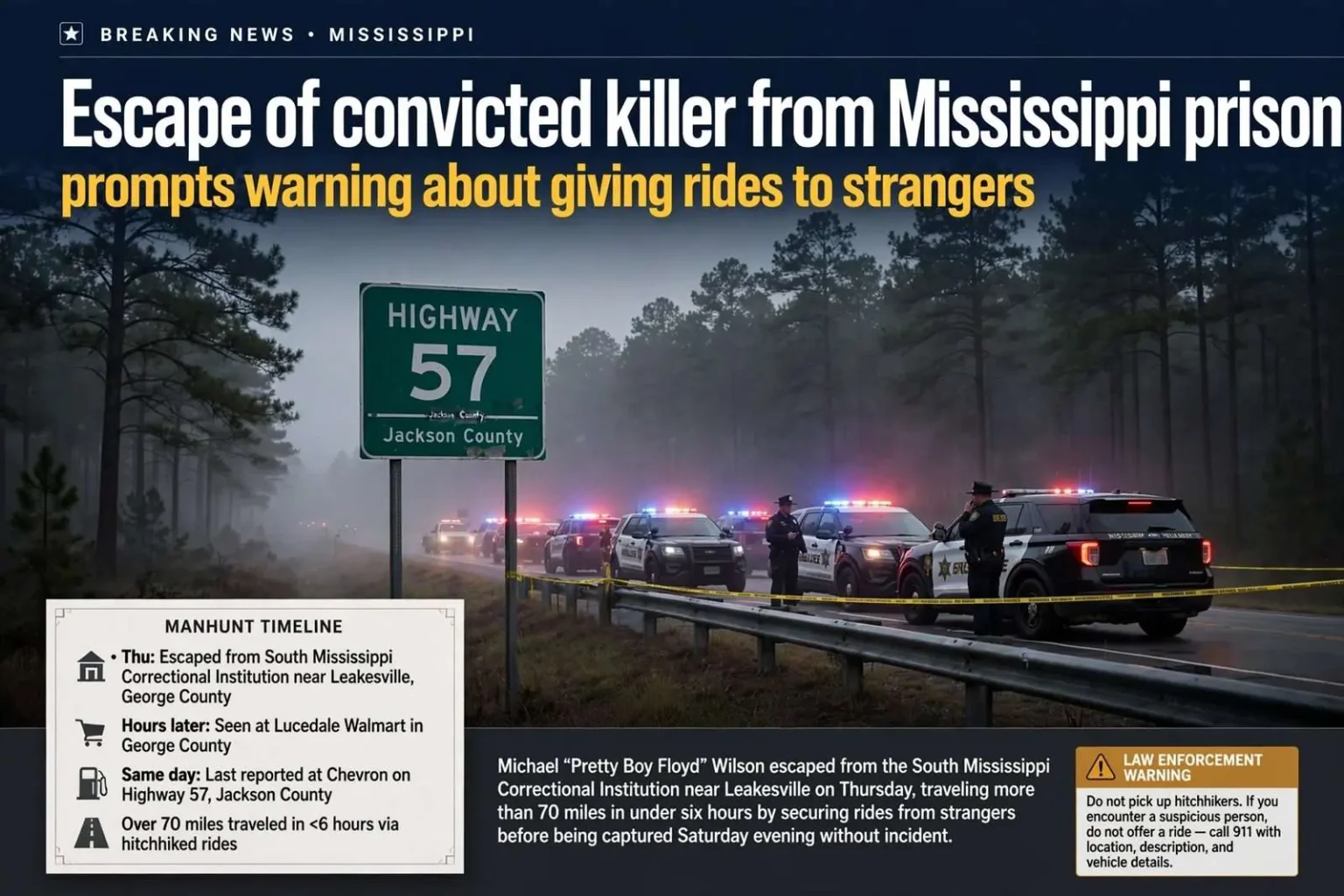
An escaped convicted killer traveled more than 70 miles in less than six hours by persuading strangers to give him rides, prompting a warning from authorities about picking up hitchhikers. Michael “Pretty Boy Floyd” Wilson escaped from the South Mississippi Correctional Institution on Thursday, according to authorities, and the speed of his movement across two counties showed how far a fugitive can get simply by blending in on the roadside.
Wilson was seen at the Lucedale Walmart a few hours after the escape and was last reported at a Chevron on Highway 57 in Jackson County. Deputies searched the area by air and on foot Friday morning as the manhunt concentrated on the corridors between the prison and the coast. Authorities said several people gave Wilson a ride without knowing they were helping a convicted killer flee, which is precisely the danger law enforcement officials were warning the public about as the search stretched on.
The prison and its surroundings
The South Mississippi Correctional Institution sits near Leakesville in George County, one of the state’s major correctional facilities and a fixture of the rural landscape along Highway 63. The area around the prison is thick with pine forest, and the county roads run for miles between scattered houses, churches and small businesses. It is the kind of terrain where a person on foot can move a long way without being seen, and also the kind where strangers stand out, which is why authorities believe Wilson relied on rides rather than trying to walk the distance himself.
Lucedale, the George County seat, lies south of the prison and is the first real town a fugitive would reach heading that direction. A sighting at the Walmart there placed Wilson in town within hours of the escape, moving through one of the busiest commercial spots in the county. From Lucedale, the routes south and east lead toward Jackson County and Highway 57, the corridor where he was last reported before the trail went quiet.
How the search unfolded
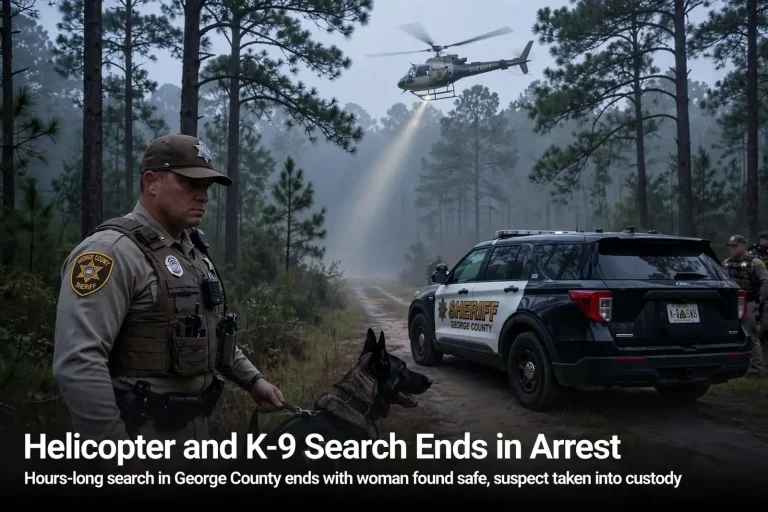
The search brought together multiple agencies, with deputies from the surrounding counties joined by state authorities and aviation support. Aerial searches cover ground that ground units would take days to clear, particularly in the pine plantations and creek bottoms that dominate the landscape between George and Jackson counties. Ground teams worked the roads, driveways and businesses along the reported sightings, and investigators tracked down everyone who had contact with Wilson to build a timeline of his movements.
Friday morning’s air and foot search around the Highway 57 Chevron marked the last publicly known location, and it came roughly a day after the escape. For residents along the route, the manhunt was disruptive and unsettling: school districts weigh closures or lockdowns when an escapee is reported nearby, deputies go door to door with warnings, and every slow-moving vehicle or unfamiliar walker in the area draws a 911 call. That flood of tips is useful to investigators, but it also stretches resources as every sighting has to be checked.
The hitchhiking warning
The most striking detail in the case was how Wilson moved. More than 70 miles in under six hours is average highway speed, and authorities said he covered that distance by persuading strangers that he needed help. Every one of those drivers learned afterward that they had unknowingly ferried an escaped murderer past roadblocks and patrols, and none of them was able to recognize the danger sitting in their passenger seat.
That outcome is why officials urged the public to use caution when offering rides to strangers. The advice sounds harsh in rural communities where picking up a stranded motorist is a long tradition, but correctional agencies have repeated the same warning after escapes across the country: an escaped inmate’s first goal is distance, and a sympathetic driver is the fastest vehicle available. The guidance is practical rather than paranoid. Note the details, call law enforcement, and let trained officers decide whether the person on the roadside is genuinely stranded or looking for a getaway.
Life in a rural county during a manhunt
For the residents of George and Jackson counties, the days after an escape carry a tension that city dwellers rarely experience. News travels fast in small communities, and within hours of the alert nearly everyone in the area knew the escapee’s name, photograph and nickname. Deputies asked residents to lock homes and vehicles, secure firearms, and report anything unusual, and the familiar rhythms of a rural week, from school runs to feed store visits, took on a watchful quality as the search continued through the weekend.
Businesses along the escape corridor were drawn directly into the investigation. Stores near the sightings reviewed security footage, clerks were interviewed about anyone matching the description, and parking lots became places deputies canvassed. In a case like this, the timeline is assembled from exactly those fragments: a camera here, a witness there, a receipt with a timestamp. Each confirmed sighting narrows the search area, and each gap in the timeline forces investigators to widen it again.
How escapes are investigated
An escape from a state prison triggers a response that goes well beyond the local sheriff. The correctional system’s own investigators work to determine how the escape happened, whether it involved outside help, and whether the inmate had assistance from staff or visitors. Those questions run on a separate track from the manhunt, but their answers shape it, because a fugitive with outside support moves differently from one who is improvising with cash, a stolen phone and luck.
Investigators also map an escapee’s known associations. Family members, friends, old addresses and past haunts are checked in the first hours, because statistically many fugitives eventually reach for people they know. In Wilson’s case, the early pattern suggested something different: movement through public places, reliance on strangers, and no confirmed contact with acquaintances as he worked his way toward the coast. That kind of improvisation is harder to predict and harder to intercept, which is one reason the search lasted into the weekend.
The capture
By Saturday evening, Wilson had been captured without incident, authorities said. The word “without incident” matters in escape cases: a peaceful end to a manhunt for a convicted killer means no hostages, no shootout on a rural road and no injuries to the deputies who made the arrest. Captures like this one usually come down to a tip that checks out, an officer who recognized the face, or the fugitive simply running out of room as the search perimeter tightened.
An escape also restarts the clock on the inmate’s sentence. Under Mississippi law, escaping custody brings additional charges and additional time, so a man who already had years to serve faces more of them for the attempt. Prosecutors in the county where the escape occurred typically handle the new charges, and the investigation into how the escape was accomplished can lead to further consequences inside the correctional system, including for anyone who aided it.
What residents should take from the case
The episode ends with a set of lessons that law enforcement hopes outlast the news cycle. If a stranger asks for a ride, it is reasonable to stay in your vehicle, offer to call someone for them, or direct them to a business where help is available. If someone seems suspicious, a description, a direction of travel and a license plate called in to dispatch can break a case wide open, as the timeline in this manhunt was built almost entirely from citizens’ reports of where Wilson had been seen.
The case also illustrated how quickly modern manhunts mobilize. Within a day of the escape, authorities had sightings tracked across two counties, aircraft in the air and a public alert system pushing the fugitive’s photo to phones across the region. That speed is deliberate, because the first six hours of any escape are when the fugitive is most exposed, moving on foot or by luck through communities where almost anyone who sees him could call it in. In this case, despite Wilson’s 70-mile head start, the system caught up with him by Saturday evening, and the residents who gave a killer a ride can consider what they learned the hard way so that their neighbors never have to.
Escapes along the Gulf Coast corridor
South Mississippi’s prison system sits in a region where escape routes run in predictable directions: south toward the coast, west toward Hattiesburg, or east toward the state line and Mobile’s large population centers. Law enforcement agencies along those routes, including sheriffs’ offices in George, Jackson and Greene counties and their counterparts across the line in Alabama, coordinate on manhunts because a fugitive does not respect jurisdictional lines. An alert that starts in Leakesville can have patrol officers checking truck stops on Alabama’s coastal highways within the same shift.
The geography explains both the risk and the reassurance. Pine forests and swampy creek bottoms give a fugitive places to hide, but the road network funnels movement through a limited number of highways, bridges and crossings, all of which can be watched. In this case, Wilson’s reported path followed exactly that funnel, from the prison through Lucedale and down the Highway 57 corridor toward Jackson County, which is where the search concentrated and where the net eventually closed.
After the manhunt ends
Once a fugitive is returned to custody, the visible part of the story ends, but the follow-up continues for months. Investigators complete their review of how the escape occurred, the district attorney decides how to charge it, and the correctional department examines its procedures for whatever weaknesses the case revealed. Communities along the escape route are left with their own aftereffects, from restored confidence in the agencies that closed the case to lingering conversations at dinner tables about the strangers stopped on the roadside.
The drivers who unknowingly assisted Wilson were, by every account, simply being helpful to someone who appeared to need it. That is worth remembering as the warning is repeated: officials are not asking residents to abandon decency toward people in trouble, only to route that decency through a phone call instead of an open passenger door. A stranded traveler who gets a ride to a gas station loses a few minutes; a manhunt that ends safely costs a region two anxious days and leaves everyone a little wiser about who might be standing at the edge of the road.