Fairhope Author Terry Cline Channels the Sleeping Prophet in The Return of Edgar Cayce
Fairhope author Terry Cline answers questions as the Sleeping Prophet would in The Return of Edgar Cayce, a 99-cent Kindle release out June 25.
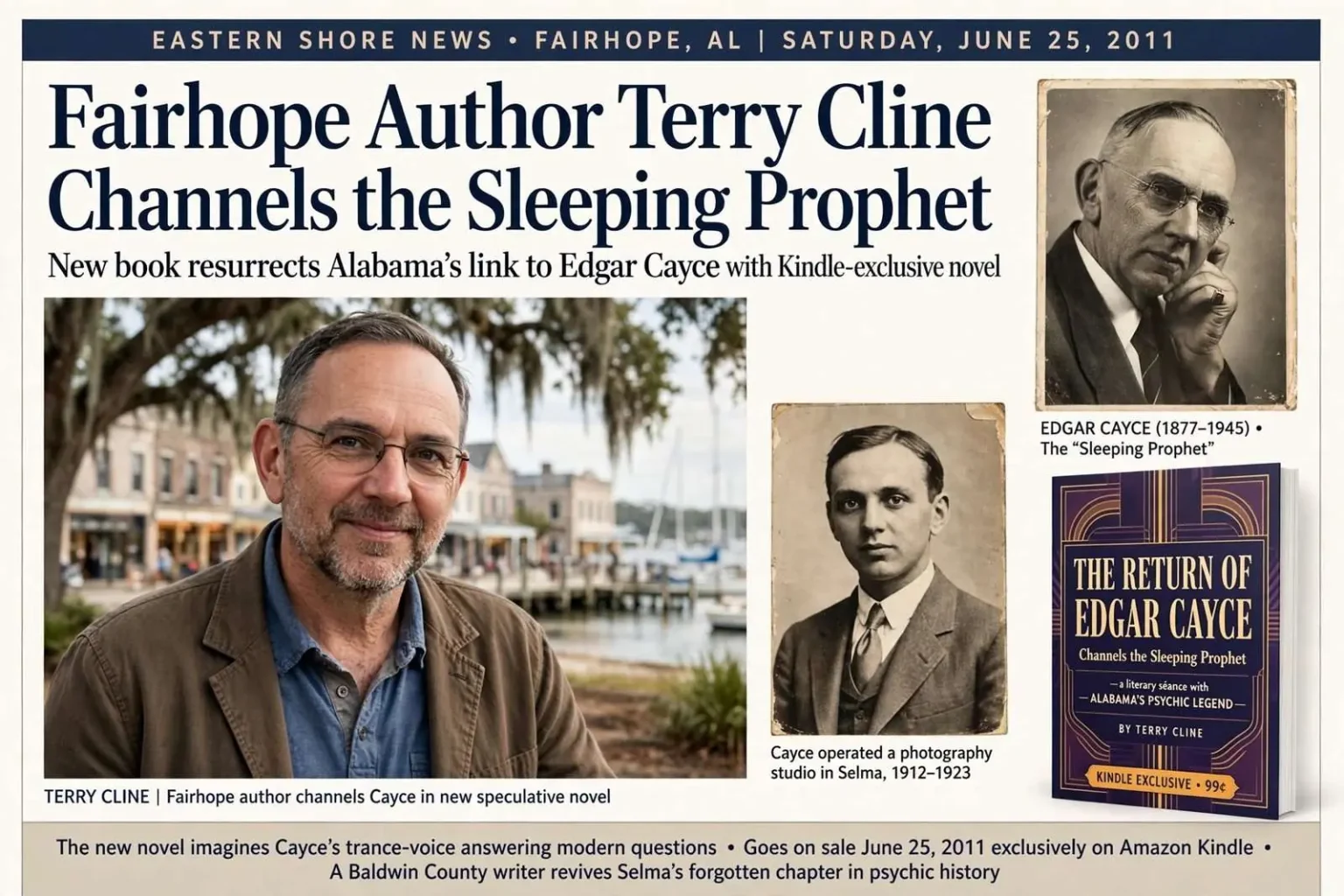
Fairhope author Terry Cline has a new book out this month that resurrects one of Alabama’s strangest homegrown legends: Edgar Cayce, the Kentucky-born psychic whose early years included nearly a decade in Selma.
The Return of Edgar Cayce is structured around a simple premise — Cline answers questions as he imagines Cayce would have.
Who Edgar Cayce was
Cayce (1877–1945) claimed the ability to enter a hypnotic trance and channel answers on subjects ranging from healing to Atlantis, earning the nickname “the Sleeping Prophet.”
Born on a farm near Hopkinsville, Kentucky, Cayce was, by all outward accounts, an ordinary man — a Sunday school teacher, a photographer by trade — who became one of the most written-about figures in American paranormal history. His claimed method was unusual: after entering a self-induced trance, he would answer questions posed to him, most often about the illnesses of people he had never met. Thousands of those “readings” were transcribed and preserved, and they continue to be studied, debated and dismissed by skeptics more than half a century after his death in 1945.
The topics he covered ranged far beyond health. Readings touched on reincarnation, ancient civilizations, prophecies and philosophy, and the sheer breadth of the subject matter helped fuel the legend that grew around him. Believers credited him with remarkable cures; critics countered that the readings were vague, unfalsifiable or simply wrong. What neither side disputes is that Cayce built one of the largest followings of any American psychic, and that the organization he inspired continued his work long after he died.
The Alabama chapter
Less well remembered is Cayce’s time in Alabama. From 1912 to 1923, Cayce lived in Selma, where he operated a photography studio while developing the trance readings that made him famous.
Those were the years in which the readings evolved from parlor curiosity into something closer to a calling. Selma, then a prosperous Dallas County river city, gave Cayce a stable professional base: the photography studio paid the bills while the trance work, conducted largely for friends and correspondents, grew in reputation. It was during the Selma period that the readings began attracting attention well beyond central Alabama, drawing people who traveled to Selma specifically to ask the sleeping photographer about ailments that doctors had failed to resolve.
The connection gives Alabama an unusual claim on a figure better known today through organizations headquartered hundreds of miles from the state. For Cline, a Baldwin County novelist, the Selma years offered a hook that is genuinely local: one of America’s defining psychic legends spent eleven formative years running a business on Alabama soil.
The book and the 99-cent plan
The Return of Edgar Cayce goes on sale Saturday, June 25, 2011, exclusively on Amazon’s Kindle platform, priced at just 99 cents — a deliberately low price point aimed at building readership quickly in the fast-changing e-book market.
In 2011, that pricing strategy was at the center of a debate reshaping the publishing industry. E-book readership was climbing fast, and a wave of authors discovered that a 99-cent price could push a title up Amazon’s bestseller rankings, where visibility fed on itself: higher rankings meant more browsers, more reviews and more word of mouth. Traditional publishers still treated low e-book prices as a threat to hardcover sales, while independent-minded authors treated them as the cheapest advertising available.
Cline’s decision to release the book exclusively on Kindle places it squarely in that moment. The exclusivity concentrated sales on a single storefront at a time when Kindle ownership was expanding rapidly, and the sub-dollar price removed nearly every barrier to a first-time reader taking a chance on an unfamiliar author. For a genre title built around speculative fiction, the strategy traded short-term revenue for audience, betting that readers hooked at 99 cents would return for later books at higher prices.
The premise
Structurally, the book works as a thought experiment. Cline answers questions as he imagines Cayce would have, stepping into the trance-voice of the Sleeping Prophet and channeling responses in his style. The device lets the novel operate on two levels at once — as speculative fiction about what Cayce might say if he were speaking today, and as an act of literary séance that invites readers to weigh the appeal of Cayce’s worldview for themselves.
Whether a reader accepts Cayce’s claimed abilities or not, the figure remains a rich subject for fiction. He sits at the intersection of faith, entertainment and commerce — a man whose nightly trances drew paying questioners, whose answers founded an organization, and whose reputation has survived repeated rounds of skeptical debunking. Fiction built on that foundation can explore the psychology of belief without needing to settle the factual question.
Fairhope and the Eastern Shore literary tradition
Cline is part of Fairhope’s productive Eastern Shore literary scene, a Baldwin County town long associated with writers.
The association dates to the town’s founding. Fairhope was established in 1894 as a single-tax colony, an experimental community built on the economic theories of Henry George, and from its earliest days it attracted idealists, free-thinkers, artists and writers who saw it as a place where unconventional ideas could find an audience. That heritage left a mark: the town’s boutiques, bookshops and cultural institutions have long reflected a sensibility more Bohemian than most Alabama towns of its size, and its bayside setting has drawn a steady stream of authors, painters and musicians who chose to live and work there.
Writers on the Eastern Shore work within sight of Mobile Bay, in a town that has spent more than a century marketing itself as a haven for the arts. For a novelist like Cline, the setting supplies both a community of readers and a tradition of independent thinking that suits a book about a man who claimed to speak from another plane of consciousness.
Blending Alabama history with speculative fiction
What sets The Return of Edgar Cayce apart from the ordinary paranormal title is the specificity of its regional grounding. Cayce’s Selma years are a matter of documented history — the photography studio, the growing stream of visitors, the readings that spread his name beyond the state — and Cline builds his speculative premise directly on that real foundation.
The approach reflects a broader pattern in Southern fiction, where writers regularly mine local history that larger cultural institutions have overlooked. Cayce is remembered nationally through organizations and archives far from Alabama, yet the decade that shaped his readings happened in Dallas County. Anchoring the novel there connects Baldwin County’s literary present with a piece of central Alabama’s stranger past, and it gives the book a claim on readers’ attention that a generic psychic thriller could not make.
Reading it today
For readers encountering Cayce for the first time through fiction, the historical record offers plenty of context. The transcripts of his readings fill thousands of pages, archived and studied by followers and researchers alike, and the biographies written about him range from admiring to openly skeptical. The most frequently repeated claims about his work involve health readings for people he never met face to face, descriptions of Atlantis and ancient civilizations, and predictions whose accuracy remains a subject of argument more than seventy years after his death.
The Selma chapter of that story is the part with the strongest local resonance. Between 1912 and 1923, the man who would become known as the Sleeping Prophet was simply a photographer working on Alabama soil, developing his practice while the trance readings that made his reputation grew around him. The years in Selma saw the readings broaden from medical questions toward the philosophical and prophetic subjects that defined his later fame, and they produced the network of correspondents and questioners that carried his name far beyond the state after he left for Virginia Beach.
Cline’s book arrives as a Kindle exclusive at 99 cents beginning Saturday, June 25, 2011, a price that positions it as an impulse buy for anyone curious about the legend. Whether read as entertainment or as a gateway into the Cayce literature, it adds an Alabama footnote to a story that is usually told as if it belonged somewhere else — and it does so from a Baldwin County town that has always made room for writers chasing unusual subjects.
The Return of Edgar Cayce is available exclusively through Amazon’s Kindle store, and readers interested in the historical Cayce can explore the Selma years through the substantial archive of readings and biographical material that survives from his Alabama decade.
The episode is also a reminder of how much of the state’s cultural history lives outside the textbooks. Selma’s place in the Cayce story predates the city’s better-known civil rights history by half a century, and the photography studio on Alabama soil hosted the formative years of a phenomenon whose following eventually spread across the country. A Baldwin County novelist reviving that story in 2011 closes a loop that runs from Kentucky farm country through Dallas County to Mobile Bay.