Fairhope Police Identified 2008 Barnwell Homicide Victim
A 2008 WKRG report identified the man found stabbed in a boat behind a Barnwell business and noted no arrests had been made.
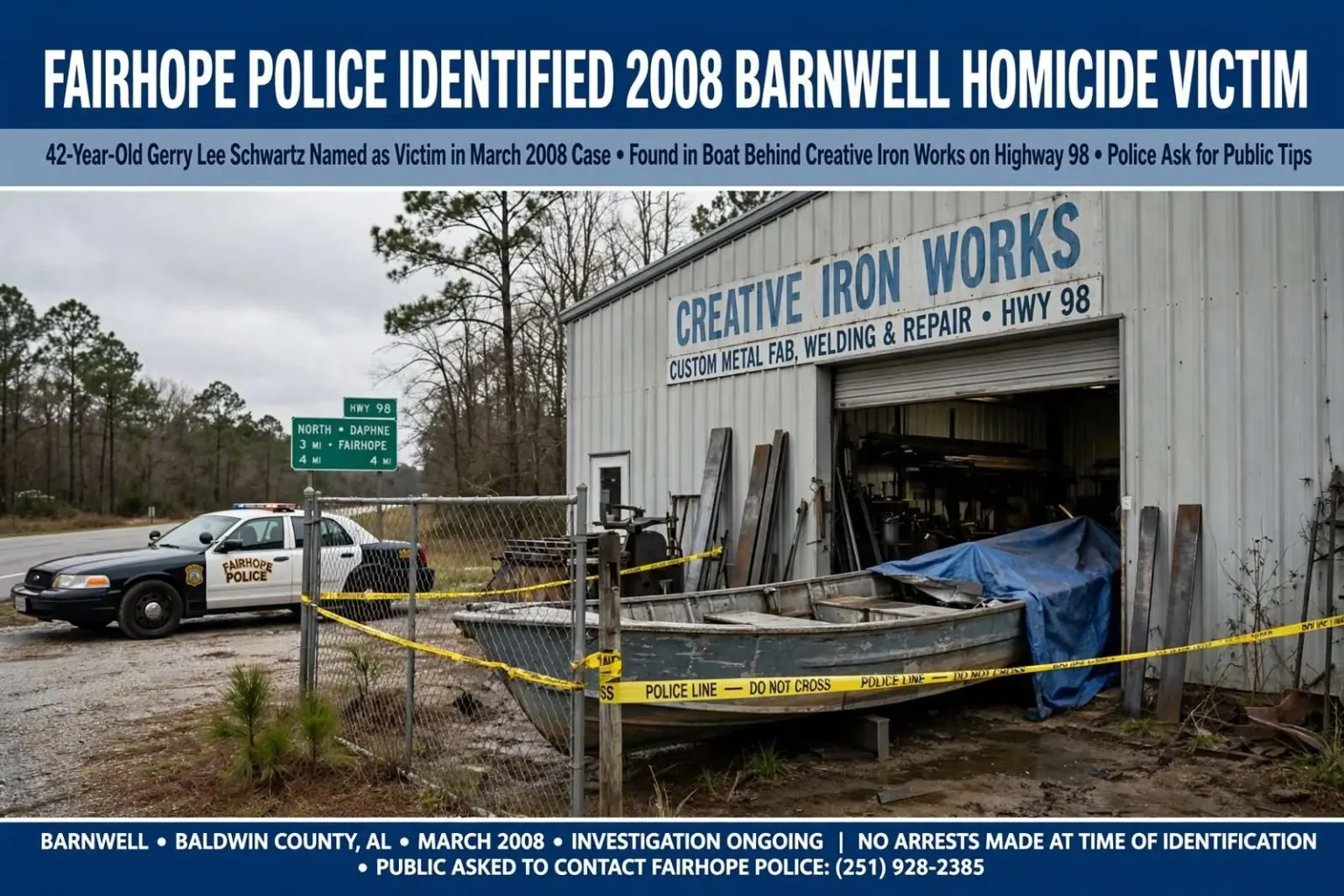
Fairhope police identified the victim in a March 2008 Barnwell homicide investigation as 42-year-old Gerry Lee Schwartz, according to a local station’s report at the time. Schwartz, originally from Fort Wayne, Indiana, had moved to Fairhope from Florida about a year before his death, making him a relative newcomer to the Eastern Shore community where he was found killed inside a boat behind a metal fabrication business.
Police said Schwartz was found stabbed inside a boat behind Creative Iron Works on Highway 98, where his employer had allowed him to live. The circumstances — a man living on the property of his workplace, killed inside a vessel stored there — made the case one of the more unusual homicide investigations in the Fairhope area in recent years, and investigators worked to establish who had been at the property in the hours around the discovery.
The station reported that no arrests had been made in the case at the time of the identification, and police asked anyone with information to contact Fairhope Police. This is a historical account of police statements reported in 2008; it does not state a final case outcome, and no disposition is recorded in the preserved report.
The Barnwell community
Barnwell is an unincorporated community in north Fairhope, in the stretch of Baldwin County between Fairhope’s downtown and the Daphne city line. The area takes its name from the Barnwell family, early settlers whose roots in the region go back to the antebellum era, and it remains a mixed landscape of older homes, small farms, churches and light commercial property. Unlike Fairhope’s waterfront districts, Barnwell developed as a working crossroads community, with businesses scattered along the highways rather than gathered in a walkable center.
Highway 98, the corridor where Creative Iron Works was located, is one of the main north-south routes through the Eastern Shore. It carries commuter and commercial traffic between Fairhope, Daphne and points north, and the properties along it include a mix of trades businesses, retail shops and residential parcels set well back from the road. In 2008, the corridor was already feeling the growth pressure that would transform much of Baldwin County over the following decade, as Fairhope’s population climbed and development pushed outward from the historic core.
Living where you work
The detail that Schwartz’s employer allowed him to live in a boat behind the business is a reminder of how housing worked for many working people on the Eastern Shore. Fairhope’s housing market, even in 2008, was among the priciest in the region, and it was not uncommon for tradesmen, caretakers and laborers to arrange informal living situations on the properties where they worked — a room over a shop, a trailer behind a fence, or in this case a boat on the business’s grounds. Such arrangements are mutually practical: the business gains an on-site presence, and the worker gains affordable shelter close to the job.
They also shape investigations when violence occurs. A residence on commercial property generates a different pattern of comings and goings than a house in a neighborhood, and detectives in such cases typically work through the victim’s work relationships, the property’s access points and the timeline of who was seen near the site. Police did not release details about how or when Schwartz was killed beyond the cause, and the preserved report does not indicate whether evidence pointed to a stranger or someone known to the victim.
Fairhope police and a small-city homicide
Fairhope operates its own police department, one of the longer-established municipal forces in Baldwin County, and homicide investigations in the city are rare enough that each one draws sustained attention. A department of Fairhope’s size does not maintain a large dedicated homicide unit the way Mobile or Birmingham does, so major-case work typically involves detectives reassigned from other duties, support from the Baldwin County Sheriff’s Office and the Baldwin County Major Crimes Unit, and assistance from state or federal partners when needed.
The Baldwin County Major Crimes Unit was formed to give the county’s smaller departments exactly that kind of shared capacity, pooling investigators from municipal departments, the sheriff’s office and district attorney investigators for serious cases. In a 2008 investigation like this one, forensic processing — scene photography, evidence collection, medical examiner work through the Alabama Department of Forensic Sciences in Mobile — would all have been part of the standard sequence, along with canvassing the Highway 98 corridor for witnesses.
The request for public tips, which police made through the local station’s report, is standard practice in unsolved cases. Fairhope residents with information were directed to contact the department, and tips from the public — a seen vehicle, a heard argument, a remembered stranger — have historically broken more Baldwin County cases than any other single investigative source, in part because the county’s communities are small enough that unusual activity is noticed.
The victim’s path to Fairhope
Schwartz’s story, as far as the report preserves it, traces a path common to many Baldwin County transplants. Born and raised in Fort Wayne, Indiana — a manufacturing city in the state’s northeast — he moved to Fairhope from Florida about a year before his death. The Indiana-to-Florida-to-Alabama arc describes a familiar migration pattern: workers leaving the Rust Belt for the Sun Belt, often following construction, trades or service work down the Gulf Coast. Baldwin County’s building boom of the 2000s pulled hundreds of tradesmen into the area in exactly that fashion, and metal fabrication shops like Creative Iron Works supplied the railings, gates and structural work that the region’s rapid development demanded.
Fairhope itself, a city of about 15,000 in 2008, has long attracted newcomers — first as an intellectual and artistic colony founded in 1894 by a group of Iowans associated with a single-tax movement, and later as one of Alabama’s fastest-growing and most affluent communities. The Single Tax Colony’s founders chose the bluff above Mobile Bay for its health and beauty, and the city’s flower-lined streets, pier and parks made it a regional destination. By the 2000s, growth had spread well beyond the original core, north into the Barnwell area where Schwartz lived and worked.
An unresolved record
The preserved report ends where the identification ended: a named victim, a cause of death, a location, a plea for information. It does not state whether anyone was ever arrested or charged in Schwartz’s killing, and this account makes no claim about a final outcome. Unsolved homicides in Baldwin County have at times remained open for years before developments emerged, sometimes through advances in forensic technology, sometimes through witnesses who came forward long after the fact, and sometimes through renewed investigative attention.
Fairhope police have historically kept cold cases on the books, and family members of homicide victims across Baldwin County have periodically renewed public appeals for information years after the original reports faded. For the Schwartz family in Indiana and Florida, the 2008 identification would have been the first public confirmation of how and where he died; what followed the identification is not preserved in the account.
How the region responded to violent crime in 2008
The March 2008 report came during a period of transition for law enforcement in Baldwin County. The county’s population was climbing past 180,000, growth that brought both prosperity and new demands on police departments that had operated for decades at small-town scale. Agencies were expanding, adding officers and equipment, and working to keep response times and investigative capacity in step with subdivisions that seemed to appear overnight along every corridor from Spanish Fort to Gulf Shores.
Homicides remained rare by big-city standards — Baldwin County typically counted them in single digits in a year — which meant each case drew concentrated attention from a small pool of experienced investigators. Departments leaned on mutual aid, and the county’s major crimes framework meant that a Fairhope case would not be worked by Fairhope alone. The asking of the public for help, as in this report, reflected both that reality and the department’s understanding that a commercial property on Highway 98, with its steady traffic and neighboring businesses, would have been seen by many eyes in the days around the crime.
Remembering the case today
Nearly two decades later, the Schwartz case belongs to the archive of Baldwin County crime history — a record of a man from Fort Wayne who came south for work, lived aboard a boat behind a metal shop on Highway 98, and was found stabbed there in March 2008. The account preserved here documents what police said at the time: the victim’s identity and age, his path to Fairhope, the location and manner of his death, his living arrangement with his employer’s permission, and the fact that no arrest had been made as the report was published.
Anyone who lived or worked along the Barnwell stretch of Highway 98 in 2008 and recalls something about the case — the property, the activity around Creative Iron Works, or anything heard since — can still contact Fairhope police, as the department originally requested. Homicide cases do not close with the news cycle, and information that seemed minor in 2008 can matter in a file that remains open. For the family of Gerry Lee Schwartz, the account stands as the public record of a life that ended at 42 on the Eastern Shore he had made home a year earlier.