Fairhope Brewing Teams Up With Underhill Family Orchestra for Limited-Run Smoked Porter
Fairhope Brewing Company has released Stories of Appalachia Porter, a limited-run smoked porter inspired by the Underhill Family Orchestra, continuing its series of collaboration beers honoring local musicians.
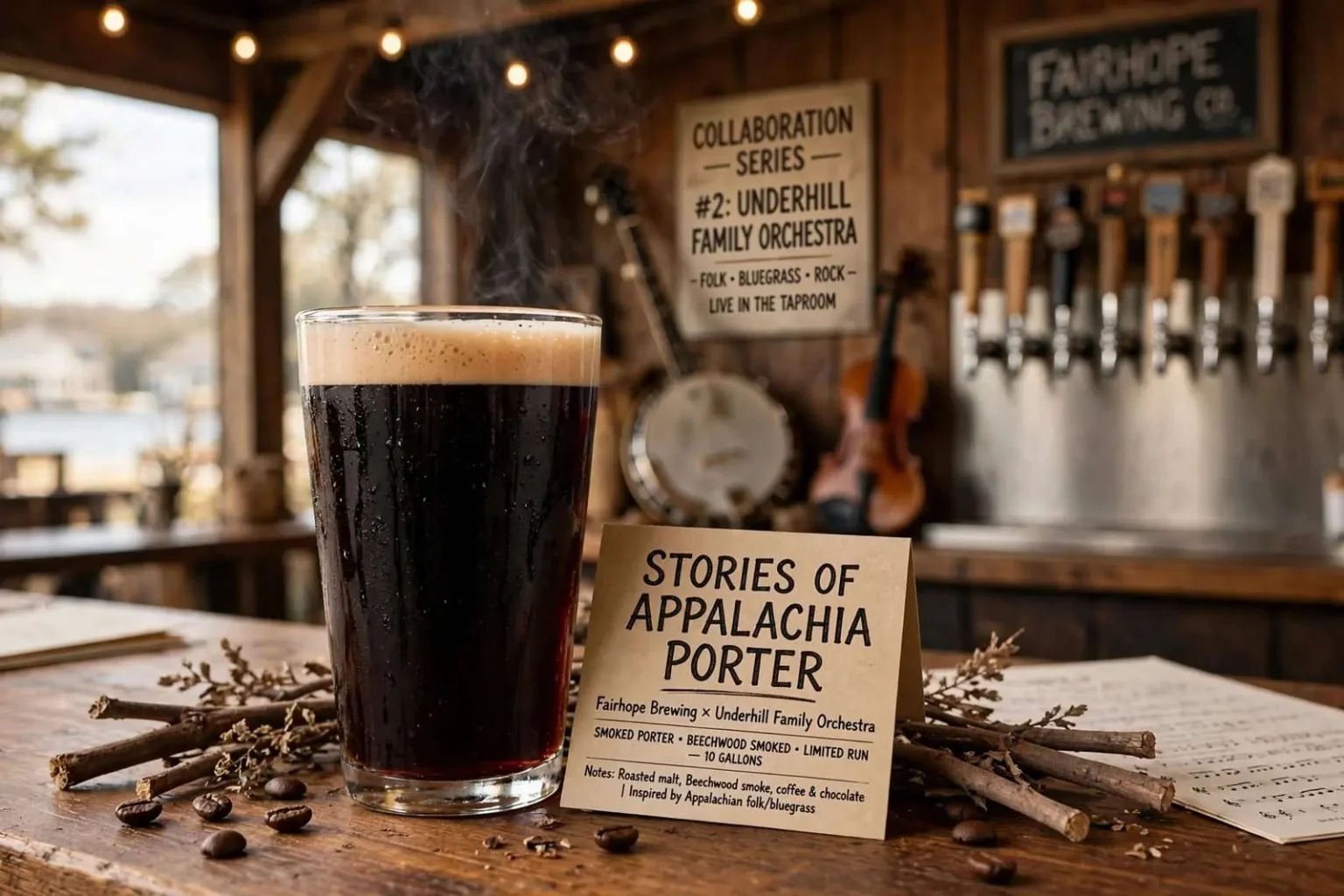
Fairhope Brewing Company has released a new small-batch beer inspired by the Underhill Family Orchestra, the latest release in the brewery’s ongoing series that pairs local musical acts with custom brews created in their honor. The collaboration puts two of the Eastern Shore’s creative communities — craft brewing and live music — in the same glass, and it gives the Fairhope taproom another reason to draw crowds from across the Bay.
The beer, called Stories of Appalachia Porter, is a smoked porter brewed to reflect the sound and spirit of the eclectic Alabama band. Fans can expect a dark, roasty beer with a distinct Beechwood smoke flavor running through it, a nod to the band’s rootsy, Appalachian-tinged style. Smoked porters occupy a particular niche in the beer world: the style builds on the roasted malts that give porters their coffee-and-chocolate character, then layers in malt dried over burning wood, producing a subtle campfire quality that pairs naturally with the kind of old-time and folk music the name evokes.
The choice of Beechwood-smoked malt ties the beer to a tradition more often associated with German brewing than with Gulf Coast taprooms, and using it here is a deliberate act of translation — taking a flavor with deep European roots and pointing it at the band’s own blend of Southern and Appalachian influences. Brewers who work with smoked malts describe them as easy to overdo, since the smoke character can bulldoze everything else in the glass; calibrating it so the roast and smoke hold each other in balance is the difference between a beer people finish and one they admire from a distance.
A series built on local music
The release continues a collaboration series that Fairhope Brewing Company started to celebrate musicians with ties to the Gulf Coast music scene. The brewery’s first release in the series was Lil’ Poison Brown Ale, created in honor of singer-songwriter Grayson Capps. Underhill Family Orchestra’s namesake beer marks the second installment, and brewery staff say the band’s own enthusiasm for craft beer made the pairing a natural fit. The model is a familiar one in the American craft beer industry, where breweries have found that naming beers after beloved local artists builds community goodwill on both sides — the band gets a new promotional vehicle and a signature drink at its shows, and the brewery gets the band’s audience through the door.
Fairhope itself has proven fertile ground for that approach. The city on the eastern shore of Mobile Bay has cultivated an identity around its arts scene, its parks and pier, and a walkable downtown that draws visitors from Mobile and the beach communities to the south. A brewery embedded in that scene has a natural audience for releases that celebrate it in return, and a music-themed series turns each new beer into a small civic event rather than just another tap handle.
The band behind the beer
Underhill Family Orchestra built a following across the region in 2014, including a standout performance at that year’s Hangout Music Festival in Gulf Shores that drew praise as one of the highlights of the weekend. The Hangout Fest slot carried particular weight for a young Alabama band: the festival is the Gulf Coast’s marquee music event, drawing national acts and enormous crowds to the beachfront each May, and a strong set there reaches both industry watchers and thousands of potential new fans in a single weekend. For a band from the region, being singled out among the festival’s highlights is the kind of momentum that a local scene cannot manufacture on its own.
The band’s blend of folk, bluegrass and rock influences has made it a fixture at venues and festivals across South Alabama. That eclecticism is reflected in the group’s name as much as its sound — the “orchestra” framing suggests a large ensemble with a shifting cast of collaborators, and the band’s shows have built a reputation as communal events rather than conventional performances. It is exactly the kind of act that benefits from the craft beer audience: fans who seek out taprooms tend to be the same concertgoers who follow local bands, and the two worlds overlap heavily along the Gulf Coast.
10 gallons, gone quickly
Because Stories of Appalachia Porter was brewed in a small, limited batch of just 10 gallons, supply is expected to be extremely limited. Fairhope Brewing Company has encouraged fans of the band, and of craft beer in general, to visit the taproom soon if they want to try it before it runs out. To put the batch size in perspective, 10 gallons amounts to roughly two kegs — barely over a hundred pints — which means the release will last days, not weeks, and only on-site. Small batches like this serve a different purpose than a year-round flagship: they are experiments and events, giving brewers a low-risk way to try demanding styles while giving regulars a reason to keep checking back.
The scarcity is also the point commercially. A beer most people will never taste generates more conversation than one on every corner grocery shelf, and the brewery benefits from the urgency in a way that rewards taproom visits over package sales. For fans of the band, the beer becomes a piece of the group’s story — a limited physical artifact of a moment when the band was rising through the regional scene.
A Gulf Coast trend
The collaboration reflects a broader trend among craft breweries along the Gulf Coast, where taprooms have increasingly leaned on local music and community partnerships to draw crowds and build loyalty among regulars. Breweries from Mobile to the beaches have discovered that a taproom functions as a venue as much as a bar, and programming it — live music, artist features, community nights — turns occasional customers into weekly ones. The economics reinforce the arrangement: local bands bring their followings at little cost to the brewery, and a beer named for a musician gives patrons a story to take home along with the pint.
For Fairhope Brewing Company, pairing a beer release with a live performance gives fans two reasons to turn out on the same night, tying a taste of local craft brewing to a taste of the local music scene in a single evening. That dual draw has become a template for how smaller regional breweries compete — not against national brands on shelf space, but for the leisure hours of the people who live around them. A release tied to a hometown band converts the taproom from a place that sells beer into a place where the community’s creative life gets celebrated, and that positioning is far harder for a large competitor to replicate than any particular recipe.
The series also documents the Gulf Coast’s music scene as it unfolds. Each collaboration beer is effectively a marker saying that a particular artist mattered here, at a particular moment — a liquid footnote to the region’s cultural history. Grayson Capps, whose Lil’ Poison Brown Ale started the series, has long been part of the songwriting tradition that runs along the coast, and the Underhill Family Orchestra release extends that lineage to a younger generation of acts finding audiences in festivals and venues across South Alabama. If the series continues, it will accumulate into a kind of rotating portrait of the scene itself.
For now, the practical guidance is the one the brewery itself gave: anyone hoping to taste Stories of Appalachia Porter should get to the Fairhope taproom quickly. Ten gallons of a smoked porter inspired by one of the region’s most talked-about young bands will not last, and that is precisely how the brewery intended it.
The brewery’s taproom location in Fairhope has made it a stop on the informal circuit of Eastern Shore destinations — the pier, the downtown shops, the restaurants along the Bay — and that positioning matters for releases like this one. Weekend visitors who come to town for the arts-and-crafts traditions the city is known for often end up at the brewery afterward, which means a limited release benefits from tourist traffic as well as regulars. Taproom-only batches essentially market themselves to whoever happens to be in town, and Fairhope happens to be a town people come to.
Porters themselves carry a long history worth knowing when approaching a beer like Stories of Appalachia. The style dates to eighteenth-century London, where it emerged as the drink of the working class before spawning its stronger sibling, the stout. American craft brewers revived the style in the modern era and have treated it as a canvas ever since — adding coffee, chocolate, bourbon-barrel aging, and in this case wood smoke. The smoked variant has its own lineage in Germany, where brewers in Bamberg have made rauchbier with kilns fired by beechwood for centuries. Borrowing that technique for a beer named after Appalachian-rooted music is a fitting bit of cross-pollination, since much of American roots music itself is an inheritance carried across the Atlantic and remade in the South.
What fans of the band should expect from the glass, then, is a beer built as a portrait: the roast from the porter tradition supplying the dark, grounded base, and the beechwood smoke threading through it the way a drone string threads through an old-time tune. It is a demanding style to drink casually, which suits a 10-gallon batch — the people who come out for it are the people who will appreciate what the brewer was reaching for.
As the series grows, each release will be measured against the precedent the first two set: a genuine connection to the honoree, a style that reflects their sound, and a batch size that turns the taproom into the only place to find it. On all three counts, the Underhill Family Orchestra collaboration follows the formula that made the Grayson Capps ale a welcome start to the series.