Fairhope Police Chase Ended in Crash in 2008
A 2008 WKRG report covered an early-morning Fairhope police chase that ended with multiple vehicles struck near the Fairhope Yacht Club.
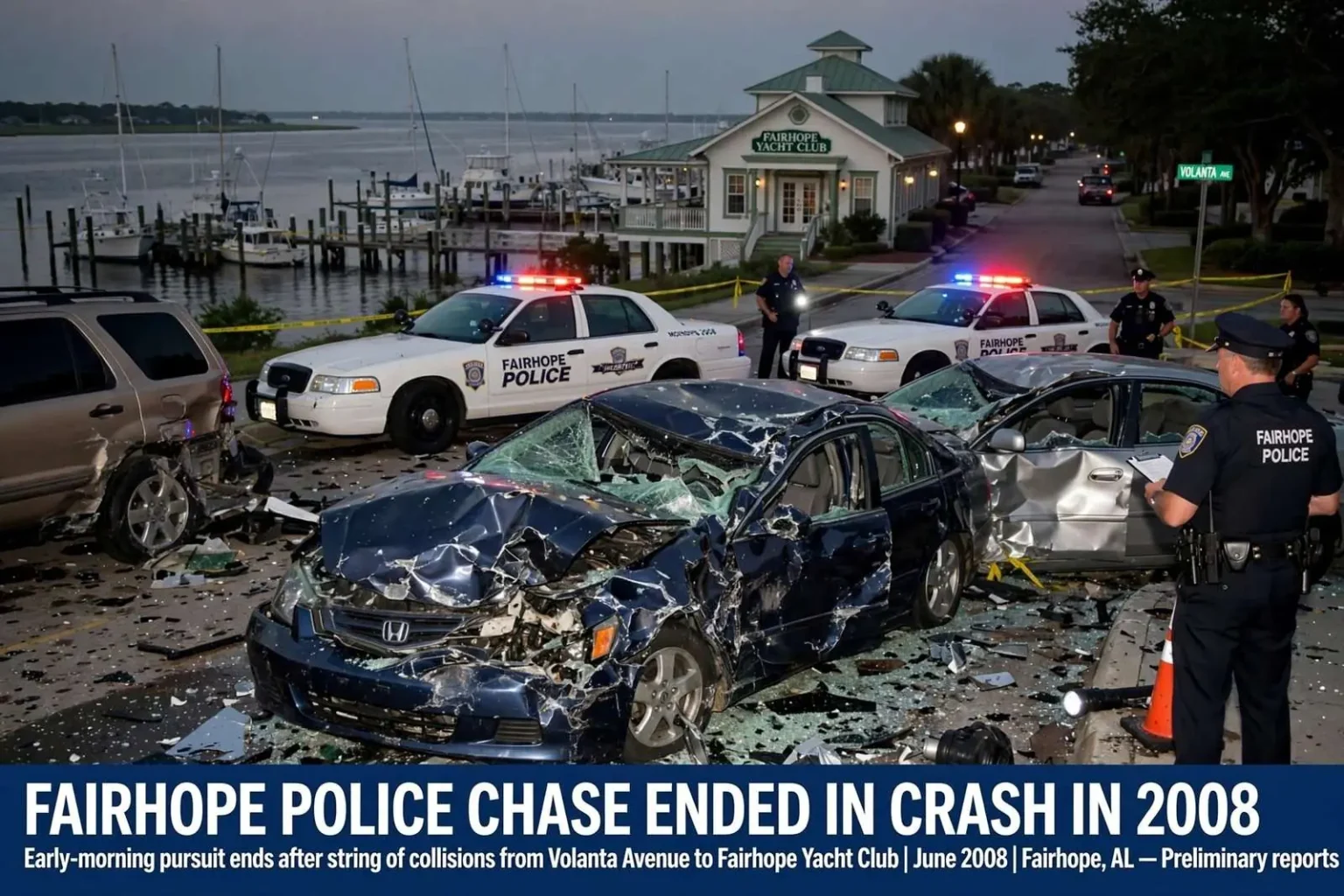
An early-morning Fairhope police chase ended in a crash near Volanta Avenue in June 2008, according to a local station. The person being pursued struck several cars before the chase stopped near the Fairhope Yacht Club, where two police vehicles were also hit. Authorities had not said whether anyone was injured or whether arrests had been made. This is a historical summary of preliminary information reported in 2008. It does not state later investigative or court outcomes.
The incident unfolded in the early hours of a June morning in 2008, when Fairhope police initiated a pursuit that ran through the city’s streets before ending near the waterfront. During the chase, the fleeing vehicle struck several cars along the route, and the pursuit concluded near the Fairhope Yacht Club, where two police vehicles were struck as well. The sequence of collisions made the incident, from its start near Volanta Avenue to its ending by the bay, one of the more destructive pursuits in the city’s recent history at the time.
Details available in the immediate aftermath were limited. The station’s report did not include an injury count, and authorities had not announced whether the driver was taken into custody. What was clear from the preliminary account was the shape of the event: a vehicle refusing to stop, police units following, and a trail of struck cars stretching from the area near Volanta Avenue to the yacht club parking area at the bottom of Fairhope’s bluff.
Fairhope and the streets the chase ran through
Fairhope sits on the eastern shore of Mobile Bay in Baldwin County, a city known for its bluff-top views, its downtown along Fairhope Avenue, and its long identity as an artists’ and writers’ colony. By 2008 it was already one of the fastest-growing cities in the region, its population swelling with people drawn to the waterfront, the schools, and the walkable core. Its streets, laid out in a compact grid on the bluff, see steady traffic in the daytime and fall quiet after midnight.
Volanta Avenue runs along the northern side of the city’s core, connecting the upper-town commercial stretches to the residential streets that slope toward the bay. The Fairhope Yacht Club sits at the foot of the bluff on the waterfront, reached by streets that descend steeply from the ridge to the municipal pier area. A chase that begins near Volanta and ends near the yacht club has essentially crossed the width of the city’s built-up area, from the top of the hill to the water’s edge, in the dark hours when few witnesses are on the street.
The geography matters for understanding the collisions. Streets that carry light traffic at 2 a.m. still hold parked cars, and a vehicle traveling fast through that grid, pursued by police, has nowhere to redirect its momentum. The several civilian cars struck along the route were, in the language of pursuit reviews, collateral of the fleeing driver’s decisions, not the pursuing officers’ speed alone.
How police pursuits work and go wrong
A police chase is one of the most scrutinized activities in law enforcement, and departments nationwide regulate them with written pursuit policies. Officers are typically authorized to pursue when a driver refuses to stop and the need to apprehend outweighs the danger the pursuit itself creates. During the chase, supervisors monitor the route and speed, units coordinate rather than string out, and the decision to break off is always available when the risk grows beyond the value of the capture.
The danger comes from the fleeing driver, who controls the vehicle that does most of the harm. National statistics on pursuits consistently show that the majority of injuries and property damage in chase-related crashes involve uninvolved parties: the parked cars, the intersections, and the bystanders who happen to be in the fleeing vehicle’s path. That imbalance is why pursuit policies weigh so heavily the seriousness of the original offense against the mounting collateral risk.
In the Fairhope case, the original reason for the stop that led to the chase was not detailed in the preliminary reporting. The outcome, several struck cars and two damaged police vehicles within city limits, falls into the category that pursuit reviews examine closely afterward: what was the offense, what was the flight pattern, and at what point should the pursuit have been terminated. Those questions are answered in internal reviews that departments conduct after nearly every extended chase, whatever the eventual disposition of the case.
The aftermath and the open questions
In the days after the incident, the preliminary picture remained just that. Authorities had not said whether anyone, in the struck cars, the fleeing vehicle, or the police units, was injured. Nor had they confirmed an arrest. In pursuits that end with the fleeing vehicle disabled or surrounded, the driver is usually taken into custody at the scene, but confirmation comes from the department, and none had been issued in the immediate aftermath.
The two struck police vehicles represented a concrete cost to the small department, which like most Baldwin County cities of its size operated a modest fleet. Damaged units mean repair bills, insurance claims, and shifts reorganized around the loss, on top of the damage to the civilian vehicles struck along the route. The city’s insurers and its internal review would both have had their parts of the story to settle.
As a historical summary of preliminary 2008 reporting, this account deliberately stops where the reporting stopped. What the investigation concluded, whether charges were filed, and how the courts resolved the case are not recorded here. What the June 2008 morning left behind, in the moment, was a trail of damaged cars across a quiet city and a set of questions that Fairhope’s officials and residents had to work through as the details emerged.
Pursuit policy in a growing Baldwin County city
Fairhope’s police department in 2008 operated in one of Alabama’s fastest-growing counties, where the pressures of growth were reshaping every public service. More residents meant more traffic, more calls, and more of the ordinary friction that produces traffic stops, and traffic stops are where most pursuits begin. Departments across Baldwin County reviewed and updated their pursuit policies in those years, as national best practices shifted toward greater restraint.
The trend nationwide in the years around 2008 was to narrow the grounds for pursuit, limiting chases primarily to violent felonies and impaired drivers rather than minor offenses. Technology helped: license plate readers, better radio coordination, and later, remote tracking devices allowed departments to apprehend fleeing drivers without following them at speed. The calculus departments faced was stark, because each pursuit risked exactly the kind of damage the Fairhope chase produced, several civilian cars struck before it ended.
For the community, an incident like the June 2008 chase prompts the same reflection that pursuit reviews formalize: the value of an immediate arrest against the cost of the chase itself. Fairhope’s city leaders and residents would weigh those same considerations in the years that followed, as the city continued to grow and the police department continued to balance enforcement against the safety of the streets it patrolled.
What the 2008 incident left behind
Fifteen years and more on, the June 2008 chase is a snapshot of one early morning in a city that has changed a great deal since. The streets are the same: Volanta Avenue still runs along the north side of town, and the yacht club still sits at the water below the bluff. What the incident illustrates for readers today is less a single event than the enduring pattern it fit, a fleeing driver, a short and destructive pursuit, and a community counting the damage afterward.
The historical record here, based on preliminary reporting, preserves the confirmed outline: an early-morning chase in June 2008, a crash near Volanta Avenue, several struck civilian cars, two damaged police vehicles near the Fairhope Yacht Club, and unanswered questions about injuries and arrests at the time. Everything beyond that outline belongs to the official record of 2008, not to the summary of what was known then.
For anyone researching the incident or the history of police pursuits in Baldwin County, the useful takeaways are the enduring ones: pursuits remain among the riskiest activities police undertake, the damage they cause falls most heavily on uninvolved people and property, and the policies governing them have continued to evolve in the years since that June morning in Fairhope.
The wider record of chases on the eastern shore
Fairhope was not alone in facing these moments. Communities across Baldwin and Mobile counties experienced chases in that era, and each one fed the same public conversation about when a pursuit is worth its risks. Departments in Daphne, Fairhope, Gulf Shores, and the county sheriff’s office all confronted the same arithmetic, and the growth of the county’s population kept raising both the number of stops and the stakes of every decision to chase or not to chase.
The June 2008 chase also illustrates how quickly such events test a small department’s resources. Within minutes, a routine night in Fairhope required multiple units, coordination over radio, damage documentation at several collision points, and the management of a scene near the waterfront, all before sunrise. Small departments train for exactly this kind of sudden multi-part incident, and the aftermath, reports, insurance, repairs, and review, extends the workload for weeks.
As with all accounts drawn from preliminary reporting, the details that would complete this story rest in the records of the Fairhope police department and the Baldwin County courts. The summary of June 2008 stands as it was reported at the time: a chase across a quiet city, a series of crashes, and a morning in which the community woke to damaged cars and unanswered questions near the bluff and the bay.