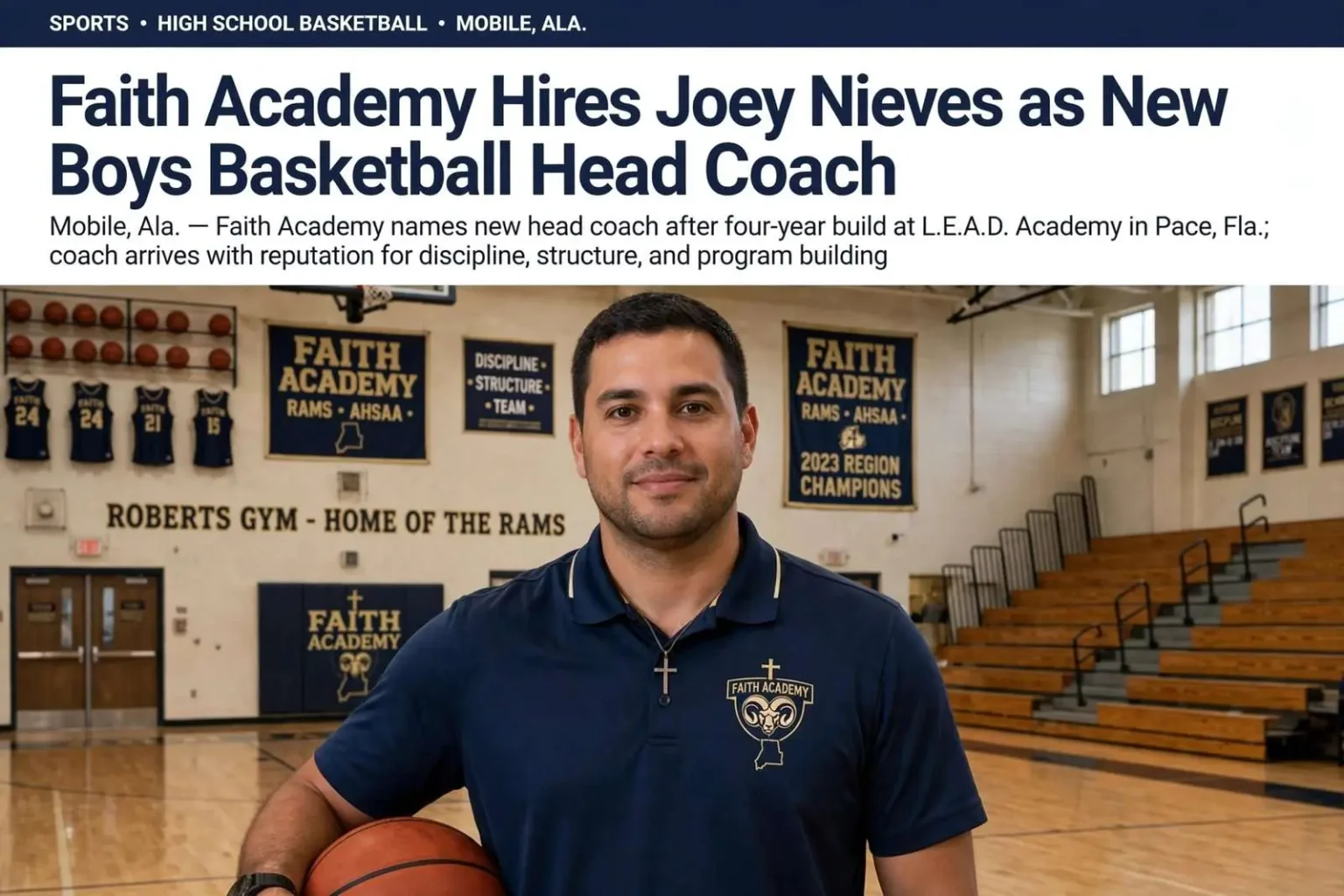
MOBILE, Ala. — Faith Academy has a new leader for its boys basketball program, naming Joey Nieves as head coach after he built a winning reputation at a Florida Panhandle Christian school.
Nieves arrives in Mobile County from L.E.A.D. Academy in Pace, Florida, where he started the school’s basketball program from scratch in 2019. He steps in for Chad Applin, who left Faith Academy to take a new position elsewhere. In a Facebook post, the school thanked Applin for his years of commitment to the program and wished him well in his next opportunity, though efforts to reach Applin directly for comment were unsuccessful.
The hire closed a search that had taken an unexpected turn. Nieves said the move to Faith Academy came about somewhat unexpectedly.
“I didn’t look for a coaching vacancy,” he said. “In fact, I wasn’t planning to leave L.E.A.D. Academy. (Faith) was looking for someone else and the person they were interested in threw my hat into the ring. Some of the best jobs you don’t expect to get and when God opens a door, I try my best to be obedient.”
Faith Academy, a private Christian school serving students from across the western Mobile area, competes in the Alabama High School Athletic Association and has built its athletic reputation on programs that draw families as much for the culture as the win totals. The boys basketball program plays a schedule that spans the metro area’s public and private schools, and the head coaching seat is one of the most visible jobs on campus.
A Philosophy Built on Structure
Describing his coaching philosophy, Nieves said he plans to keep things straightforward.
“I’m all about being disciplined, structured and playing team basketball,” he said. “It’s all about we and not about me. I think we’ll be satisfied with the types of players we have there.”
The emphasis on structure reflects how he built at L.E.A.D. Academy, where he inherited nothing — no roster, no tradition, no program — and constructed a competitive team over four seasons. Coaches who start programs from scratch tend to carry that builder’s mentality with them: systems installed early, expectations stated plainly, and a refusal to shortcut the process regardless of the roster he walks into.
At L.E.A.D. Academy, Nieves guided the program through four seasons with records of 5-20, 8-13, 27-2 and 14-16, with that final mark coming after the school became a provisional member of the Florida High School Athletic Association and began facing larger Class 5A and 6A programs such as Pine Forest and Chiles.
The arc of those records tells the story of a program maturing in public. The early losing seasons were the price of starting with a brand-new roster; the 27-2 breakout marked the payoff of the first full classes he recruited and developed through his system; and the 14-16 final season reflected a deliberate step up in competition quality rather than a step back in program health.
Nieves said the program deliberately sought out tougher competition rather than padding its win total.
“We could’ve had a schedule that would have guaranteed us another 20-win season but we wanted to be able to go up against some tough competition,” he said.
That choice — provisional FHSAA membership and a schedule stacked with Pensacola-area powers like Pine Forest and Tallahassee’s Chiles — meant his players faced programs with deeper rosters and longer winning traditions every week. For a coach building a resume, it was a risk that paid off twice: his players developed against elite competition, and the administrators watching his program saw a team that competed up a classification without folding.
The Path to Mobile
Nieves, a native of Jersey City, New Jersey, graduated from Gateway High School in Kissimmee, Florida, in 2005, where he played basketball, before his career carried him into coaching and, eventually, the Panhandle. His journey from a tough North Jersey basketball town through Central Florida to Pace traces the route of many coaches who came up through Christian school programs — learning the craft in small gyms where one coach does everything, from teaching the fundamentals to driving the activity bus.
Jersey City’s basketball culture, which has produced NBA talent and legendary high school programs, gave Nieves an early apprenticeship in the physical, defense-first style the city’s teams are known for. Coaches from that pipeline tend to import the same expectations: pressure defense, physical rebounding and an offense that runs with purpose rather than freelancing.
At Faith Academy, he takes over a program with a stronger foundation than the one he started at L.E.A.D. Academy — established facilities, a stable enrollment base and an administration that made the hire after watching his four-year build in Florida. The school’s announcement, made through its Facebook page, introduced him to a community that follows its athletics closely.
For Nieves, the move to Mobile also means a return to the kind of basketball environment he grew up around: a metro area with enough schools, talent and tradition to make every district game matter. His stated plan — discipline, structure, team basketball — will be tested against the private school powers and public school programs that share the Alabama Gulf Coast’s competitive landscape.
What He Inherits
Taking over from Chad Applin, Nieves inherits a roster and a culture rather than an expansion draft. Applin’s departure for another position left a program in mid-stride, and players who committed their summers to the previous staff will now learn a new system, new terminology and a new standard of accountability. Program transitions in high school athletics succeed or fail on how quickly the new coach connects with the returning players, and Nieves’ record suggests a coach comfortable with the persuasion part of the job.
The timing also matters. A summer hire gives a new staff the off-season weight room, the summer league schedule and the June team camps that high school coaches use to install systems before the first practice in the fall. Nieves’ first competitive look at his team would come in those summer settings, months before the record counted.
His route to Faith Academy — through the recommendation of another coach rather than his own application — is a familiar mechanism in coaching searches. Administrators making a hire for a program of this profile lean heavily on the judgments of coaches who have competed against a candidate, and the story Nieves told about having his hat thrown into the ring suggests that a peer who knew his work vouched for him directly to the Faith Academy search.
The Standard He Sets
The quotes that accompanied his introduction gave the community a preview of the culture he intends to build. The emphasis on being “all about we and not about me” speaks to the star-management challenge every high school coach faces in an era of transfer-heavy rosters and individual showcase culture. His record at L.E.A.D. Academy suggests the philosophy was more than talk: a program that deliberately traded safe wins for brutal competition is a program that asks its players to value development over statistics.
Faith Academy families, for their part, get a coach whose own story models the school’s stated values — the language of faith and obedience that ran through his comments about the job coming to him is a fit with a Christian school environment where coaches are expected to be mentors first. His four years in Pace, building from 5-20 to a 27-2 peak while steering through a classification transition, showed both the patience and the competitiveness the job will require.
The Mobile County private school basketball scene is unforgiving in its own way — the AHSAA classification system places Faith Academy against well-resourced public programs and a private school field with its own championship traditions. Nieves’ first season will be judged less on the record than on the trajectory: whether a program that played disciplined, structured basketball under Applin continues to grow under a coach whose own teams in Florida climbed exactly that way, one foundation stone at a time, from a five-win beginning to a schedule nobody in the Panhandle took lightly.
A Builder’s Resume in Detail
The four-season ledger at L.E.A.D. Academy rewards a closer look because each line represents a different kind of coaching job. The 5-20 first season is the one nobody volunteers for — teaching brand-new players how to practice, absorbing lopsided losses against established programs, and selling a skeptical student body on joining something that has not yet won anything. The 8-13 second season showed the roster beginning to believe. The 27-2 third season, the breakout, was the payoff for four years of recruitment in a school small enough that every player on the roster was someone Nieves personally developed.
The 14-16 finale, on its surface a retreat, was in context the most impressive line of all. With the school newly provisional in the FHSAA, the schedule filled with Class 5A and 6A public schools whose enrollment and depth dwarfed L.E.A.D.’s. Programs in provisional status often drift toward forgettable seasons while they find their footing; Nieves’ team instead competed in every district game against opponents like Pine Forest, a Pensacola program with a long playoff pedigree, and Chiles, a Tallahassee school that plays near the top of its region most seasons.
That willingness to schedule hard is also the most transferable part of his resume. Alabama coaches know the difference between a coach who wins by arrangement and a coach who wins by development, and the L.E.A.D. record — a program that could have scheduled 20 wins and chose not to — advertises the second kind.
His personal story adds the finishing touches. A Jersey City upbringing in one of the Northeast’s great basketball towns, a playing career at Gateway High School in Kissimmee that ended with his 2005 graduation, and a coaching climb through Florida Christian school athletics gave him the full arc that athletic directors look for: a coach who has been the undersized kid in a big gym, the first-year coach taking his lumps, and the veteran whose team finally beats the programs that used to beat him.
At Faith Academy, the timeline starts now. Summer workouts, a new system and a roster learning its third set of expectations in as many years lie between the announcement and the first tip of his Mobile era — the same distance his program in Pace covered once already, from nothing to a schedule full of teams nobody wants to play.