
Family Cat Killed in Reported Dog Attack Has Midtown Mobile Neighbors on Edge
Midtown Mobile residents are on alert after a reported dog pack killed a family cat on Fulton Street, with similar attacks reported all summer.
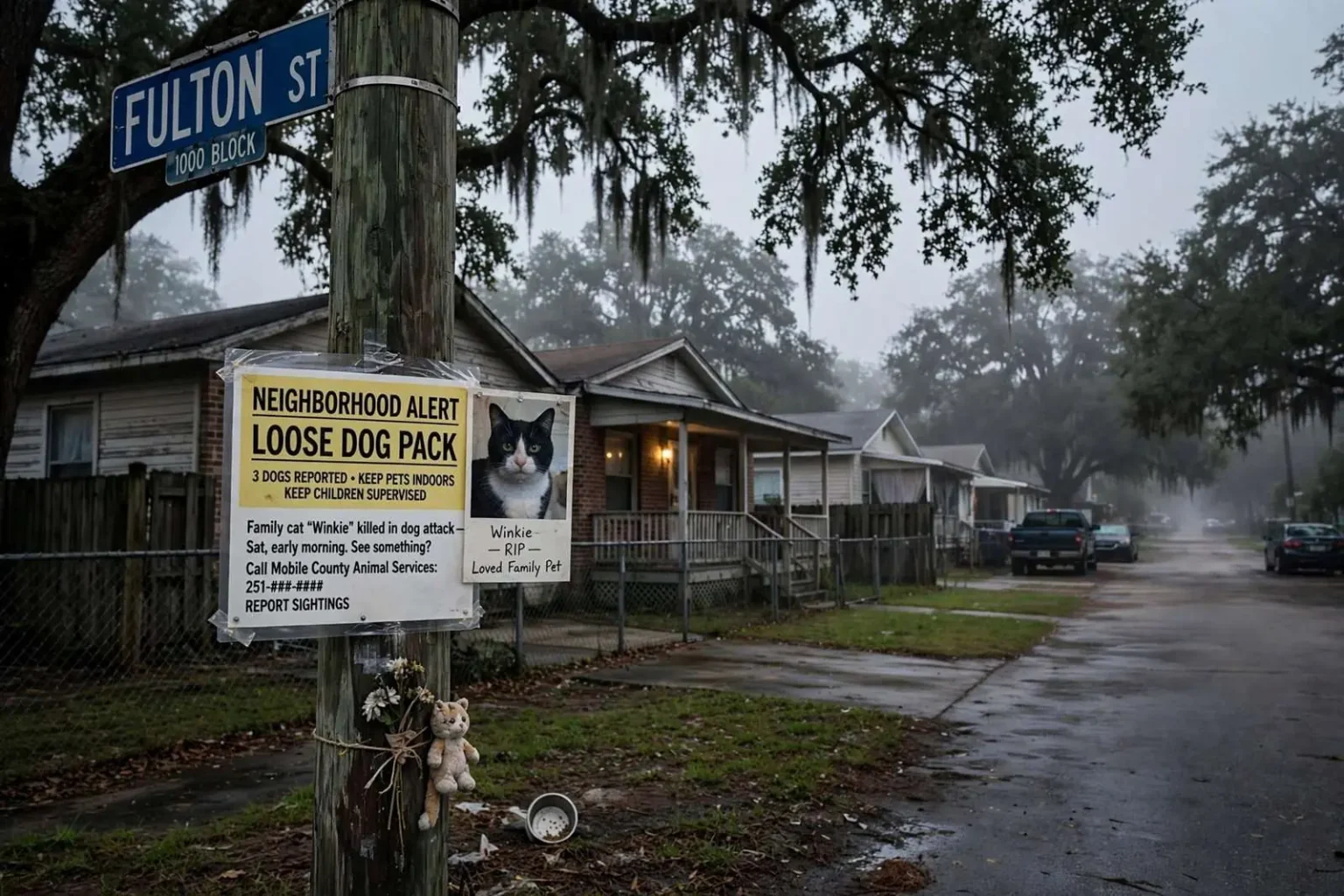
Residents of a midtown Mobile neighborhood are on alert after a family cat was dragged away and killed by what one man describes as three brazen dogs, the latest in a string of suspected attacks that has people in the area worried about their pets and, increasingly, about themselves.
Sean Phinney said he heard a commotion outside his Fulton Street home early Saturday morning and went to investigate. What he saw, he said, was the family’s cat, Winkie, being dragged off by three dogs. The animals were gone by the time he could intervene, and the cat did not survive.
The incident has stirred anger and fear on the streets around Fulton Street, a residential stretch of midtown Mobile where front porches and fenced yards are common and outdoor cats have long been part of neighborhood life. For many residents, the question is no longer whether loose dogs are in the area, but who is letting them out, and what happens the next time one of them corners something smaller than itself.
Pattern of Attacks Suspected
Phinney believes the dogs he saw are the same ones caught on camera in midtown over the summer, when other homeowners reported seeing them attack their pets. If he is right, the animals have been working the same territory for months, and Saturday’s loss of Winkie was not an isolated event but part of a pattern that residents say has been building.
He is trying to spread the word so residents can band together to contain or catch the animals. That effort, sharing photos, camera footage and sightings between households, is often the first step in these situations, because a pack of dogs that ranges across several blocks is hard for any single family to document on its own. Coordinated reports also give animal control officers specific locations and times to target.
Neighbors say the latest incident has raised concerns not just for pets but for people. One resident, Bonnie Williams, said whoever is letting the dogs out, if it is intentional, should be worried about what could happen next: a small dog on a walk could just as easily become a target, or a person. Children waiting for school buses, joggers and older residents walking in the early morning all move through the same streets where the dogs have been seen, and a pack that has learned to chase animals does not always distinguish between a cat and a small child running away from it.
Why Packs of Loose Dogs Are Dangerous
Animal behavior specialists and animal control officers consistently warn that dogs behave differently in groups than they do alone. A single loose dog may bark at a passing cat and lose interest. Three or four dogs together can trigger what is known as pack or predatory behavior, in which the excitement of the group drives a chase that none of the individual dogs might have started. Once a chase begins, stopping it from a distance is nearly impossible, which is why packs of loose dogs are treated as a public safety issue rather than a simple nuisance.
The risk grows when dogs are allowed to roam regularly. Free-roaming dogs establish a territory, learn the routes where other animals move and become increasingly confident around people. In neighborhoods across Mobile County, animal services officers respond to hundreds of calls each year involving dogs at large, and the cases that end badly, whether for a pet, livestock or a person, almost always involve animals that had been roaming for some time.
What Mobile Residents Can Do
Residents who spot the dogs are encouraged to report each sighting to Mobile County Animal Services or the city’s animal services office, with the location, time, number of animals and a description of each. Photographs and video from home security cameras, which are increasingly common in midtown neighborhoods, are especially useful because they let officers identify specific animals and confirm whether the same group is responsible for multiple attacks.
Officials generally advise residents not to attempt to confront or capture a pack of dogs themselves. A pack that has already killed pets is capable of turning on a person who gets between it and an escape route, and the safest approach is to get indoors, keep children and pets inside, and call. Trapping a specific pack usually requires baited traps set by animal control officers and patience over several days.
In the meantime, pet owners in the neighborhood are taking precautions that animal welfare groups recommend anywhere loose dogs are active: keeping cats indoors, walking dogs on short leashes and carrying something loud, such as a whistle, to break a dog’s attention during an encounter. Small dogs are safest walked close to their owner rather than at the end of a retractable lead, which gives a charging dog several feet of vulnerable leash to target.
The Legal Side: Owner Responsibility in Mobile County
Under Mobile County and city of Mobile ordinances, dogs are required to be confined to their owner’s property or under physical control, and owners of animals that attack pets or people can face citations and civil liability. When it can be shown that someone is deliberately releasing dogs to roam, the potential consequences rise sharply, because intent turns a confinement violation into something closer to reckless endangerment. That is the possibility that has residents like Bonnie Williams speaking out: if the same three dogs keep appearing and someone is letting them out on purpose, that person could ultimately be held responsible for everything the animals do.
Identifying the owner is often the hardest part. Dogs that roam regularly may belong to a household in the neighborhood, may be semi-owned animals that several families feed but none confines, or may be truly stray. Animal services officers use registration records, microchip scans and neighborhood canvassing to track ownership, and residents’ camera footage of where the dogs enter and leave a property can make the difference between a dead-end call and an enforcement case.
The Cost to a Family
For the Phinney household, the loss is personal. A family cat like Winkie is part of the daily rhythm of a home, and the manner of the loss, dragged away within earshot of the family, has made the neighborhood’s anger all the sharper. Pet owners who have been through similar attacks describe the same mix of grief and helplessness, along with the lingering fear of letting children or surviving pets outside.
Incidents like this one also tend to galvanize neighborhoods. Group messaging threads, social media pages and porch-light networks fill with sighting reports, and residents who had never met compare notes about when and where the dogs appear. That network effect is exactly what Phinney says he is trying to build, because containment and capture require dozens of eyes rather than one.
Looking Ahead on Fulton Street
Until the dogs are caught or confined, residents of the midtown neighborhood say they are watching the streets differently. Morning walks have gotten shorter, cats are staying inside, and homeowners are checking their cameras each day for another sighting. The hope is that coordinated reports will bring animal services officers and, if needed, law enforcement into the effort before the pattern that claimed Winkie claims another pet, or worse.
The episode is a reminder that a neighborhood’s safety sometimes depends on neighbors acting together on small warnings. A commotion in the dark, a blurred camera clip, a missing cat: taken alone, each is easy to dismiss. Put together, they describe a pack of dogs that has learned to hunt inside the city, and a community that has decided it will not wait for a worse headline before doing something about it.
How Animal Services Responds to a Pack Complaint
When calls about a specific pack of dogs start arriving from the same neighborhood, animal services typically escalates its response. Officers may increase patrols during the hours when the animals have been seen, often early morning and late evening, and set baited humane traps at locations residents have identified. The agency asks complainants to keep reporting every sighting even after a trap is in place, because movement patterns shift and a trap set on the wrong corner catches nothing. Officers also coordinate with police when an animal is considered dangerous, and in cases where a person is attacked or threatened, law enforcement takes the lead on the scene.
Documentation from residents feeds directly into that process. A log of dates, times, locations and descriptions, backed up by video clips, allows animal services to establish that the same animals are involved in repeated incidents. That record matters both for locating the pack and for any enforcement action against whoever owns or releases the animals, since repeated violations carry stiffer penalties than a first offense.
Public health is another piece of the response. Dogs that roam without vaccination records raise rabies and parasite concerns, and an attack on a pet usually triggers a quarantine investigation if the offending animal is caught. Health officials advise anyone bitten or scratched by an unknown dog to wash the wound thoroughly, seek medical care and report the bite so the animal can be located and observed.
A Neighborhood Decides Not to Wait
What is happening around Fulton Street is playing out in neighborhoods across the Gulf Coast as loose-dog complaints rise in growing communities. The difference here is that residents are organizing early, before a person is hurt. The family that lost Winkie has turned its grief into a neighborhood effort, and longtime residents have taken up the cause, sharing what they know and pressing officials for action.
Animal welfare advocates say that kind of response is exactly what works. Packs are caught not by chance encounters but by sustained, detailed reporting from the people who live where the animals roam. Each camera clip, each phone call and each conversation between neighbors narrows the territory officers have to cover. For the midtown Mobile residents watching their streets a little more closely these days, the goal is simple: get three dogs off the streets before the next commotion in the dark ends with another family standing in its yard, searching for a pet that is not coming home.


