
FBI and Base Commander Brief Reporters on Ongoing NAS Pensacola Attack Investigation
The FBI and NAS Pensacola's commander briefed reporters on the ongoing terror attack probe, locked iPhones and the base's continued public closure.
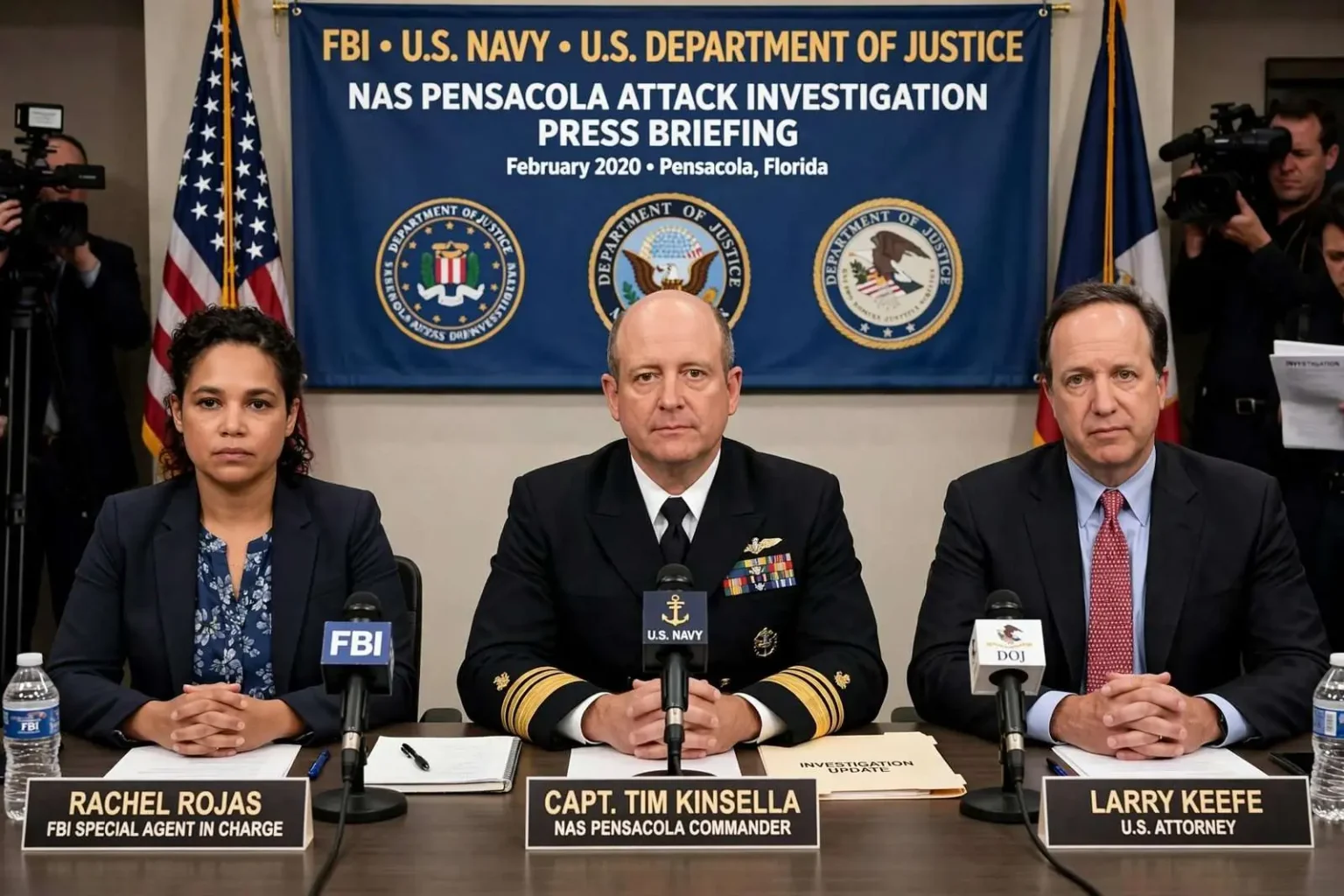
Nearly eight weeks after the terrorist attack at Naval Air Station Pensacola, FBI agents sat down with local reporters to update the public on the investigation — and on what comes next for a base still closed to outsiders.
FBI Special Agent in Charge Rachel Rojas appeared alongside base commander Capt. Tim Kinsella and U.S. Attorney Larry Keefe. Among the most stubborn obstacles, Rojas said, remains the shooter’s two iPhones: the FBI will keep pressing Apple to grant investigators access to the locked devices.
The Phones That Won’t Open
The encrypted phones have become the defining evidentiary problem of the case. Investigators believe the devices may hold communications and context that would complete the picture of how the attack came together, but the security features that protect ordinary users’ data also shield whatever the phones contain. Without Apple’s assistance, the FBI has limited ability to examine what is stored inside them, and Rojas made clear that the bureau’s request for the company’s help remains active rather than abandoned.
The standoff echoes a dispute that has run for years between federal investigators and technology companies, one that has repeatedly landed in courtrooms and congressional hearings: manufacturers argue that weakening their encryption for law enforcement would weaken it for everyone, while investigators argue that evidence critical to protecting the public sits unreachable behind the locks. For the families and colleagues affected by the Pensacola attack, the debate is not abstract — it determines whether answers arrive at all.
Base Remains Closed While Navy Review Continues
Although FBI personnel left the base weeks earlier, NAS Pensacola is still off-limits to the general public. Capt. Kinsella said he could not say when visitors would again be able to reach the Pensacola Lighthouse and the National Naval Aviation Museum, explaining that the Navy must finish its own investigation before access can be restored.
The closure matters far beyond the base gates. The National Naval Aviation Museum is one of the most visited attractions on the Gulf Coast, a free museum that draws visitors from across the country to see its collection of historic aircraft, and the Pensacola Lighthouse has stood on the western end of the base since the 1800s, guiding ships into the deepwater harbor that made Pensacola a naval city. Both sit inside the installation’s security perimeter, so the shutdown of public access effectively suspended two of the area’s signature destinations.
The region’s tourism economy felt the loss in real time. Hotels, restaurants and tour operators in Pensacola and the surrounding communities count on the steady stream of museum visitors and aviation enthusiasts, particularly during the season when the Navy’s Blue Angels, who train at the base, perform over the water. Every week of closure is a week the community waits — and a reminder that the investigation’s pace, not local preference, sets the calendar.
Kinsella’s message to the public balanced patience with reassurance: the Navy’s review runs its own course alongside the FBI’s criminal investigation, and reopening the gates before it concludes is not an option he is willing to consider. When the review is complete, the museum and lighthouse will return to the visiting public that has long treated them as essential stops.
Saluting the First Responders
The briefing also honored the heroism of local first responders and others on base during the December 6 attack — especially Escambia County sheriff’s deputies who entered the scene and killed the gunman.
“When our Navy security forces arrived on scene, they were alone trying to do their best. Then when Escambia County came within minutes to back them up, it was like the 7th Calvary coming to the scene,” Kinsella said. “They were fantastic.”
The commander’s account described a sequence familiar to anyone who studies emergency response: base security personnel confronting the shooter first, with county deputies arriving in minutes to reinforce them and end the threat. The coordination between military security forces and local law enforcement, rehearsed in joint trainings across the region, was credited with keeping the loss of life from growing.
Rojas noted that several responders were set to receive the Medal of Valor the following day. “Them being honored tomorrow with the Medal of Valor is deserving, and we are so appreciative and really just proud,” she said.
The Medal of Valor is among the highest recognitions a public safety officer can receive, awarded to those who demonstrate extraordinary courage in the face of immediate danger. The honorees from the Pensacola response earned theirs by running toward an active shooter on a military installation — a decision the speakers at the briefing returned to repeatedly as the clearest example of the day.
The awards ceremony was scheduled for Friday at 10 a.m. at Marcus Pointe Baptist Church in Pensacola, with the public invited. The choice of a church sanctuary large enough for a community crowd reflected the scale of the moment: an official recognition not just of the individual officers, but of a region’s gratitude to everyone who responded when the base needed help.
What Comes Next
For the FBI, the work continues on multiple tracks: the effort to gain access to the phones, the interviews and evidence review that accompany any terrorism investigation, and the coordination with prosecutors about what the record will ultimately show. Rojas framed the bureau’s commitment in straightforward terms — the investigation will not be considered finished while questions remain open, and the requests to Apple remain part of that unfinished business.
For the base, the path forward runs through the Navy’s own review. Commands across the military have been reexamining security procedures for international personnel and installation access since the attack, and Pensacola, as the site often called the Cradle of Naval Aviation — where generations of naval aviators, including the Blue Angels, have trained — sits at the center of those conversations. When Kinsella can announce a reopening date for the museum and lighthouse, it will signal that the Navy has reached the conclusions it needs from the review.
For the community, the weeks since the attack have been a study in patience and remembrance. Escambia County’s deputies, the base’s own security forces, and the medical and emergency personnel who handled the aftermath have been recognized repeatedly at public events, and Friday’s Medal of Valor ceremony gives the region a formal moment to say what residents have said informally since December: the response saved lives.
The briefing itself served a purpose beyond the headlines. Eight weeks into an investigation that spans federal agencies, foreign partners and a stalled dispute with one of the world’s largest technology companies, the three officials offered the public what they could — an accounting of where things stand, a promise to keep pressing for the evidence, and a pledge that the base will reopen when the Navy’s work is done, and not before.
The presence of the U.S. Attorney at the briefing underscored the case’s seriousness. Federal terrorism prosecutions bring resources and penalties far beyond ordinary criminal matters, and the district’s top federal prosecutor sitting beside the FBI’s special agent in charge signaled that the Justice Department is managing the Pensacola attack as a national priority rather than a local incident. The coordination between the prosecutors, the bureau and the Navy also spared families and the public the confusion of competing accounts from separate agencies.
The attack itself, carried out on December 6 at the installation where student naval aviators train, shook a community whose identity is inseparable from the Navy. Pensacola has hosted naval aviation since the early twentieth century, and generations of local families have served, worked or welcomed the students who pass through the base each year. An act of terrorism on those grounds struck close to home for nearly everyone in the region, which is why the questions at the briefing ran less toward politics than toward practical concerns: when the phones open, when the gates open, and how the responders will be honored.
Two of those three questions now have at least provisional answers. The honors come Friday morning at Marcus Pointe Baptist Church, where the public will be able to stand for the officers who stood for the base. The gates reopen when the Navy finishes its review. The phones — and the full account of the attack they may contain — remain the open question, and the FBI says it intends to keep asking.
Local reporters pressed on the timing of both the phone dispute and the reopening question, and the officials’ answers made clear that neither is on a fixed calendar. Encryption litigation and technical work move at their own pace, and the Navy’s review will conclude when its findings are complete. What the public got instead was a commitment to transparency along the way — briefings like this one, held close enough to the investigation’s progress to be meaningful.
The region has learned to measure recovery in those markers. A ceremony honoring the deputies and security personnel, a reopening date for the museum and lighthouse, and ultimately an answer to the encrypted-phone question each represent a step back toward normal life for a base and a city still processing the attack. Eight weeks in, two of those steps are scheduled or in motion, and the third remains the FBI’s unfinished work.


