Federal kidnapping charges dropped against Mobile mother accused of taking sons from Pascagoula foster parents
Federal charges were dropped against Sara Caswell of Mobile, accused of kidnapping her two sons from foster parents in Pascagoula, Mississippi.
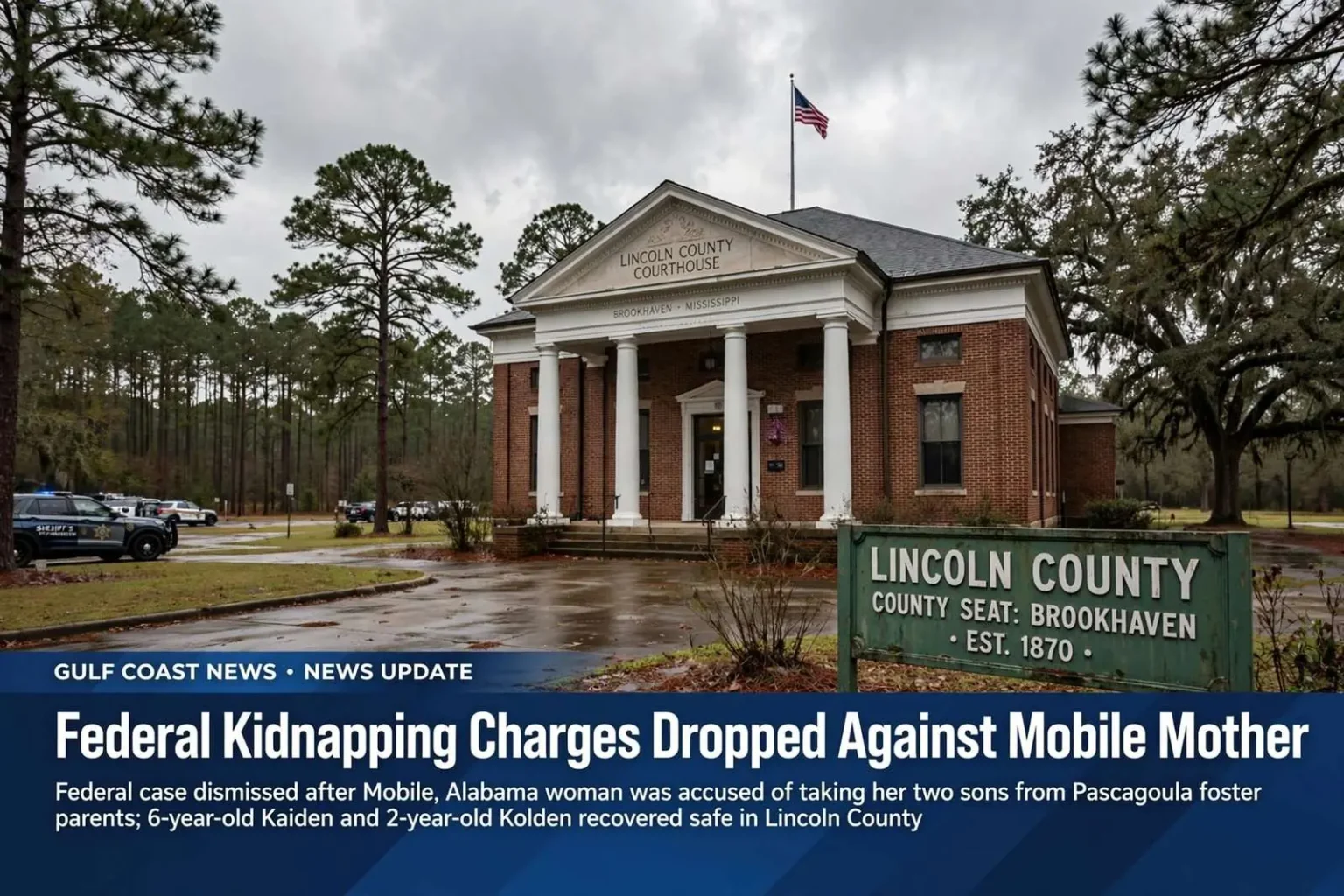
Federal kidnapping charges have been dropped against a Mobile, Alabama woman accused of taking her two young sons from their foster parents in Pascagoula, Mississippi, according to court documents filed this week. The dismissal closes the federal chapter of a case that drew attention on both sides of the state line, though the documents do not detail the reasoning behind the decision to drop the charges. The boys at the center of the case, 6-year-old Kaiden Wall and 2-year-old Kolden Wall, were recovered safe after a multi-state search, and no injuries were reported in connection with their recovery.
Sara Caswell of Mobile was taken into custody after she and her sons were found in Lincoln County, Mississippi, a mostly rural county in the southwestern part of the state whose county seat is Brookhaven. An AMBER Alert had been issued the previous Sunday morning after police said the boys were taken three days earlier, during a supervised visit with their foster parents in Pascagoula. What began as a custody dispute escalated into a search that stretched across two states and involved authorities in Mississippi and Alabama, along with an AMBER Alert that spanned county lines.
How the search unfolded
The case began, by every account released so far, as a supervised visitation — the kind of structured contact that courts and child welfare agencies arrange when a child is in foster placement but a parent still retains visitation rights. In such settings, visits typically occur at a designated agency office, a neutral facility, or another approved location, with a caseworker or supervised visitation monitor present. Police in Pascagoula said the boys were taken during one of those visits, a detail that immediately separated this case from an ordinary custody disagreement between two households.
Once the boys were reported missing and the AMBER Alert went out, the search took on a regional character. Pascagoula sits on the Mississippi Gulf Coast, roughly 30 miles from the Alabama line, and Interstate 10 connects the city directly to Mobile, making cross-border movement a realistic possibility that investigators had to account for from the first hours. Alerts and bulletins circulated to law enforcement across southern Mississippi and southwest Alabama, and the case drew attention across the Gulf Coast precisely because of its cross-state nature. The eventual recovery in Lincoln County, more than 150 miles inland from the coast, underscored how far the search radius had widened before the boys were found.
The federal charge and why it mattered
Federal prosecutors became involved in the case at some point after the recovery, and the charging decision itself reflected the geography of the episode. Federal kidnapping statutes can come into play when a child is transported across state lines, and cases that begin as parental abductions are sometimes referred to federal authorities when the conduct spans more than one state’s jurisdiction. That referral placed the matter in federal court even though the underlying events — a supervised visit in Pascagoula and a recovery in Lincoln County — both occurred inside Mississippi.
The dismissal of those federal charges was filed this week, and the court documents do not detail the reasoning behind the decision. Prosecutors are not required to explain a declination, and dismissals of this kind can happen for a range of reasons, including assessments of whether the evidence fits the federal statute, decisions about where the case is best handled, or developments in the underlying custody matter. What the documents do make clear is that the federal case against Caswell has been dismissed. It remains publicly unknown whether any state-level proceedings are pending, and this report does not speculate beyond what the filings and prior police statements show.
AMBER Alerts and how they work across the Gulf Coast
The AMBER Alert system that carried this case to the public is a cooperative program between broadcasters, transportation departments, and law enforcement agencies. Alerts are reserved for the most serious child abduction cases and generally require a confirmed abduction, a belief that the child is in imminent danger of serious bodily harm or death, and enough descriptive information — a vehicle, a direction of travel, or identifying details — to make a public appeal useful. When those thresholds are met, the alert interrupts radio and television programming, pings mobile phones across a designated area, and lights up highway message boards.
Because the Gulf Coast is a dense corridor of interstates running east and west — Interstate 10 above all, but also U.S. 90 along the shoreline and U.S. 49 running north from the coast into central Mississippi — an alert issued on the coast can quickly need to reach drivers and residents far inland. Alerts in Mississippi are coordinated through the state’s bureau of investigation and can extend into neighboring states when investigators believe a suspect may have crossed a border. Alabama operates its own AMBER Alert program through the Alabama Law Enforcement Agency, and the two systems routinely share information when a case, like this one, involves both states.
Mobile County, home to Caswell’s city of residence, has its own history of high-profile cross-border child recovery cases, and local agencies participate in regional task forces that coordinate on missing-child matters. The readiness of agencies in both states to act on a single alert is one of the practical products of that long-standing cooperation, and it is the mechanism that allowed a case that started at a visitation office in Pascagoula to end with a traffic stop or field contact in a county more than two hours away.
Foster care, foster parents, and the courts
The case also turned a public spotlight on the position of foster parents, who care for children removed from their homes by court order while the family works toward reunification or another permanent outcome. Foster placements on the Gulf Coast are administered through state child welfare agencies — the Mississippi Department of Child Protection Services in the boys’ case — with local courts retaining oversight of each child’s case plan, including what contact a parent may have and under what conditions.
Supervised visitation is one of the most common tools in that system. It allows a parent to maintain a relationship with a child while a court or agency monitors safety, and it is typically ordered when there are unresolved concerns about a child’s welfare. Visits of this kind are scheduled, observed, and documented, and taking a child from a supervised visit without authorization is treated by police as an abduction rather than a scheduling dispute. That is the legal framework police in Pascagoula invoked when they said the boys were taken during a supervised visit with their foster parents.
Child welfare cases of this kind move on parallel tracks. The criminal track addresses the alleged taking itself, whether charges are filed at the state or federal level. The family-court track, meanwhile, addresses the children’s placement and the parents’ rights going forward, and it continues regardless of what happens to any criminal charge. Dismissal of a federal charge does not by itself resolve the custody question, and courts handling the family-side of such a case weigh the child’s safety, the parent’s compliance with court orders, and the recommendations of caseworkers.
What the dismissal means and what remains unclear
For residents following the case along the Gulf Coast, the most immediate questions are what happens to Caswell now and where the boys will live. The public record so far answers neither. The court documents confirming the dismissal do not detail the reasoning behind it, police statements have not indicated whether state charges were ever filed or contemplated in Mississippi, and no statements have been released about the boys’ current placement. Any family-court proceedings would ordinarily be confidential, which is standard in child welfare matters in both Mississippi and Alabama.
What the documented record does establish is the arc of the case: a supervised visit in Pascagoula on a weekday; an AMBER Alert issued the following Sunday morning; a recovery of the boys, safe, in Lincoln County, Mississippi; the custody of Sara Caswell; federal charges that followed; and a dismissal filed this week with no stated rationale. The matter began as a custody dispute that escalated into a multi-state search, and the case drew attention across the Gulf Coast because of the cross-state nature of the investigation, involving authorities in Mississippi and Alabama and an AMBER Alert that spanned county lines.
The distance between the visitation site and the recovery location — from the industrial waterfront of Pascagoula to the piney woods around Brookhaven — illustrates the regional scale on which these cases are now worked. Rural counties like Lincoln County have sheriff’s offices with small staffs, and their ability to respond quickly to an alert from another part of the state depends on the coordination systems built between state bureaus of investigation, local dispatch centers, and neighboring states. In this case, those systems produced a safe recovery, which is the outcome every participant in the alert network is working toward.
Regional context: why cross-border cases are common here
The central Gulf Coast is one of the most naturally porous regions in the country for this kind of case. The Mobile metropolitan area and the Mississippi coastal counties form a single continuous population corridor, with thousands of residents crossing the state line daily for work, school, shopping, and family visits. Mobile and Pascagoula are connected not only by Interstate 10 but by U.S. 90 and a web of secondary roads, and a driver can move between the two cities in under an hour without passing through any significant chokepoint.
That geography is a feature of daily life on the coast, but it complicates child recovery work, because a child taken in one state can be in another within minutes. It is the reason AMBER Alert activations in this region are frequently multi-state from the outset, and why agencies in Mobile County and along the Mississippi Coast maintain standing relationships rather than improvising cooperation case by case. The Caswell case, which began with a visitation in Pascagoula and ended in Lincoln County, is a working example of how those relationships function — and of why, when the alert went out, law enforcement from two states was watching for the same vehicle.