FEMA reopens mobile registration centers in Theodore, Grand Bay and Foley
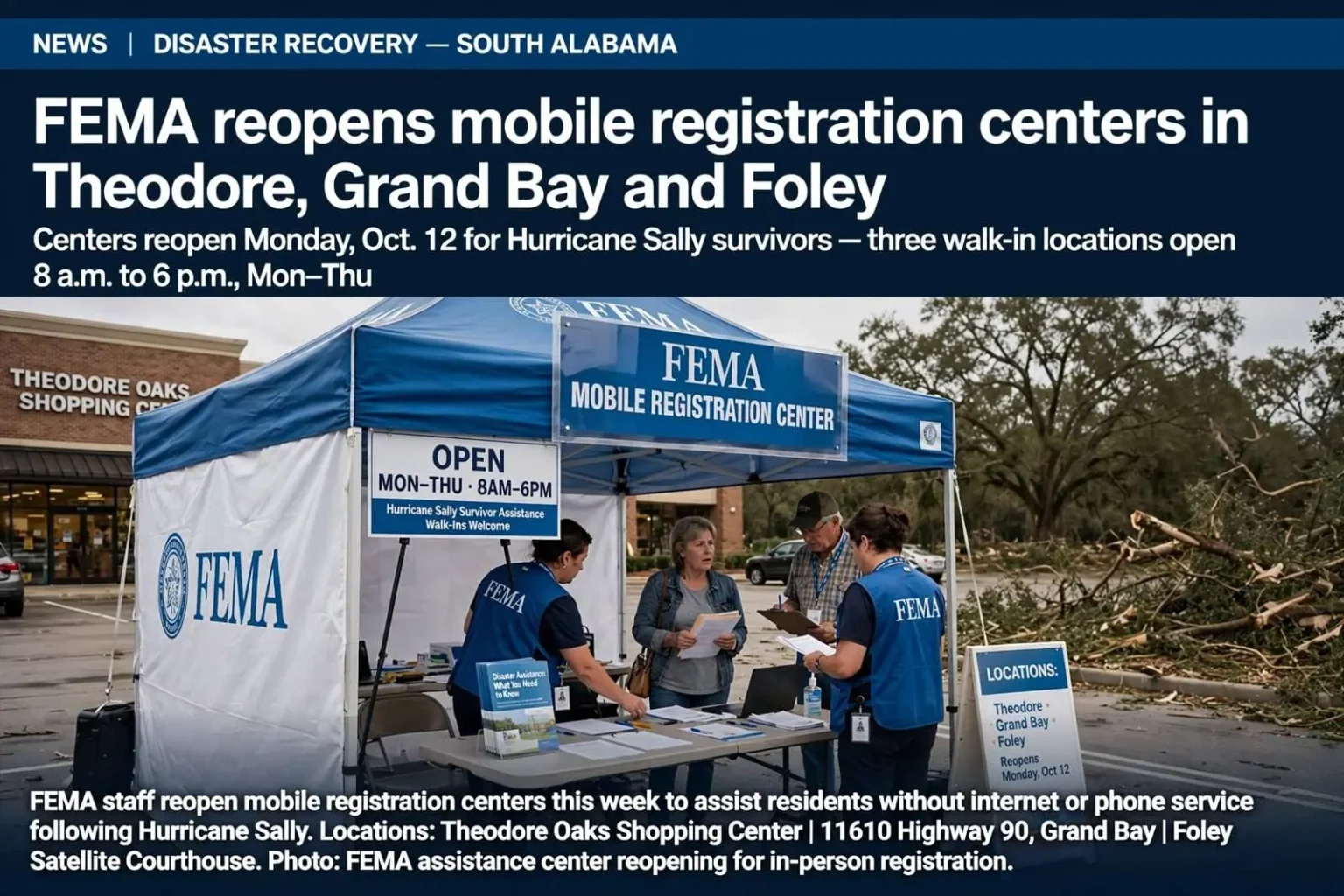
FEMA will reopen mobile registration centers in Theodore, Grand Bay and Foley on Monday, Oct. 12, for Hurricane Sally survivors.
Centers reopen Monday
FEMA will reopen mobile registration intake centers on Columbus Day, Monday, Oct. 12, for Hurricane Sally survivors in south Alabama, giving residents three walk-in locations to apply for federal disaster assistance in person.
The centers will open at the Theodore Oaks Shopping Center at 5808 Highway 90 in Theodore, at 11610 Highway 90 in Grand Bay, and at the Foley Satellite Courthouse in Baldwin County. Each location will be open Monday through Thursday from 8 a.m. until 6 p.m.
The mobile centers exist to help residents who may be without internet or phone service — a widespread problem after Hurricane Sally, which knocked out power to hundreds of thousands of Gulf Coast customers and damaged communications infrastructure across south Alabama when it came ashore in mid-September. Survivors who have internet or a phone can sign up for assistance at disasterassistance.gov or by calling the FEMA Helpline at 800-621-3362.
What the mobile centers do
A FEMA mobile registration intake center is a staffed walk-in station where survivors can apply for assistance, check the status of an existing application, update contact information, submit documents and get questions answered about the programs available. Staff at the centers can walk applicants through registration step by step, which matters for older residents, those without reliable internet access, and anyone whose records were damaged in the storm.
The centers do not distribute money or goods on site. Instead, they are the front door to the federal assistance process: a survivor registers, FEMA verifies eligibility and damage, and assistance is disbursed through direct deposit or mail. The intake step is essential because federal law requires individual registration before any assistance can flow — there is no automatic enrollment based on location or damage.
Location choices follow the damage pattern. The Highway 90 corridor through Theodore and Grand Bay took some of Mobile County’s heaviest Sally damage, with the storm’s landfall pushing wind and water through south Mobile County communities. Foley, in the heart of Baldwin County, served survivors on the eastern side of the bay, where Sally’s winds also downed trees and power lines across wide areas.
What survivors can apply for
FEMA’s individual assistance programs for a disaster like Sally cover a defined set of needs. Housing assistance can include money for temporary rental housing, home repair to make a damaged house safe and habitable, and, in limited cases, replacement of a destroyed home. Other Needs Assistance covers personal property replacement, moving and storage costs, and other disaster-related expenses not covered by insurance.
Applicants should be ready with the basics: their address, a description of the damage, insurance information if they have a policy, income details, and contact information where FEMA can reach them and where assistance checks can be sent. A phone number and email that survive the recovery process are worth establishing early, since FEMA correspondences about inspections and determinations follow up by phone and mail.
Homeowners and renters both can register. Renters who lost belongings or housing may qualify for assistance even though they do not own the damaged property, a distinction many applicants don’t realize. Survivors with insurance should still register — FEMA assistance can cover gaps that insurance does not, though the agency cannot duplicate benefits an insurance policy pays.
Hurricane Sally’s impact on south Alabama
Sally made landfall near Gulf Shores in mid-September as a strong Category 2 hurricane, the first hurricane to come ashore in Alabama since Ivan in 2004. The storm’s slow forward speed compounded its damage, dropping torrential rain across the Panhandle and south Alabama — more than two feet in some areas — while sustained hurricane winds drove storm surge into coastal communities and toppled trees across the region.
The damage picture spanned two counties in this part of the coast. In Mobile County, communities south of the city along the bay and the Highway 90 corridor took wind and surge damage. Baldwin County, east of the bay and nearest the landfall point, saw some of the storm’s worst destruction, from coastal Gulf Shores and Orange Beach inland through Foley, Robertsdale and beyond. Power outages in the storm’s aftermath reached into the hundreds of thousands of customers, and weeks passed before the last residents were restored.
The president issued a major disaster declaration for Alabama after the storm, activating federal individual assistance for affected residents in designated counties. That declaration is what made FEMA’s registration process and the mobile centers possible, and the centers’ schedule — Columbus Day through the week, 8 a.m. to 6 p.m. Monday through Thursday — reflects the ongoing demand for in-person help weeks after landfall.
Why the centers reopened
Mobile registration centers open and close based on demand and the flow of the recovery. Centers that closed after their initial run reopen when staff determine that survivors are still seeking in-person help — late registrants, residents whose circumstances changed, applicants following up on denied or underpaid claims, and people who lacked access during earlier openings.
The Columbus Day reopening also served residents whose recovery was just reaching the application stage. Weeks after a hurricane, many survivors are still dealing with insurance adjusters, contractors and repairs, and some don’t apply for federal help until they see what their policies won’t cover. FEMA’s registration window extends for months after a declaration, and the agency typically keeps access channels open long past the storm’s immediate aftermath.
For residents who do have phone or internet access, applying online at disasterassistance.gov or calling the FEMA Helpline at 800-621-3362 remains the fastest route, and the agency encourages those channels for anyone who can use them — keeping the walk-in centers’ queues shorter for those who can’t.
What to expect when you register
Registration at a mobile center takes a matter of minutes with the right information in hand. Staff enter the applicant’s details into FEMA’s system, record the damage description, and issue a registration number that becomes the reference for everything that follows. That number should be kept handy — it is required for every follow-up call, appeal and status check.
After registration, most applicants for housing assistance receive a call to schedule a FEMA inspection. The inspector visits the damaged property, documents the damage, and reports to the agency, which then issues a determination letter explaining what assistance was approved, for what purpose, and what to do if the applicant disagrees. Determination letters matter: they govern how any awarded money must be used, and misused assistance can complicate future applications.
Applicants who are denied or believe their award was too small have appeal rights. Appeals must be submitted in writing within 60 days of the determination, and many early denials stem from fixable problems — missing documents, insurance that hadn’t settled yet, or damage misclassified at inspection. The mobile centers’ staff can explain the appeal process, though the appeal itself goes through FEMA’s written channels.
Other help beyond FEMA
FEMA assistance is only one strand of the recovery safety net. The U.S. Small Business Administration offers low-interest disaster loans to homeowners, renters and businesses in declared counties — often the largest single source of recovery funding, since loans can cover far more than FEMA grants, which are limited by statute. SBA loan applications frequently follow FEMA registration, and applying does not obligate the borrower to accept a loan.
Voluntary organizations active in disasters — church groups, the Red Cross, community foundations and charities — fill gaps federal programs don’t cover, from cleanup help to building materials. Long-term recovery committees organized at the county level coordinate those efforts as the immediate response fades, matching volunteer labor with residents whose needs outlast the news cycle.
Survivors should also be alert to fraud, which follows every disaster. FEMA never charges for registration or assistance, federal inspectors carry identification, and applicants should never pay anyone to file a claim or accelerate an inspection. Reporting suspected fraud protects both the survivor and the assistance programs on which the whole region relies.
Locations and hours at a glance
The three reopened centers give south Alabama survivors accessible coverage on both sides of Mobile Bay. In Mobile County, the Theodore Oaks Shopping Center at 5808 Highway 90 in Theodore serves the communities south of Mobile, while the center at 11610 Highway 90 in Grand Bay covers the county’s southwestern corridor. In Baldwin County, the Foley Satellite Courthouse serves the eastern shore communities still working through Sally’s aftermath.
Each location operates Monday through Thursday, 8 a.m. to 6 p.m. — a four-day week that concentrates staffing when demand is highest and gives the program flexibility as the recovery evolves. Centers can open, close and relocate as conditions change, and FEMA announces schedule updates through its news releases and local media.
Survivors who cannot reach a center in person are not out of options: registration at disasterassistance.gov runs around the clock, and the FEMA Helpline at 800-621-3362 handles applications and status questions by phone. The centers, the website and the helpline all lead to the same registration record — what matters is that each survivor registers once, accurately, and follows through on the determination letters that follow.