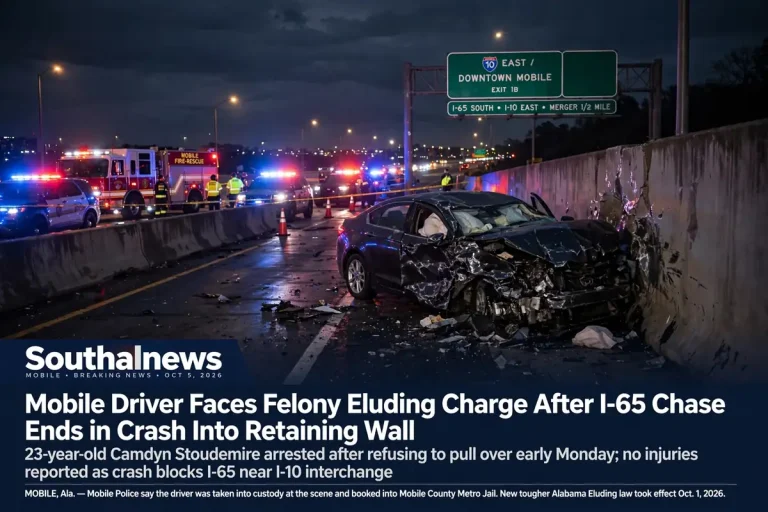
Few Members of the Public Turn Out to View Billings Murder Evidence in Pensacola
Surveillance video from the Byrd and Melanie Billings murder case went on public viewing at the Escambia County Courthouse, drawing only a handful of.
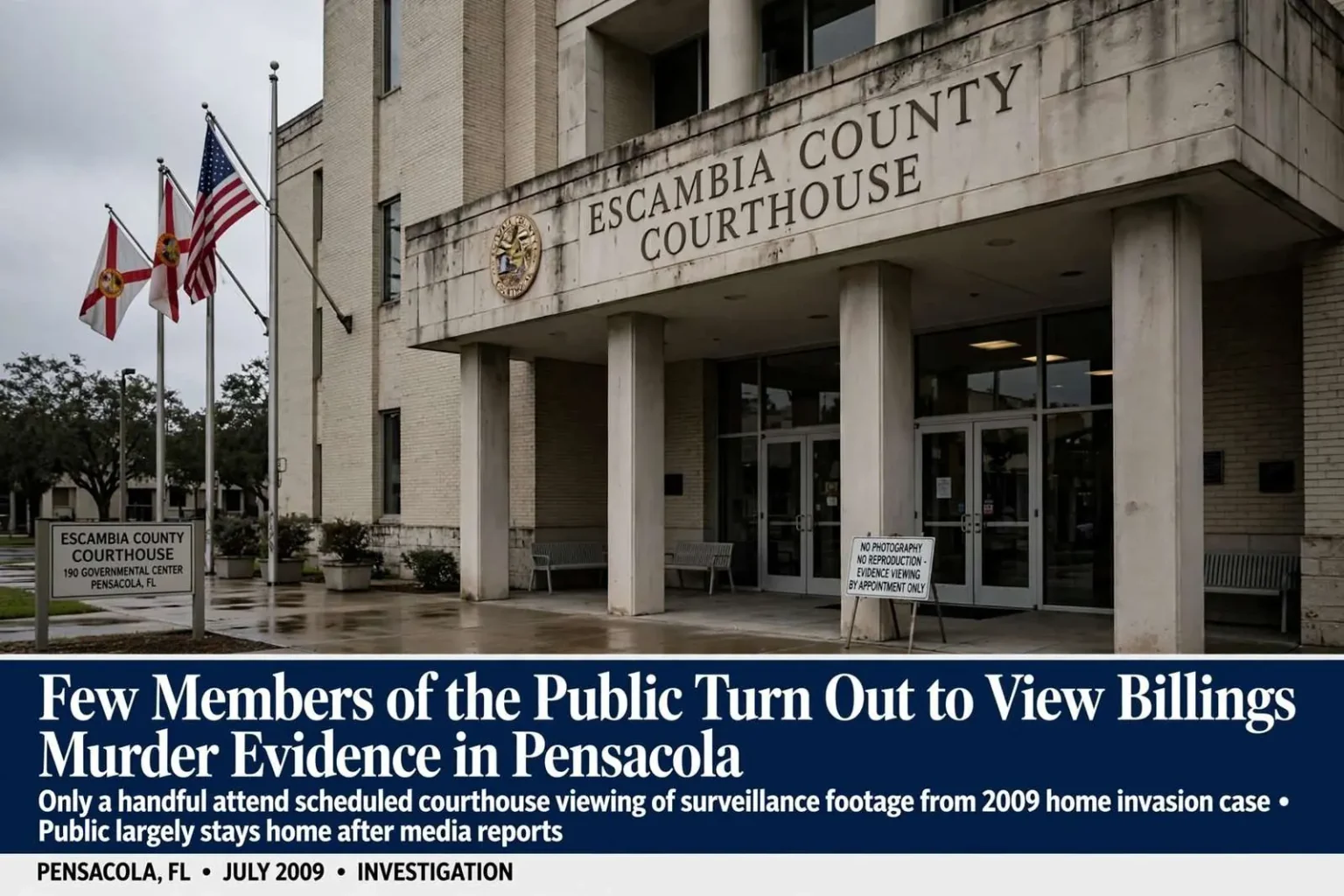
Hours of surveillance video and photographs from inside the Pensacola-area home of Byrd and Melanie Billings were released for public viewing at the Escambia County Courthouse, but the State Attorney’s Office said it was surprised by how few people came to see them.
The recordings, pulled from 16 cameras inside the couple’s Beulah home, captured the moments during and after the July 2009 home invasion in which the Billingses were killed. Among the footage is a child watching as the suspects entered the house.
State Attorney Bill Eddins said only a handful of people from the general public requested to view the materials. One woman who did attend, who asked not to be identified, said she came simply out of curiosity. Eddins suggested that media coverage describing the footage had satisfied most of the public’s interest: after reporters viewed the video and described its contents, many people who had scheduled sessions canceled their appointments.
A judge ordered that none of the videos or photographs be reproduced. The materials show Byrd Billings confronted in his living room by armed intruders before he and his wife were led to the back of the home; both were later found shot to death.
Seven suspects await trial
All seven people charged in the murders — Leonard Gonzalez Sr., Leonard Gonzalez Jr., Wayne Coldiron, Donnie Stallworth, Gary Sumner, Frederick Thornton and 16-year-old Rakeem Florence — have pleaded not guilty to two counts each of first-degree murder and one count each of home invasion robbery. The six adult defendants could face the death penalty; Florence, because of his age, faces a maximum of life in prison.
Sheriff David Morgan has also confirmed that Henry “Cab” Tice, a former business partner of Byrd Billings, was questioned in connection with the case. Morgan said investigators believe Tice, who faces theft charges, owed money connected to the Mexican Mafia, though they do not believe Billings himself had any ties to that organization. Pamela Long Wiggins has been charged with first-degree accessory after the fact and is held in the Escambia County Jail on $500,000 bond.
The public viewing arrangement itself was unusual enough to draw attention to how it was handled. Florida’s broad public-records law makes evidence in criminal cases presumptively available once it has been disclosed through discovery, and the Billings case — among the most notorious in modern Pensacola history — made its surveillance footage a matter of intense public interest. Rather than releasing copies that could circulate indefinitely, the court allowed viewing only at the courthouse, under supervision, with no reproduction permitted. The arrangement balanced Florida’s sunshine-law tradition against the dignity of the victims, the privacy of the surviving children, and the defendants’ right to a fair trial uncolored by widely circulated images of the crime itself.
The meager turnout said something about the difference between curiosity and appetite. In the weeks after the murders, national media had descended on Beulah, and the case’s details — a large adoptive family, cameras throughout the home, a crew of intruders — had been recounted endlessly in print and broadcast. What the courthouse sessions tested was whether that secondhand familiarity translated into demand for the raw record. It largely did not: reporters who watched the footage wrote what they saw, and the public, having absorbed those accounts, mostly stayed home. Eddins’s observation that canceled appointments followed the media’s descriptions suggested that for most people the account was the experience — the knowledge was enough, and the images were not something they needed to see.
The footage’s most haunting detail — a child watching the intruders enter — captured the dimension of the case that distinguished it from other home-invasion murders. The Billingses had adopted and fostered more than a dozen children, many with special needs, and the house they built in Beulah was designed around that family: the cameras that recorded the crime had been installed, by most accounts, to help the couple keep watch over children whose care demanded it. The intrusion that the cameras recorded was thus an intrusion on a household built deliberately for vulnerable children, and the children who were home that night — some of whom saw or heard parts of the attack — became both witnesses and survivors in the aftermath.
The case against the seven defendants moved forward on two tracks that would define its judicial history. The first was the sheer scale of trying seven co-defendants for a double murder — a logistical burden that courts typically resolve by severing trials, trying defendants in groups, and managing a witness list that included the children who were home that night. The second was the penalty phase calculus: six adults facing potential death sentences meant each trial carried two phases, guilt and penalty, each with its own evidence and its own jury deliberations. Florida’s death-penalty procedure — in which a jury’s recommendation is weighed by the judge under statutory standards — added a layer of legal scrutiny that would eventually reach the state’s highest courts as the cases moved through the system.
The financial thread that investigators wove through the case — the debts, the money owed, the business relationship between Billings and Tice — reflected the prosecution’s theory that the murders were not random. Sheriff Morgan’s public statements drew the outline: a former business partner under financial pressure, a debt connected to a violent organization, and a home invasion executed by a crew whose members were tied to one another through work and family. The theory’s corollary — that Billings himself had no ties to the Mexican Mafia — was an attempt to keep the victim’s memory distinct from the circumstances of his death: a man whose business dealings may have intersected with dangerous people, killed in a crime whose motives belonged to others.
Pamela Long Wiggins’s arrest on an accessory charge extended the case’s reach beyond the men who entered the house. Under Florida law, accessory-after-the-fact charges require knowledge of a crime and assistance in avoiding its consequences, and her $500,000 bond reflected the court’s assessment of the gravity of the accusation. Her role in the case — and the eventual outcomes of the charges against all the defendants — would be parsed in court filings and trial testimony for years, as the judicial system worked through the conduct of each participant in one of the Panhandle’s most examined crimes.
For the children the Billingses left behind, the courthouse sessions and the coverage they generated were one more stage of a loss whose public dimension never entirely receded. Guardians and family advocates in cases of this notoriety face the recurring task of managing what children encounter — footage descriptions, anniversary coverage, trial news — while preserving the ordinary structures of school and home that recovery requires. The community organizations and churches that rallied around the family in July 2009 continued that work through the judicial process, which would stretch across years and courtrooms before the last appeals concluded.
The viewing sessions at the Escambia County Courthouse closed a chapter in how the case lived in public. The evidence existed, it was available, and almost no one came — a quiet ending to the loudest part of the case’s public life. What remained was the machinery of the trials themselves: seven defendants, two counts each, and a legal process that would measure, in the language of verdicts and sentences, what the events of that July night in Beulah would cost the people who carried them out.
The Beulah community that surrounded the Billings home also lived with the case’s long shadow. The rural stretches of Escambia County west of Pensacola — where the family’s house sat among the fields and woodlots at the edge of subdivision Florida — had rarely figured in national headlines before July 2009, and residents found their community’s name attached to one of the state’s most notorious crimes. The case’s details were replayed in documentarians’ treatments, true-crime coverage, and anniversary reports for years afterward, and each retelling reopened the question of how a household known for taking in children who needed one became the site of such violence. Neighbors interviewed across that coverage returned to the same themes: the family’s generosity, the scale of the household, and the shock that the two facts could coexist with the events of that night.
The surveillance system itself became a subject of public fascination in the case’s aftermath. Sixteen cameras — covering entrances, hallways, and common areas of a home occupied by a large family of children with special needs — produced a continuous record of the intrusion that few crimes generate. Prosecutors’ reliance on that record was comprehensive: timestamps established the sequence of the entry, the movements of the intruders through the house, and the departure that ended the attack. Defense attorneys would contest the meaning of portions of the footage, as they contested every element of the state’s case, but the cameras’ existence removed the ambiguity that governs most homicide investigations. The trial that eventually unfolded was, in that sense, among the most documented murders in Florida’s judicial history — a crime whose every minute inside the house existed on video.
The judicial outcomes across the seven defendants would eventually span more than a decade of court proceedings. Trials were severed and staggered; juries heard overlapping evidence with defendant-specific theories of culpability; sentences ranged from the life terms available to the youngest defendant to death sentences for those the juries and judges found most culpable. The case also intersected with the evolving law of capital punishment in Florida — the U.S. Supreme Court’s Ring decision and later the state’s 2016 statute requiring unanimous jury recommendations for death — which reshaped the penalty phase for defendants whose cases were still moving through appeal as the law shifted beneath them. Each change added years to the final resolution of the case, and each hearing returned the details of the Beulah murders to the courthouse where the public had once been invited to view its evidence.
What the sparse turnout at the courthouse ultimately documented was the boundary of the public’s relationship to true crime. The Billings case had everything that draws sustained attention — a large and unusual family, a brazen attack, a cast of defendants whose connections traced through the region’s labor and financial underworlds — and the appetite for its story was satisfied by the accounts that media witnesses provided. The raw record, the thing itself, drew almost no one. In that gap between the story and the evidence lies a familiar truth: that the public’s interest in crime is an interest in narrative, and that the actual footage of a killing — silent, dark, and final — is not entertainment but evidence, viewed in a courthouse under a judge’s order, by the few whose role requires it.