Final Days for ‘Shoot’n Southern’: Women Photographers Past and Present at the Mobile Museum of Art
The Mobile Museum of Art's 'Shoot'n Southern' exhibit showcased 70-plus women photographers, from Eudora Welty to Mobile Bay area artists.
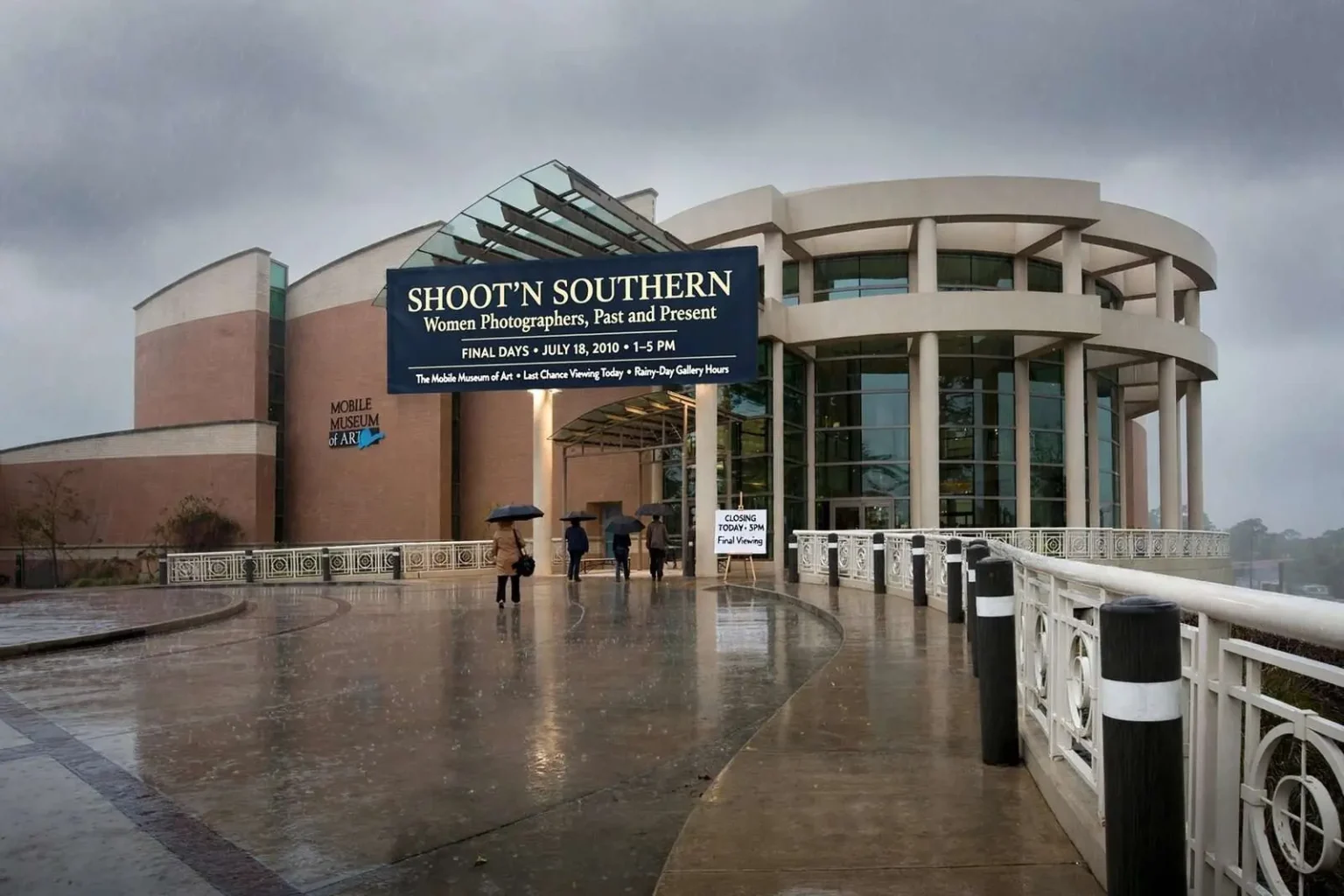
The Mobile Museum of Art closed out its summer exhibition “Shoot’n Southern: Women Photographers, Past and Present” with final viewing hours on Sunday, July 18, 2010, from 1 to 5 p.m. — a rainy-day option museum staff suggested for visitors looking to catch it before it left town. The closing marked the last chance to see one of the year’s most distinctive photography shows on the Gulf Coast, and staff were encouraging holdouts to use a stormy Sunday afternoon for exactly the purpose museums exist for.
The exhibit gathered the work of more than 70 female photographers, with particular attention to those carrying a Southern heritage or documenting Southern experience. That organizing idea gave the show its shape and its title: a survey of what the South looks like through the eyes of the women who photographed it, across generations, regions, and styles. Photography exhibitions of that scale are ambitious undertakings for a museum of Mobile’s size, and the breadth of the roster — more than seventy artists — made the show a genuine regional event on the 2010 arts calendar.
It reached from important 20th-century figures such as Rollie McKenna and writer-photographer Eudora Welty to early-career and established photographers working at the time. That span — nearly a century of image-making in a single gallery sequence — let visitors see both continuity and change: the Southern subjects that persist across decades, and the ways camera technology, artistic fashion, and the photographers’ own freedom to work evolved around them.
The big names: McKenna and Welty
Rollie McKenna, whose work anchored the historical end of the show, built her reputation as a portrait photographer of literary figures and as a documentarian of architectural landscapes, and her presence in the exhibition connected Mobile audiences to the mid-century heyday of American photojournalism and portraiture. Photographers like McKenna worked in an era when a woman with a camera had to fight for professional standing, which makes her survival in the historical record — and her inclusion in a show of Southern women — doubly significant.
Eudora Welty’s place in the exhibition underscored the show’s central argument. Welty is remembered primarily as one of the great American short story writers, a Mississippi author whose fiction defined Southern literature for much of the 20th century, but she was also a working photographer whose black-and-white images of Depression-era Mississippi documented the same people and places her stories would later populate. Her photographs are direct, unsentimental, and humane, and they read today as the visual companion to her prose.
Placing Welty in a photography exhibition invited visitors to see her eye before her fame: the composition, the attention to gesture and expression, the instinct for the moment a story starts. For many attendees, the Welty images were the show’s revelation — the famous author revealed as a photographer of real accomplishment, working the same Southern ground her fiction made immortal.
The local roster on the walls
The Mobile Bay area was well represented on the walls. Local photographers in the show included Pinky Bass, McLeod Turner, Leigh Jordan Brown, Sheila Hagler, Susan Downing-White, Melissa Springer, Rita Skiadas and Billie Goodloe. That roster spanned working photographers, educators, and longtime figures of the local arts community, and it made the exhibition as much a statement about Mobile’s own creative depth as about the wider South.
Pinky Bass, whose experimental and self-examining photography has made her one of the region’s most distinctive artists, brought the kind of work that resists easy categorization — images about memory, body, and place rather than documentation. Bass’s career, rooted in Fairhope and the Eastern Shore arts community, exemplified the “past and present” of the show’s title: an established artist whose work has evolved across decades, shown alongside photographers at earlier points on the same path.
The other local names filled out a portrait of a working photography community. Sheila Hagler and Melissa Springer built careers on editorial and documentary work along the Gulf Coast; Susan Downing-White’s precise images reflected her background in drafting and design; and photographers like McLeod Turner, Leigh Jordan Brown, Rita Skiadas, and Billie Goodloe represented the mix of fine-art, commercial, and community practice that keeps a regional photography scene alive. For Mobile audiences, the local section offered the pleasure of recognition — familiar places and people rendered by photographers they might actually meet at the museum’s opening.
What the exhibition argued about the South
Beneath its roster, “Shoot’n Southern” made a quiet scholarly claim: that the visual record of the South cannot be understood without the women who made it. Photography has historically been a field where women worked extensively — in studios, in documentary projects, in family and community archives — yet their contributions have often been treated as secondary to those of their male contemporaries. A show that gathered seventy of them, and put a Pulitzer-and-Presidential-Medal literary giant like Welty in the same frame as working Gulf Coast photographers, made the case in the most direct way a museum can: on the walls, image by image.
The “past and present” structure also let the show trace how Southern subjects have been handled across eras — the Depression-era documentarians, the mid-century modernists, and the contemporary artists who photograph the region with full knowledge of all the images that came before them. Visitors moving through the galleries walked, in effect, through a century of the South’s self-examination, much of it carried out by women whose names never reached the textbooks.
For the museum, the exhibition fit a broader institutional role. The Mobile Museum of Art, in Langan Park, serves as the largest art museum in the region, and its temporary exhibitions bring work to the Gulf Coast that would otherwise require a trip to New Orleans, Atlanta, or beyond. A show of this scope — more than seventy photographers, spanning nearly a century — is the kind of programming that justifies the museum’s place in the community and gives regional artists a professional stage at home.
The final Sunday and what it meant for Mobile’s arts calendar
The closing weekend carried the particular urgency that every exhibition generates as its end approaches: the sense that a chance is about to expire. Museum staff’s suggestion that a rainy Sunday was a good day to see the show was a practical nudge as much as a marketing line — Gulf Coast summers deliver plenty of afternoon storms, and a gallery is the ideal place to spend one. The 1 to 5 p.m. final session gave visitors a full afternoon to work through the seventy-plus photographers on view, and for many it was a second or third visit rather than a first.
For Mobile’s arts calendar in 2010, the show stood out as one of the year’s most substantial photography exhibitions — a survey of how Southern women have seen and recorded the region across nearly a century. Photography shows of that ambition are rare on the central Gulf Coast, and the exhibition gave local photographers the added benefit of seeing their own community’s work hung in a national context, between figures of Welty’s and McKenna’s stature rather than segregated into a regional afterthought.
Why shows like this matter to a city like Mobile
A port city’s cultural life depends on institutions that take risks on substantive programming. Mobile has invested in its museums, its historic districts, and its performing arts precisely because those assets do quiet economic and civic work: they draw visitors, they retain creative professionals, and they tell residents that the place they live is worth taking seriously. An exhibition like “Shoot’n Southern” — scholarly in its premise, popular in its appeal — is the product of that investment and an argument for more of it.
The show also documented something the region is still working through: the role of women in shaping how the Gulf South sees itself. Many of the seventy-plus photographers in the exhibition spent careers photographing communities that larger media organizations rarely visited closely — small towns, family gatherings, working waterfronts, church picnics. Their archives, built over decades, are now an irreplaceable record, and exhibitions that surface that material perform a historical service as much as an aesthetic one.
When the final hours ended at 5 p.m. on July 18, the exhibition came down and the walls prepared for whatever came next on the museum’s calendar. Shows leave quietly — crates, condition reports, and a gallery reset in a day — but their influence lingers in the students who came through on school tours, the local photographers who saw their peers on museum walls, and the collectors and donors who saw what a serious photography program can look like on the Gulf Coast.
What remained was the record: a summer in which Mobile saw nearly a century of Southern experience through the lenses of more than seventy women, from Eudora Welty’s Mississippi to Pinky Bass’s Eastern Shore — a reminder that the region has always been watched closely, and often best, by the women behind the cameras.