
Five Months After Stray Bullet Struck Mobile Boy in His Home, No Arrests Made
Five months after a stray bullet severed an artery in a 10-year-old's arm inside his Dobbs Avenue home, Mobile police report no arrests.
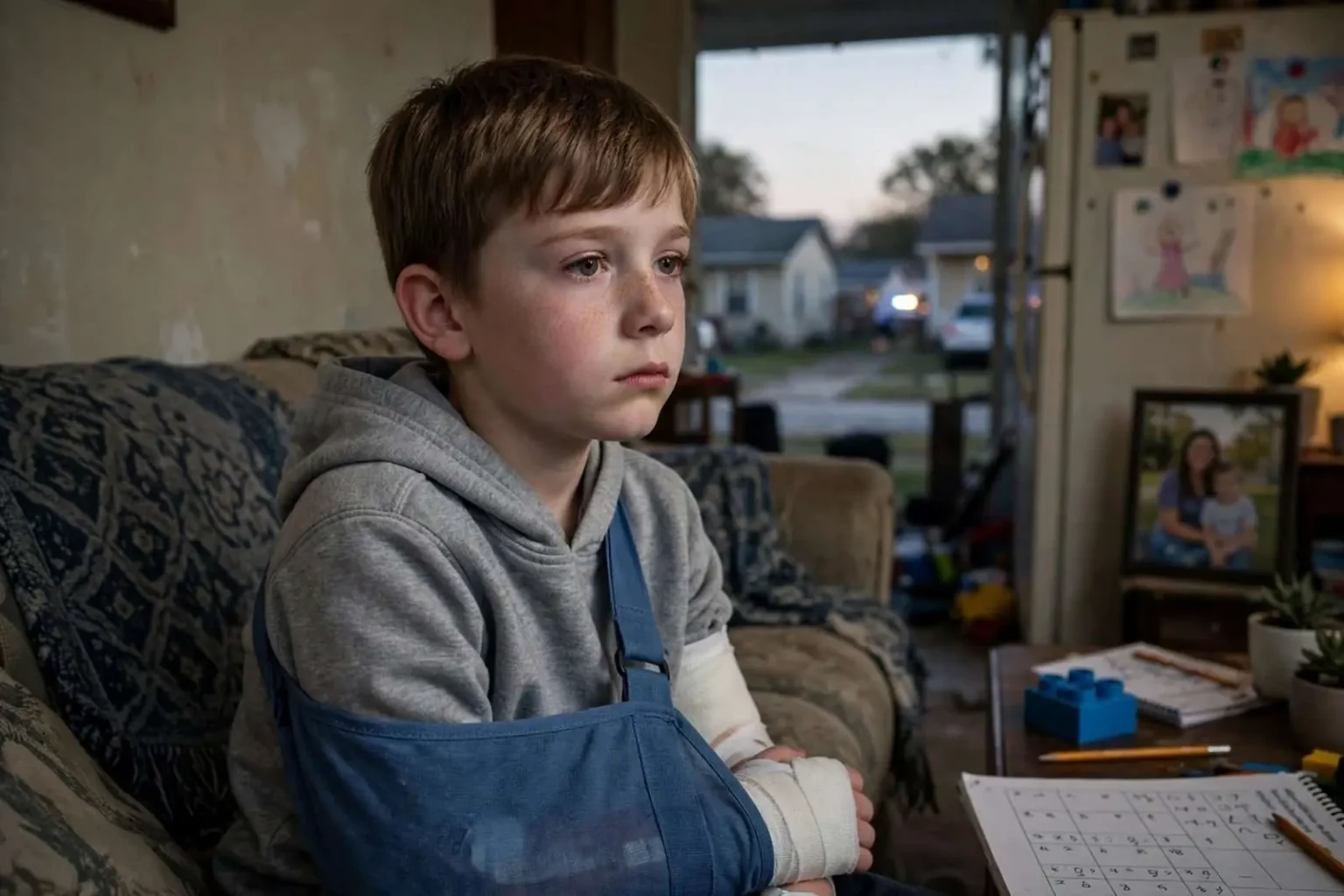
Five months after a bullet tore through a home on Dobbs Avenue near Emogene and Sage Avenue and struck a 10-year-old boy in the arm, Mobile police have made no arrests in the case — and the child at the center of it is asking the question his family cannot answer. Orion Comiskey was watching videos inside his mother’s home on December 4 when a gunshot severed an artery in his left arm, turning an ordinary evening in a midtown Mobile living room into a months-long medical ordeal that is not yet over.
He initially mistook the sound for lightning and didn’t realize he’d been hit until his mother told him. That detail — a child confusing gunfire for a December thunderstorm — captures how quickly and quietly the incident unfolded. There was no argument at the door, no confrontation visible from the yard; a bullet arrived from outside, crossed the walls of a family home, and struck a boy on his couch before he understood what had happened.
The family said two cars at the neighboring property were also riddled with bullet holes, evidence that more than one shot was fired and that the neighborhood itself, not Orion’s family specifically, absorbed the gunfire. They believe Orion was an innocent bystander — a child hit by rounds intended for no one inside that living room, fired by someone who has still not been identified five months later.
A Recovery Measured in Surgeries
The now-10-year-old has undergone two surgeries and attends physical therapy twice a week to rebuild muscle in the injured arm. An artery injury of that kind is among the most serious wounds a gunshot can inflict short of death — the kind of damage that threatens a limb before it threatens anything else, and that requires surgeons to repair blood flow first and function afterward. Orion’s two operations reflect that sequence, and the therapy schedule reflects the slow work of rebuilding what trauma and repair take from a child’s body.
He says his wrist aches when he becomes active, he can no longer tie his shoes, and a third surgery may be needed to repair the muscle. For a child, those losses are measured in ordinary childhood: shoelaces, playground games, writing assignments, the hundred small uses of a left arm that other 10-year-olds never think about. Physical therapy twice a week means the shooting remains part of his school-week rhythm half a year later, and the possibility of a third operation keeps the family’s medical chapter open indefinitely.
The psychological recovery runs alongside the physical one. Children injured in their own homes often carry a changed relationship with the place that was supposed to be safest, and the family’s account of that December evening — videos on the couch, thunder in the distance — is now the memory attached to the room where it happened.
Five Months Without an Answer
Orion said what bothers him most is that whoever fired the shot is still out there. “Why haven’t they caught the person that shot me yet,” he asked. It is the question that hangs over every unsolved neighborhood shooting, and five months after the fact, Mobile police are still asking for the public’s help answering it.
Anyone with information about the December 4 shooting is urged to contact the Mobile Police Department. In cases like this one, investigators depend on residents who saw or heard something that night — a car speeding away, voices outside before the shots, a stranger on the block in the days before. Tips do not need to be complete to be useful, and in a case with no arrest after five months, even a small detail can be the thread that pulls the whole account together.
The geography of the case places it in one of Mobile’s older midtown neighborhoods, where Emogene and Sage Avenues cross the blocks off Spring Hill Avenue and Dobbs Avenue sits among a mix of modest cottages, family homes, and longtime residents. It is the kind of neighborhood where children play in yards and families have owned their homes for generations — not the kind where a living-room shooting ordinarily happens, which is part of why the case has unsettled the streets around it.
What Stray Bullet Cases Demand
Stray bullet shootings present investigators with a specific and frustrating profile. There is usually no target standing in front of them — no victim who knew the shooter, no dispute to trace backward, no motive waiting at the scene. Instead there is a trajectory, a cluster of damaged property, and a collection of sounds and sightings that someone in the neighborhood must have registered. The cars riddled with bullet holes at the neighboring property give investigators multiple impact points to map, and from such mapping a direction of fire, a firing position, and sometimes a weapon type can be reconstructed.
The passage of five months without an arrest does not mean the case has gone inactive. Homicide and shooting investigations continue to build long after the news cycle moves on, and detectives revisit unsolved cases as new information arrives. What five months does mean is that the gap between what the neighborhood knows and what investigators can prove remains unfilled — and that the people who can fill it have not yet come forward, or have not yet been identified.
The family, for its part, has spent those five months doing what families in these cases do: attending therapy appointments, weighing the next surgery, and publicly asking the city for help. Their account of the evening — the lightning sound, the mother’s realization, the bullet-riddled cars next door — is itself an appeal, painted in the details only a household hit by gunfire can provide.
The Broader Cost of a Single Shot
The full ledger of the December 4 shooting extends well beyond one boy’s arm. There are the two surgeries and the possible third, each a major medical event with its own recovery and expense. There are the twice-weekly therapy sessions, the school days shaped around appointments, and the months of an adult-equivalent injury carried by a child’s body. And there is the neighborhood’s own accounting: two damaged vehicles, a family home with a bullet hole in it, and the quiet recalculation every nearby household performs after gunfire finds a living room.
That is the arithmetic Mobile residents are asked to weigh when a case like Orion’s goes unanswered. A single round fired carelessly produced a severed artery, a reshaped childhood, and a community holding an unanswered question — and it produced all of it in the time it took a 10-year-old to mistake a gunshot for thunder. The people who know who fired it live with the same arithmetic, and the Mobile Police Department’s request stands five months later: anyone with information about the December 4 shooting should come forward, for the boy on Dobbs Avenue who cannot tie his shoes and still wants to know why.
How Gunshot Trauma Shapes a Child’s Recovery
The medical path Orion is walking is one pediatric trauma specialists know well. A severed artery demands emergency repair because blood loss threatens the limb within minutes; once flow is restored, the focus shifts to the nerve, tendon, and muscle damage the bullet left behind. Each of his two surgeries addressed a stage of that sequence, and the possible third procedure — to repair the muscle — speaks to the layered nature of the injury. Muscle lost to a bullet and its aftermath does not regenerate on its own; surgeons must either repair what remains or reconstruct what was destroyed, and children’s bodies, though resilient, still heal on a schedule measured in months.
Physical therapy is where that healing becomes visible. Twice-weekly sessions work the injured arm through ranges of motion it resists, rebuilding strength the trauma took and retraining a child’s brain to trust a limb that failed him once. The wrist ache Orion describes with activity is a normal companion to nerve injury, and the small defeats — shoelaces that now require help — are the milestones his therapists are working to win back. Progress in these programs is real, but it is slow, and it runs on a calendar set by the healing body rather than by anyone’s impatience.
Families carry the schedule too. A parent whose child needs surgery, therapy, and follow-up imaging arranges work around appointments, manages insurance and expense, and watches for the signs — favoring the arm, guarding the scar — that tell her the injury still shapes her son’s days. Five months after the shooting, that is the Comiskey household’s routine, built around a wound caused by a bullet no one has answered for.
Why Every Detail Matters Now
Investigators weighing a five-month-old shooting case work backward from fragments, and the public’s memory is the most renewable source of fragments there is. Someone on Dobbs Avenue or the surrounding blocks heard the shots that night and knows how many there were; someone saw a car or a figure moving away from the area before the sirens arrived; someone has since heard a conversation, a boast, or a complaint that only makes sense as knowledge of the crime. Each of those memories is small on its own, and each is potentially the detail investigators lack.
The Mobile Police Department’s appeal has remained open since December precisely because of how these cases close: rarely with a dramatic break, and usually with an accumulation of corroborated detail — a tip here, a record there — until the account becomes evidence. Residents who hesitate because they are unsure whether their information matters should understand that in a case with no arrest, uncertainty is the investigating team’s daily condition, and anything that reduces it helps.
Orion’s family has made its own contribution to the file: the timeline of that evening, the description of the sound, the condition of the neighboring cars. What they cannot supply is the identity of the shooter — that piece lives in someone else’s memory, somewhere on the streets of Mobile, and the department’s request is that whoever holds it finally delivers it. A 10-year-old has been asking why for five months. The answer is known to someone, and one call can hand it to the investigators waiting for it.


