Five Takeaways on Mobile’s New Downtown Airport — From Opening Timeline to Winning Back Travelers
Mobile Airport Authority Chairman Sandy Stimpson outlined the 2027 transition plan, expansion capacity and how local travelers can help Mobile win new flights.
Five Takeaways on Mobile’s New Downtown Airport
Mobile Airport Authority Chairman Sandy Stimpson gave business leaders a detailed look at Mobile International Airport — the new downtown airport — during the Mobile Chamber’s Executive Roundtable, covering everything from the opening timeline to how local companies can help land new flights. The wide-ranging briefing offered the clearest picture yet of how Mobile plans to bring commercial air service to a location long considered more industrial than aviation.
1. Service Moves in 2027 — All at Once
The transition of commercial air service from Mobile Regional Airport to the downtown airport is expected in 2027, with project leaders working toward a late-spring goal. An exact date has not been announced — deliberately. With a project this complex, officials want confidence the date can be met before putting it on the calendar.
And unlike most airport relocations, this one happens in a single step: all commercial service moves from Mobile Regional to the downtown airport at once. Teams specializing in Operational Readiness, Activation and Transition (ORAT) are working through airline and rental car computer systems, baggage equipment, employee training and passenger logistics to make the switch possible.
The single-step move contrasts with approaches used at other airports, where legacy and new terminals operate side by side for months or years. Mobile leaders have chosen a “big bang” cutover because the downtown site cannot easily host temporary airline operations, and a phased move would risk confusing travelers and unsettling airline partners. Officials continue to test systems with airline information technology teams and to coordinate training for the thousands of workers who will staff the new terminal.
2. Location Is the Whole Point
For years Mobile has suffered passenger “leakage,” with travelers driving to neighboring airports. The downtown site changes the math: far easier access from Interstate 10 for travelers from downtown Mobile, Baldwin County, the Mississippi Gulf Coast and beyond. The goal is to put a commercial airport within a short drive of a much larger share of the region’s population — and win back the drivers.
The Mobile Regional Airport, located in west Mobile near the Brookley Aeroplex, has historically required travelers from Baldwin County and the Eastern Shore to drive west through downtown Mobile and then back across town to reach the terminal. The new downtown airport, situated much closer to the central business district and to Interstate 10, is expected to cut drive times for many of those passengers in half, removing a key reason residents have long chosen Pensacola or Gulfport for direct flights.
3. Built to Grow
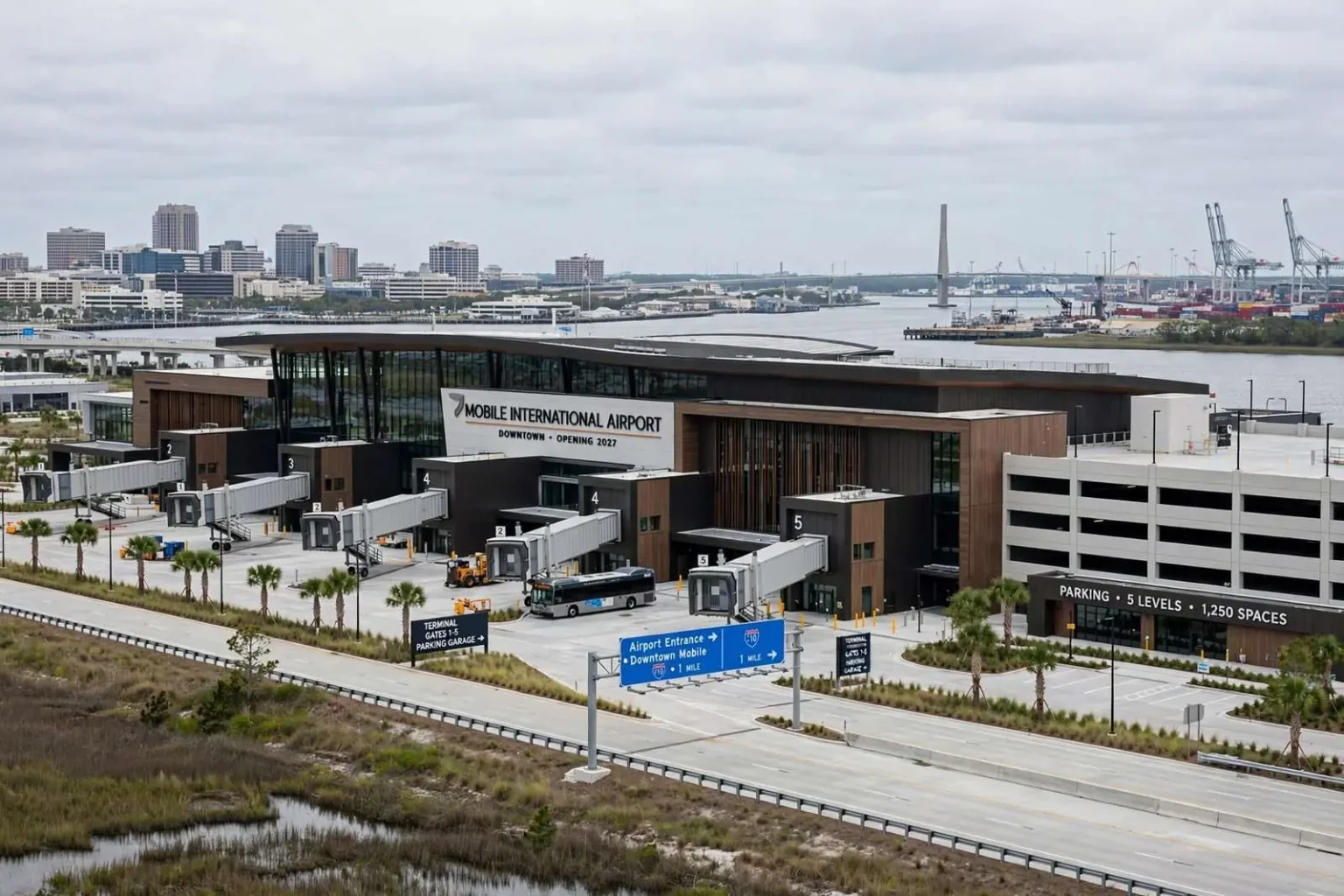
Phase one opens with five gates, but the terminal is designed to expand to 12 as demand grows, with additional capacity available through the existing low-cost terminal nearby. Parking follows the same plan: a five-story garage with 1,250 spaces plus surface lots, roughly 1,600 spaces in all, connected directly to the terminal. Planners are working to give the facility a distinctly Mobile sense of place rather than a generic design.
Design elements throughout the terminal are meant to celebrate Mobile’s coastal and industrial history, including materials and art that reflect the city’s maritime heritage. Airport Authority leaders have said they want travelers to recognize the building as Mobile’s own the moment they step off the jet bridge, not as a chain-hotel-style terminal lifted from any American suburb. The five-gate opening footprint is sized to handle initial demand while leaving clear room to add concourses, additional gates and expanded concessions as new routes are added.
4. New Destinations Take Data — and Dollars
New York, Chicago and Denver top the list of most-requested destinations, with Miami, Orlando and Nashville in the broader conversation. But airlines decide routes on data: Mobile must show consistent demand that makes a new route more profitable than other uses for the same aircraft. Growth can come through larger aircraft, more frequency, new nonstops and eventually new carriers. Keeping the airport’s cost per enplanement competitive — especially for low-cost carriers — is another lever.
Mobile Airport Authority officials have been meeting with airline route planners for months, presenting the kind of catchment-area analysis airlines want to see before committing aircraft. Local business travelers, university travel and tourism traffic all factor into those calculations. The Authority has also explored incentive programs that lower airline costs in the early years of a new route, helping carriers bridge the gap while demand builds.
5. The Community Has to Fly It
“Every time a business traveler chooses to fly from Mobile, it helps demonstrate the strength of our market,” said Mobile Chamber President and CEO Designate David Rodgers. “The more passengers we have flying from here, the stronger the case we can make for expanded air service in the future.” In other words: the airport can create the opportunity, but only local travelers can make it real. Every ticket booked from Mobile strengthens the case airport officials take to the airlines.
Local employers, especially those with frequent business travel to the Northeast or Midwest, are being asked to track how often their travelers fly out of Mobile and to use the airport whenever schedules allow. Universities, health systems and the Port of Mobile are likewise being encouraged to consider the airport as their default for staff travel, building the consistent demand numbers that airlines watch closely when deciding whether to add or upgrade a route.
Why the New Airport Matters Regionally
The downtown airport has been promoted as a once-in-a-generation piece of infrastructure for the Alabama Gulf Coast, with supporters arguing it will reshape economic development in Mobile, Baldwin County and the broader I-10 corridor. Civic leaders see the project as a chance to retain corporate headquarters, recruit new employers and give conference organizers at the Mobile Convention Center a more competitive arrival experience.
The transition also carries implications for Mobile Regional Airport’s future. Once commercial service moves downtown, the Authority has signaled that the existing facility will be redeveloped for general aviation, aerospace and industrial uses, potentially expanding the Brookley Aeroplex’s role as a manufacturing and logistics hub. That long-term vision aligns with the Authority’s broader strategy of separating commercial and industrial aviation into purpose-built facilities.
What Travelers Should Expect
For the traveling public, the single-step move means a short, intense period of adjustment. Airline tickets purchased before the cutover will be honored at the new terminal, and rental car operations will relocate simultaneously. Travelers accustomed to driving to Mobile Regional should plan for new routing to the downtown site, with signage, mapping apps and airline communications all being updated in the months leading up to the move.
The Authority has urged travelers to confirm their departure airport in the weeks before any flight, since confusion between Mobile’s two airports is expected to be a particular risk during the first month after the switch. Customer service counters, ride-share pickup zones and parking passes will all operate under new procedures designed for the larger facility.
The Bigger Picture for Coastal Alabama
Downtown Mobile’s airport project is the headline piece of a broader strategy that includes investments in cruise terminals at the Port of Mobile, expansion of the city’s riverfront and ongoing road work along the I-10 Mobile River Bridge corridor. Together, those projects aim to reposition Mobile as a logistics and tourism gateway for the northern Gulf Coast, complementing rather than competing with airports in Pensacola and Gulfport.
Local officials acknowledge that success will depend on continued regional cooperation, including the cooperation of Baldwin County commuters, Mississippi coastal travelers and business visitors from across the Wiregrass. The downtown airport’s first full year of operations will set the tone for everything that follows, and Mobile leaders are framing the months ahead as a chance to demonstrate that the market can support the new facility.
The Road to 2027: Construction and Testing
Construction of the new terminal has been visible from downtown Mobile streets for more than a year, with steel rising along the city’s waterfront and crews working through heat, rain and hurricane-season weather to keep the schedule on track. Project managers are now entering the systems-testing phase, when airline information technology, security equipment, baggage handling and concessions all have to be commissioned and stress-tested before any passenger sets foot in the building.
ORAT teams — specialists who guide airports through the cutover from old terminals to new — are coordinating with each airline, rental car company and federal agency that will operate in the building. Their checklists include everything from the wiring behind ticket counters to the route a passenger takes from curb to gate, with the goal of making the opening day feel routine rather than chaotic.
What Mobile Stands to Gain
If the new airport succeeds, Mobile stands to capture a larger share of regional air travel, support new corporate investment, and reduce the travel friction that has historically pushed travelers across state lines. Local tourism boosters also point to the convenience for visitors heading to the Alabama beaches, Bellingrath Gardens and the USS Alabama Battleship Memorial Park.
The project’s ripple effects include new hotels, restaurants and meeting space near the terminal, as well as road and infrastructure improvements connecting the airport to downtown streets and to I-10. Real estate developers have been positioning projects within walking distance of the new terminal, betting that convenient access will drive demand for nearby housing and offices. Together, these developments aim to turn the airport into a true anchor for the next decade of Mobile’s growth.