Florida Now Permitting Food Trucks at Select Rest Stops to Keep Truckers Fed During Pandemic
Florida permits food trucks at select rest stops from Pensacola to Tallahassee to keep truckers fed during the COVID-19 pandemic.
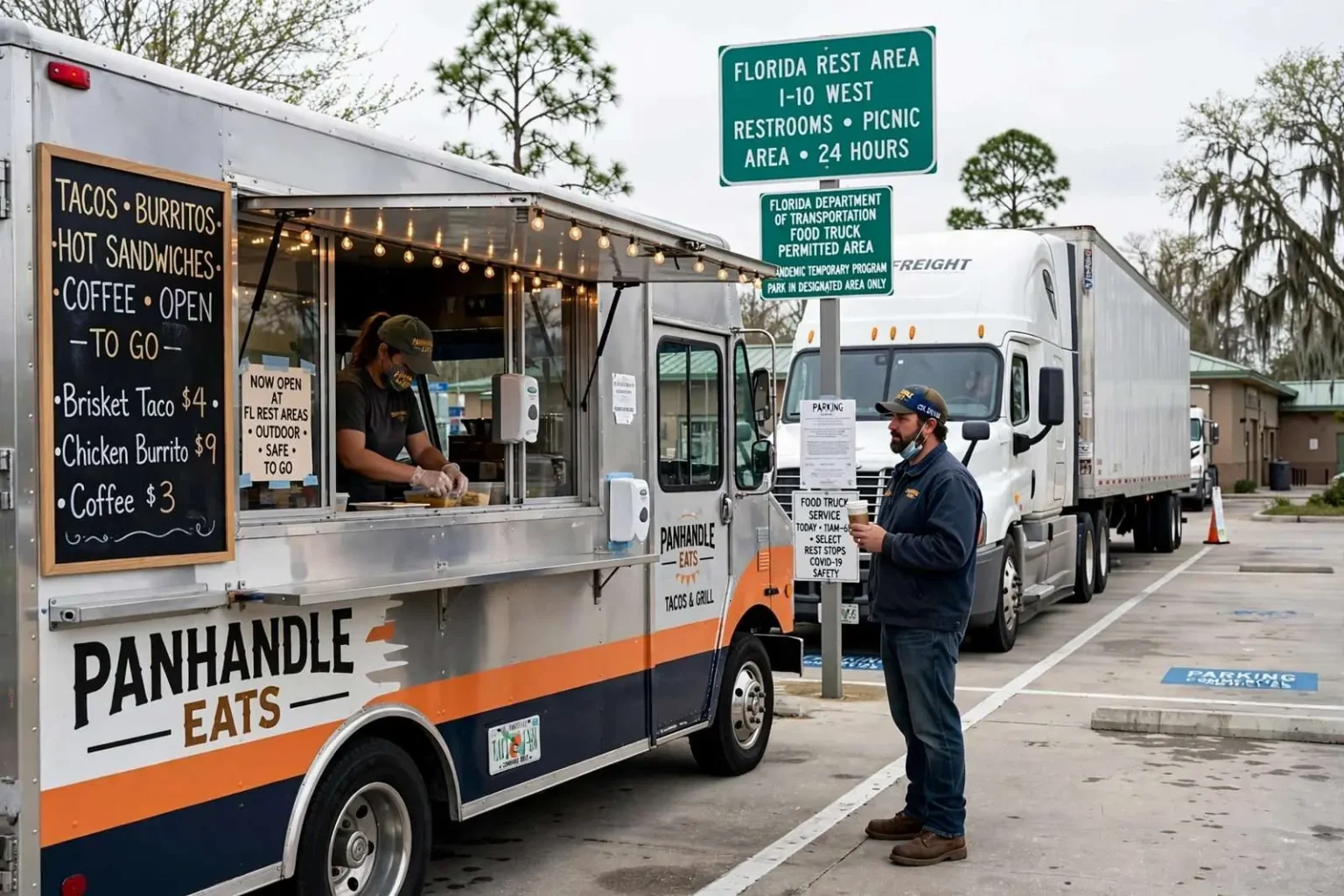
Florida is now allowing food trucks to operate at select highway rest stops, a policy shift that began in the Panhandle after a Pensacola television investigation found the state lagging behind a national effort to keep truckers fed and on schedule during the coronavirus pandemic. The change put Florida in line with an allowance from the Federal Highway Administration letting food trucks set up at rest areas nationwide — a lifeline for commercial drivers who suddenly found nearly every restaurant along their routes closed or take-out only as COVID-19 spread in the spring of 2020.
The federal accommodation came at a moment when the trucking industry had become more visible — and more essential — than at any point in recent memory. As stay-at-home orders emptied office buildings and school campuses, freight kept moving. Groceries, medical supplies, cleaning products, and e-commerce deliveries all traveled on trucks, and the drivers behind those wheels worked long shifts with few places to stop, eat, or rest.
Rest areas themselves had already become critical infrastructure during the outbreak. Many private truck stops reduced their hours or closed dining rooms entirely, and sit-down restaurants along the interstates shifted to drive-through only or shut down altogether. A driver who once counted on a diner meal in Crestview or a sit-down lunch in Tallahassee might find nothing but a locked door and a vending machine.
Into that gap stepped the Federal Highway Administration, which oversees the interstate system and regulates what commercial activity may occur at rest areas. Historically, the agency has restricted vending at rest stops to protect roadside businesses from unfair competition, which is why food trucks had never been permitted at Florida rest areas before. The 2020 allowance carved out a pandemic exception, letting states welcome mobile food vendors onto rest area property for the duration of the emergency.
Most states moved quickly. But Florida, despite hosting some of the busiest freight corridors in the Southeast, initially did not. The gap went largely unnoticed outside the trucking community until a Pensacola television station investigated the issue and found the state had not acted on the federal allowance — a discovery that quickly reached state government.
A Pensacola senator pushed the change
State Sen. Doug Broxson, of Escambia County, said he discovered Florida was still not permitting food truck operations at rest areas despite the federal accommodation — a surprise he moved quickly to fix. Broxson, a Republican whose district includes Pensacola and much of the western Panhandle, pressed state transportation officials to act on the federal permission.
Starting Wednesday of that week, Florida began welcoming food truck support from Pensacola to Tallahassee, with Broxson saying he expected the policy to expand quickly. The initial rollout covered rest areas along the Interstate 10 corridor, the main east-west artery connecting the Panhandle’s military installations, ports, and growing residential communities with the rest of the state.
“I think it’s just common sense and I’m surprised it wasn’t done before,” Broxson said, predicting the change would ultimately become policy “from Pensacola to Key West.” His comments reflected a broader frustration among lawmakers that a simple, low-cost accommodation for essential workers had taken a television investigation to set in motion.
The senator’s emphasis on speed matched the urgency drivers were describing. In the early weeks of the pandemic, the food service industry’s collapse along highway corridors was not an inconvenience but an operational problem: drivers skipping meals, cutting rest breaks short, or running out of options entirely on long hauls. A trucker running I-10 between Pensacola and Jacksonville, or pushing north from the Port of Mobile through the Panhandle, had few reliable places to eat.
For Florida, the shift also carried a regional significance. The Panhandle’s economy depends heavily on freight moving between the Port of Panama City, the military bases around Pensacola and Fort Walton Beach, and the population centers of South Georgia and Central Florida. Keeping drivers fed, rested, and on schedule supported that entire supply chain during a period when every link was already under strain.
Like many states, Florida limited the program to select rest stops; which locations would host trucks had not yet been determined when the announcement was made. The Florida Department of Transportation was left to work out the details — identifying which facilities had the parking capacity, utility access, and traffic patterns to accommodate vendors without disrupting commercial vehicle parking, which was itself a persistent shortage along the corridor.
The selection process mattered more than it might appear. Rest areas along I-10 in the Panhandle serve a mix of passenger vehicles and heavy trucks, and large rigs require dedicated parking spaces that are often scarce by late afternoon under federal hours-of-service rules. Adding food trucks meant designating vendor zones that would not consume needed truck spaces — a balance the department had to strike at each candidate site.
The federal allowance also came with structure. Because the Federal Highway Administration’s normal rules restrict commercial activity at rest areas, the pandemic exception was framed as temporary and tied to the emergency. States accepting the allowance were expected to manage vendor participation themselves, deciding how many trucks could operate, where they could park, and what health and safety requirements would apply.
That framework suited the moment. Food trucks, which had already grown into a substantial industry across Florida’s cities before the pandemic, were suddenly among the safest food service formats available — outdoors, with minimal contact, no shared indoor space, and no dine-in seating to sanitize. Vendors who had lost their office-lunch and event business when offices and festivals shut down now had a new customer base: drivers who had no alternative at all.
Why the Panhandle corridor mattered
For Gulf Coast drivers hauling freight through the Panhandle corridor, the change meant one less thing to worry about during a pandemic that had upended even the simple act of finding lunch on the road. The I-10 stretch between Pensacola and Tallahassee runs more than 150 miles through some of the least densely populated terrain in Florida, with long gaps between exits and limited food options even in normal times.
The corridor’s traffic includes a heavy proportion of long-haul and regional drivers moving goods between the Deep South and Florida’s Atlantic coast. Trucks leaving the Port of Mobile, the industrial plants of Alabama’s river region, and the military logistics hubs of the Panhandle all funnel onto I-10, and many of those drivers live in or pass through the communities between Mobile and Tallahassee daily.
Rest areas in that stretch — including facilities in Santa Rosa, Okaloosa, Walton, Holmes, Jackson, Gadsden and Leon counties — had long offered little more than parking, restrooms, and vending machines. Adding even a handful of food truck dates at select sites gave drivers a predictable option that had not existed the week before.
The change also arrived as Florida’s agricultural and logistics sectors were ramping up for a difficult season. Spring in the Panhandle brings produce shipments north, and the region’s distribution centers were managing heightened demand as consumers stockpiled goods. Every hour a driver spent searching for an open restaurant was an hour of capacity lost from a supply chain that could not afford it.
Local officials along the corridor watched the rollout with interest. Restaurants in small Panhandle towns had been among the hardest hit by the economic shutdown, and some worried about any policy that diverted customers away from communities and toward the highway itself. Others noted that the trucks were serving a customer base — long-haul drivers on strict schedules — that had never reliably stopped in town anyway.
The policy’s trajectory after the initial rollout was left to state transportation officials and the federal government. Broxson predicted the change would ultimately become policy “from Pensacola to Key West,” and the question of whether the emergency accommodation would harden into a permanent program remained open as the pandemic wore on. Federal highway officials had signaled that the allowance would last as long as the emergency did, leaving states to advocate for an extension if they wanted one.
Advocates for the change pointed out that the program required almost no public expenditure. Food truck operators covered their own costs, paid any applicable fees, and bore the risk of slow business, while the state simply allowed them to operate on property it already maintained. Compared with building new rest area amenities or contracting with fixed-site vendors, the arrangement was among the least expensive ways a state could support essential freight workers.
The episode also highlighted a broader pattern from the pandemic’s early months: federal rules written for normal times often collided with emergency realities, and the fixes frequently came from the ground up rather than the top down. A television reporter’s question about why truckers could not find food in Florida led to a senator’s phone calls, which led to a policy shift within days — a pace of change rarely seen in transportation regulation.
For the drivers themselves, the immediate benefit was practical. A hot meal at a rest area meant less time off-route, fewer miles spent hunting for open restaurants, and a small return to normalcy in a workday that had been stripped of nearly every comfort. Industry representatives had spent weeks alerting officials to the problem; in Florida, at least, the response was unusually direct.
What comes next
As the program moved from announcement to operation, attention shifted to which rest stops would be selected and how often vendors would appear. Florida’s transportation department had not published a list of participating locations, and food truck operators interested in serving the corridor were waiting for details on scheduling, fees, and site rules before committing.
The state’s experience was being watched by neighboring states along the Gulf Coast. Alabama, Mississippi, Louisiana and Texas all rest along the I-10 freight corridor that connects the region’s ports, plants, and military bases, and all faced the same federal framework and the same driver needs. If Florida’s model worked, it offered a template for the rest of the Gulf.
For the Panhandle communities between Pensacola and Tallahassee, the food truck program was a small piece of a much larger pandemic adjustment. But it captured something essential about the period: the way ordinary logistics — a meal on the road — could become a genuine operational challenge, and how quickly state government could move once the problem was named.
Broxson’s prediction that the policy would spread statewide remained a benchmark for the program’s success. In the meantime, truckers rolling through the Panhandle had a new answer to the oldest question on the highway: where to eat. After a spring in which that question had no good answer at all, even a partial solution was welcome.