Florida Overhauls AMBER Alert Criteria for the First Time Since 2002
FDLE and Florida's AMBER Review Committee updated AMBER and Missing Child Alert criteria, adding an Enhanced Missing Child Alert with cell phone warnings.
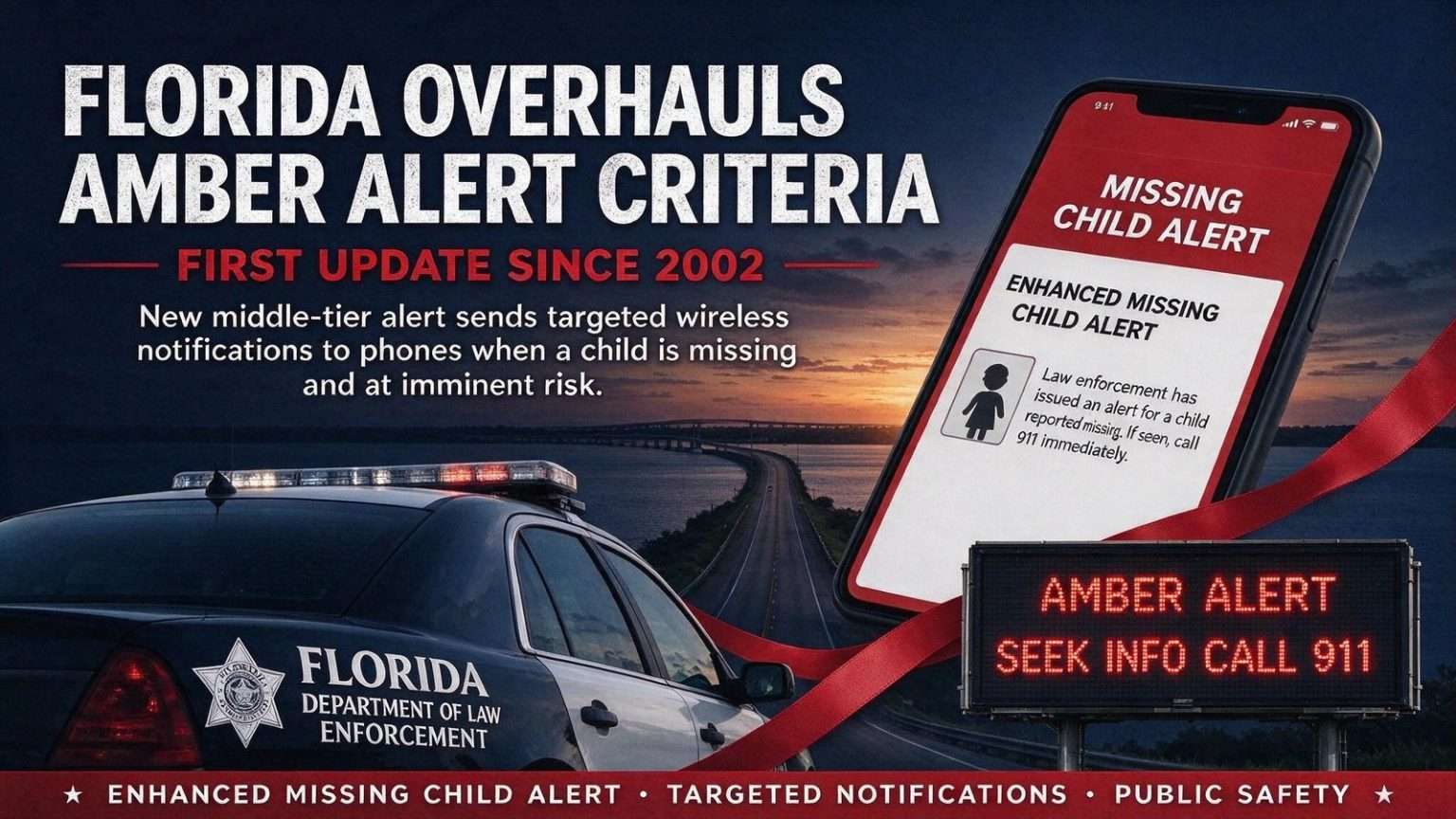
Florida has rolled out its first major update to AMBER Alert and Missing Child Alert criteria in nearly two decades, a change state officials say is designed to keep pace with shifting crime trends and modern technology. The Florida Department of Law Enforcement announced the revision in coordination with Florida’s AMBER Review Committee, the body that governs how and when the state’s child-abduction alerts go out.
The significance of the move is measured in how long the old framework stood. The state’s alert criteria had not been touched since 2002 — an era when the primary way most Floridians learned of an abduction was a bulletin interrupted into local television programming. Two decades later, the overwhelming majority of adults carry a phone capable of receiving targeted emergency messages, and the state’s alert architecture needed to catch up to that reality.
A New Tier of Alert
The centerpiece of the update is an Enhanced Missing Child Alert, a middle tier for cases where there is no evidence a child was actually abducted but investigators believe the child is in imminent danger. Unlike the traditional alerts, the enhanced version can trigger a Wireless Emergency Alert pushed directly to cell phones across a targeted geographic area.
That middle tier fills a gap that investigators have long complained about. Under the old two-track system, a case either met the strict AMBER criteria — confirmed abduction, with enough description of the child, the suspect, and the vehicle to make an alert useful — or it fell to the standard Missing Child Alert, which relies on voluntary distribution through media outlets and does not reach phones directly. Cases in between, such as a child who wandered off in dangerous conditions or left home under circumstances suggesting grave risk, often lacked the urgency tool that fits the danger.
Officials say that capability matters because a significant share of missing-child cases do not fit the classic abduction profile, yet the children involved may be every bit as much at risk. A toddler who slips out of a backyard on a hot Panhandle afternoon, a teenager with a medical condition who leaves home without medication, a child last seen near open water — none of those cases may involve an abductor, but all can turn fatal within hours. The enhanced alert lets dispatchers put a description directly onto the screens of every phone in the area where the child was last seen, the fastest notification channel the state operates.
The criteria governing the traditional AMBER Alert themselves received a fresh look in the update, ensuring that the questions deputies must answer before requesting an activation reflect how cases actually unfold today rather than how they unfolded two decades ago. That matters at the front end of an investigation, where the deputy taking a report has minutes to decide which alert tier applies and what information to broadcast. Clearer criteria reduce hesitation at exactly the moment hesitation costs the most, and they give reviewing coordinators a consistent standard across counties as different as rural Liberty County and urban Miami-Dade.
How the Program Works
The Florida AMBER Plan is a partnership between law enforcement agencies, broadcasters and state agencies. The name — America’s Missing: Broadcast Emergency Response — traces back to Amber Hagerman, the nine-year-old Texas girl abducted and murdered in 1996, whose case prompted the national system Florida and other states adopted in the years that followed. Broadcasters remain central to the design: radio and television stations interrupt programming to relay alert information, and the state’s network of agencies coordinates distribution.
It is not activated automatically: local agencies request activation when a case meets the criteria and investigators believe an alert would genuinely help locate the child. That human checkpoint is deliberate. Program administrators have long guarded against overuse, because an alert system that cries wolf trains the public to ignore it. Each activation request is reviewed against the criteria before the statewide machinery engages, a process the AMBER Review Committee oversees and periodically refines.
Once activated, an alert spreads through multiple channels simultaneously — broadcast interruptions, highway dynamic message signs, the Wireless Emergency Alert system on cell phones, and social media distribution. The goal is saturation within the geographic area where the child could realistically be, combined with enough specific detail — a vehicle tag, a distinctive clothing description — that ordinary people driving to work become the eyes of the search.
Why the Criteria Needed Updating
Crime trends have changed since 2002, and so has the technology of both criminals and investigators. The original criteria were written for a landscape of stranger abductions witnessed by bystanders and reported through landline tips. Modern cases more often involve online grooming that migrates across state lines, family abductions tied to custody disputes, and children who go missing in circumstances that blur the line between running away and being taken. A checklist frozen in 2002 was not built to classify those cases quickly, and speed is the entire premise of the alert system — the first hours after a disappearance are statistically the most decisive.
The update also brings Florida’s framework in line with wireless-alert technology that federal rules have expanded over the past decade. Wireless Emergency Alerts, the same system that delivers severe-weather warnings, now reaches phones with geo-targeted precision, giving states a notification tool that did not exist when the old criteria were drafted. The Enhanced Missing Child Alert is Florida’s bridge between an old classification problem and a modern distribution channel.
State officials framed the revision as an ongoing commitment rather than a one-time patch, noting that the AMBER Review Committee will continue evaluating how the tiers perform. Two decades between overhauls is a pace the committee is not expected to repeat now that the framework has been re-examined end to end.
What It Means for Northwest Florida
For families and residents along the Panhandle — including the Pensacola area and communities across Northwest Florida — the updated framework means faster, more precise phone-based notifications when a child disappears nearby. The region’s geography makes that precision valuable. Escambia and Santa Rosa counties sit at the far western end of the state, bordered by Alabama, and a child’s trail can cross a state line in minutes on I-10 or U.S. 98. Geo-targeted wireless alerts can blanket a specific corridor in the critical first hour instead of relying on residents to happen to see a post or a news bulletin.
Coordination across that state line is a familiar part of Panhandle public safety. Agencies in Escambia and Santa Rosa work routinely with their counterparts in Baldwin and Mobile counties in Alabama, and an alert issued on one side of the border reaches audiences on the other through media coverage and social sharing even when the official wireless alert stops at the line. The updated tiers give commanders on both sides of the state line a clearer vocabulary for describing what stage a case has reached and what level of public notification it justifies.
Local agencies in the Panhandle handle a steady volume of missing-child reports, most of which resolve quickly — a child found at a friend’s house, a teenager who returns on their own. The new middle tier is aimed at the subset that does not resolve quickly and does not involve a confirmed abduction: the cases where minutes matter and the old system had no phone-level tool to deploy. Deputies can now request an enhanced alert that puts the child’s description onto phones throughout the search area within minutes.
The System in Context
Florida operates one of the busiest alert programs in the country, and the state’s coordinators regularly credit the system with recoveries that would otherwise have depended on chance. The Missing Child Alert and AMBER Alert run alongside related tools, including Silver Alerts for missing older adults with cognitive impairment, giving the state a graduated set of notifications for different populations and risk levels. The new enhanced tier adds a rung in the middle of that ladder for children specifically.
When a phone sounds with an Enhanced Missing Child Alert, it arrives with descriptive details and, when available, vehicle information. Officials stress that the public should read the alert rather than dismiss it, and report any relevant sighting immediately through 911 or the investigating agency. In past Florida activations, tips from motorists and neighbors — people who received an alert and recognized what they had seen — have been the decisive factor in recoveries.
For parents in Pensacola, Milton, Crestview, and communities across the Panhandle, the practical takeaways are straightforward. The criteria governing when a child disappearance triggers a phone alert have broadened to cover imminent-danger cases without confirmed abduction. Notifications will be more targeted, arriving on the phones of people likely to actually be in a position to help. And the partnership structure behind the alerts — law enforcement requesting, the review committee governing, broadcasters and cell carriers distributing — remains the same machinery that has been recovering Florida’s missing children since the system was created, now updated for the way people actually receive information in the 2020s.