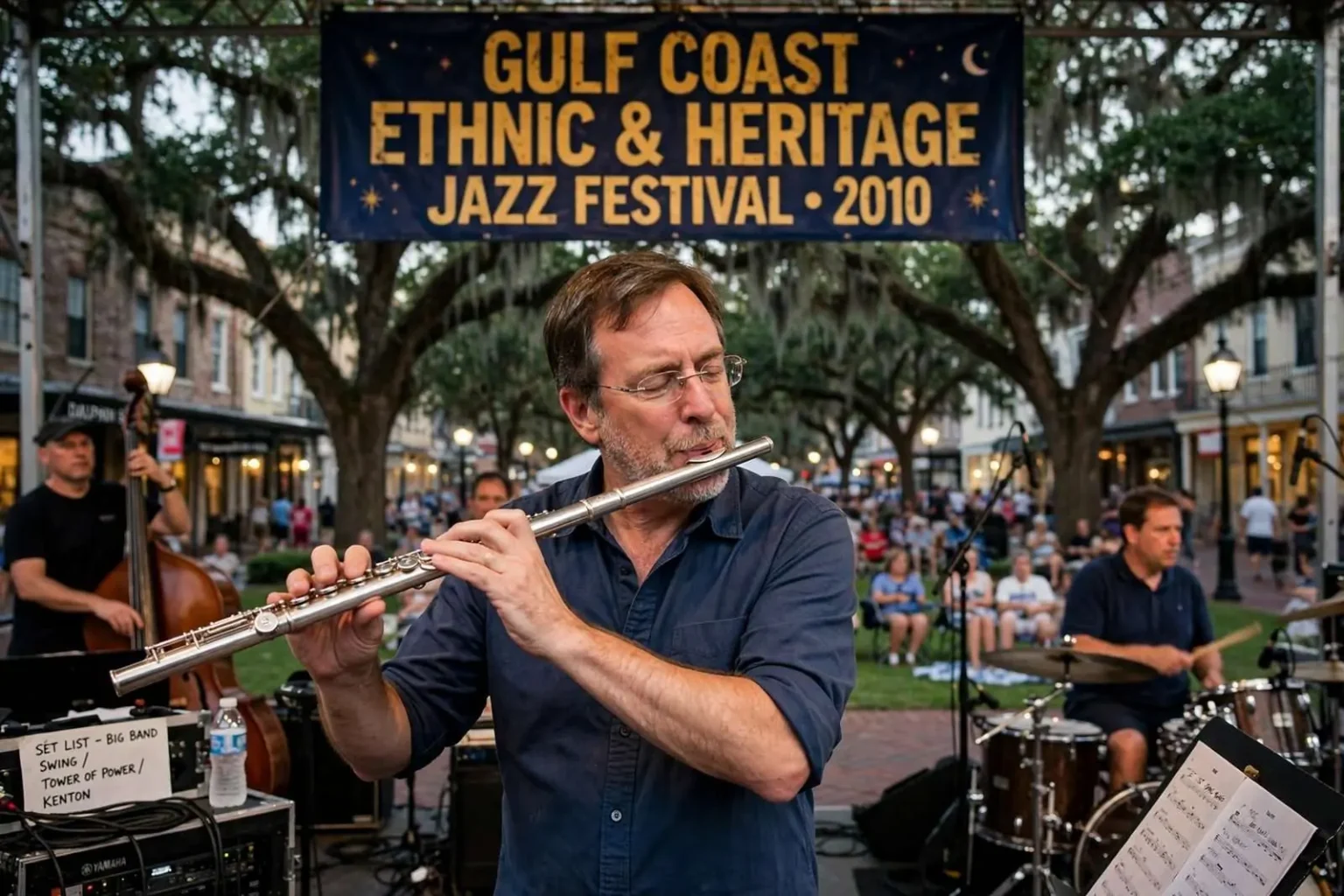
San Diego flutist Bradley Leighton took the 6:30 p.m. slot in Bienville Square — rain location 351 Water Street — on August 7, 2010, backed by some of Mobile’s best sidemen for the Gulf Coast Ethnic & Heritage Jazz Festival.
The festival booking put Leighton on one of downtown Mobile’s most storied public spaces at the height of the summer concert season. Bienville Square, bounded by Dauphin Street and Government Street in the heart of the central business district, has long served as the city’s gathering green, hosting everything from political rallies to lunchtime concerts. Its old oaks and open lawn make it a natural amphitheater, and for festival organizers it offers the kind of walkable, central setting that keeps crowds coming back through a long evening of music.
A Powerful Sound From an Unexpected Instrument
Leighton’s swing grew out of the big, high-octane bands of Stan Kenton, Woody Herman and Maynard Ferguson in the 1960s and ’70s, while his funk side came from years spent absorbing Tower of Power, Earth, Wind & Fire and the Brecker Brothers. The result was a fire and flair rarely heard from a flutist.
The flute occupies a peculiar place in jazz. The instrument lacks the volume of a saxophone and the harmonic flexibility of a trumpet, so the players who succeed on it in a jazz setting tend to be virtuosos who compensate with speed, tone, and sheer personality. The lineage runs from Herbie Mann’s globe-trotting grooves through Hubert Laws’ classical-jazz fusion, and Leighton’s style adds to that tradition a distinctly big-band attack, learned from ensembles famous for power and precision.
His influences trace a particular era of American music. Stan Kenton’s orchestra pushed jazz toward massive brass walls and experimental charts, while Woody Herman’s bands swung with relentless drive and Maynard Ferguson’s groups became famous for screaming trumpet lines and showmanship. On the funk side, Tower of Power’s horn section defined a rhythmic punch that bands still chase, Earth, Wind & Fire fused R&B with jazz sophistication, and the Brecker Brothers brought technical fireworks to fusion. For a flutist, absorbing all of that produces a sound that surprises audiences expecting a gentle, pastoral instrument.
Across more than 25 years he performed across the United States and Asia as both a sideman and bandleader, with recent highlights including opening the Greater Hartford Jazz Festival for Joyce Cooling and Gerald Albright and headlining the Gainesville Jazz Festival. He was also a Yamaha performing artist.
The Festival and Its Downtown Stage
The Gulf Coast Ethnic & Heritage Jazz Festival has long been part of Mobile’s summer cultural calendar, celebrating the jazz tradition and its roots in the communities that created it. Festivals of this kind do more than book national acts; they give regional musicians a stage, introduce students to living artists, and draw crowds downtown on summer evenings when the entertainment calendar might otherwise go quiet. Pairing visiting soloists with strong local rhythm sections is a hallmark of the format, and it gives touring artists a chance to plug into the deep pool of working players any Gulf Coast city keeps on hand.
Mobile’s claim on jazz history is real. The city produced notable musicians and absorbed the same river of musical influences — blues, gospel, brass band traditions, and Caribbean rhythms — that shaped New Orleans up the road. Events held in and around the downtown historic districts connect that heritage to the present, and the festival’s use of Bienville Square places the music in one of the oldest public parks on the Gulf Coast, a block named for the city’s colonial founder and shaded by trees that have watched over a century of public gatherings.
The rain-location arrangement at 351 Water Street reflects the practical realities of outdoor summer music on the Gulf Coast. Afternoon thunderstorms are a near-daily possibility in August, and festival organizers routinely secure an indoor fallback within reach of the primary venue so that a pop-up storm does not erase an evening of music. The backup site downtown keeps the audience close enough to move quickly when weather threatens.
Teaching While Touring
Leighton’s festival appearance came with an educational footprint: during his Mobile visit he led a jazz workshop at the Museum of Mobile with a Murphy High School student among the participants.
Workshops like the one at the Museum of Mobile serve double duty for visiting artists. They extend the reach of a festival appearance beyond a single evening, putting a professional’s insight directly in front of students and amateur players who might never otherwise work one-on-one with a touring musician. The museum setting adds its own resonance: housed in the old Southern Market building in downtown Mobile, the museum preserves and presents the city’s history, making it a fitting venue for a session on an art form rooted in that same history.
Leighton’s workshop offerings included sessions on jazz improvisation for classically trained flutists and music-for-life courses for adult amateurs. That dual focus addresses two of the largest untapped audiences in music education. Classical flute students often possess strong technique but little experience improvising, and crossing that bridge requires a teacher who can translate jazz vocabulary into the language of conservatory training. Adult amateurs, meanwhile, represent the thousands of players who set down their instruments after school and want a low-pressure path back to playing, whether for community bands, church music, or personal enjoyment.
The presence of a Murphy High School student in the workshop illustrates the pipeline such sessions feed. Murphy, one of Mobile’s oldest public high schools, has a long history in the city’s music education landscape, and its band students have long benefited from exposure to working professionals. For a young player, an afternoon spent with a nationally touring flutist can recalibrate what seems possible, and for the artist, cultivating that next audience is part of the craft of a working musician.
An Evening for the Gulf Coast Jazz Crowd
For Mobile audiences, the August 7 appearance offered a chance to hear an artist whose reputation rests on making the flute sound like a lead horn in a big band. The 6:30 p.m. slot put the music in the early evening, when the summer heat begins to lift and families can settle onto the Square’s lawns with folding chairs. Backed by local sidemen drawn from the city’s working scene, Leighton’s visit fit the festival’s formula: national-level soloists, hometown rhythm sections, and a downtown park doing what it has done for generations, bringing the city together at the end of a summer day.
The Working Life of a Touring Flutist
A career spanning more than 25 years on stages in the United States and Asia speaks to the breadth of work available to a versatile sideman and bandleader. Players like Leighton move between club dates, festival stages, studio sessions, and cruise ship or resort circuits, often maintaining several income streams at once. The ability to lead a group and to sit comfortably inside someone else’s band are separate skills, and artists who master both tend to stay employed where specialists struggle.
The festival credits on his résumé carry particular weight in the jazz world. Opening the Greater Hartford Jazz Festival for a smooth-jazz guitarist of Joyce Cooling’s standing and saxophonist Gerald Albright meant performing for one of New England’s largest free jazz audiences, and headlining the Gainesville Jazz Festival put his name at the top of a bill. Festivals function as the primary marketplace where jazz artists build regional followings, and each appearance feeds the next booking. Yamaha’s endorsement, meanwhile, marked him as a performer the instrument maker considered worth associating with its flutes, a relationship that typically includes clinic appearances like the one he brought to Mobile.
San Diego’s scene, where Leighton made his home, is a natural incubator for the style he plays. The Southern California city sustains a deep bench of session players, big band alumni, and Latin jazz artists, and its musicians have long blended funk, bebop, and Mexican influences into a sound distinct from both Los Angeles polish and New York intensity. A flutist steeped in that environment arrives on a Gulf Coast stage with a toolkit built for variety.
Why Festivals Bring Artists to Town Early
The educational component of Leighton’s visit follows a model festivals across the country have embraced. A traveling artist who spends an afternoon teaching workshops gives the host community far more lasting value than a two-hour concert alone, and the workshops often subsidize the visit itself. Federal and local arts funding frequently favors programs that include an educational component, which gives organizers another reason to pair every evening performance with classroom time.
For students, the format removes the intimidation of the concert stage. In a workshop setting a teenager can ask a touring professional about breathing, equipment, practice routines, and the practical realities of a music career, questions that never come up from the audience. The Museum of Mobile session, with its mix of students and adult players, exemplified the cross-generational audience that jazz education reaches: a high school student and a retired amateur can sit side by side working on the same concepts, each taking away something different.
The improvisation course for classically trained flutists addresses a specific gap in American music education. Most school flute instruction emphasizes reading, tone, and technique, while improvisation remains the province of band programs and private jazz study. A classically trained player who wants to cross over must learn a new vocabulary — blues scales, comping, the art of listening in a rhythm section — and clinicians like Leighton provide the bridge. His music-for-life courses for adults extend the same welcome to players returning to the instrument after decades away.
Together, the evening on Bienville Square and the afternoon at the museum made Leighton’s Mobile visit the kind of two-sided engagement festivals strive for: one night of entertainment for the city at large and a lasting deposit in the local music community, paid to the students and amateur players who will still be playing long after the stage is struck.