Flutist Kent Jordan and Chris Saunders Headline GCEH Jazz Fest’s ‘Jazz in Bienville’ Concert
New flutist Kent Jordan and Chris Saunders headline GCEH Jazz Fest’s Jazz in Bienville concert in downtown Mobile’s Bienville Square.
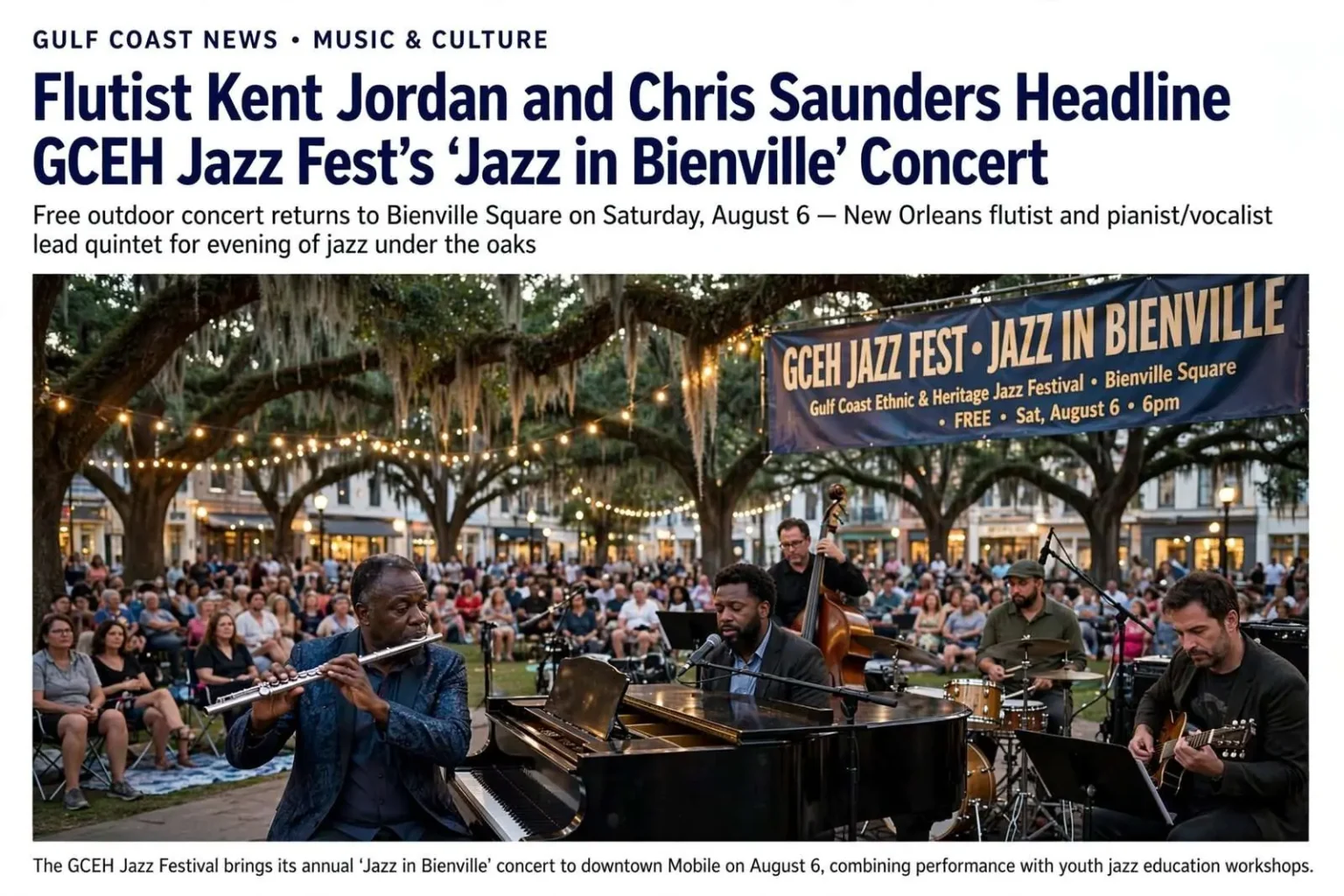
New Orleans flutist Kent Jordan returns to the Gulf Coast to headline the “Jazz in Bienville” concert presented by the Gulf Coast Ethnic and Heritage Jazz Festival on Saturday, August 6, in Bienville Square, downtown Mobile. The free outdoor concert has become one of the anchors of the festival’s summer programming, putting national-caliber jazz talent in the middle of downtown on a summer evening.
Bienville Square — the tree-shaded park at the corner of Dauphin and Bienville streets — has long served as downtown Mobile’s gathering green, and on festival nights it becomes an open-air listening room. Concertgoers bring folding chairs and blankets, office workers drift over from nearby buildings after five, and the music carries across the blocks of the historic district that surround the park.
The Gulf Coast Ethnic and Heritage Jazz Festival has spent years building Mobile’s jazz audience, pairing its summer concerts with youth education programs and celebrating the deep musical connections between Mobile and New Orleans. The two cities share a Gulf Coast musical lineage — parade bands, jazz funerals, rhythm and blues clubs and a century of performers who moved easily between them — and the festival has always drawn on that shared heritage in its bookings.
Jordan is a fitting headliner for that mission. A member of one of New Orleans’ most distinguished musical families, he has carried the city’s flute tradition from the French Quarter to stages around the world, and his return to Mobile continues a relationship with the festival that spans both performance and teaching.
Kent Jordan: Performer and Clinician
In addition to performing, Jordan is serving as the festival’s 2011 clinician, hosting the Louis “Satchmo” Armstrong Summer Jazz Camp in New Orleans and the GCEH Youth Jazz Workshop. The dual role reflects the festival’s structure: headliners do not just play Bienville Square, they pass the music along to the next generation of Gulf Coast players.
The Armstrong camp, named for the New Orleans cornetist whose virtuosity defined jazz’s first century, draws young musicians from across the Gulf South for intensive study each summer, and Jordan’s leadership there places him among the tradition-bearers responsible for keeping New Orleans jazz pedagogy alive. His work with the GCEH Youth Jazz Workshop extends that teaching mission to Mobile’s own students, giving local young players direct access to a working New Orleans professional.
Known for dazzling audiences from Rio to Tokyo, the New Orleans native has performed with the Improvisational Arts Quintet, Wynton and Ellis Marsalis and “Tonight Show” star Kevin Eubanks, and spent two celebrated years on the road with jazz drummer Elvin Jones. The résumé spans the full range of modern jazz — from the avant-garde circles of the Improvisational Arts Quintet to the mainstream elegance of the Marsalis family and the fiery post-Coltrane drumming of Jones, one of the most powerful rhythm section leaders in jazz history.
Two years on tour with Elvin Jones is a credential that jazz musicians speak about with reverence. Jones, who came to fame in John Coltrane’s classic quartet, led his own group for decades and was famous for putting sidemen through demanding, transformative road work. Flutists who survive that apprenticeship emerge as complete improvisers, and Jordan’s international reputation — from club dates in Rio to festival stages in Tokyo — was built on that foundation.
Jordan’s flute lineage runs through the heart of New Orleans. Raised in a city where music is a family inheritance, he came up through the modern New Orleans scene that produced a generation of internationally known instrumentalists, and the flute — an instrument better known in classical music than in jazz clubs — became his voice. His agility across genres has made him one of the instrument’s most distinctive jazz practitioners.
The Supporting Cast
Joining Jordan for the August 6 show are pianist and vocalist Chris Saunders, a veteran of the New Orleans Jazz & Heritage Festival making his return to the Gulf Coast. Saunders brings a double threat to the stage — piano accompaniment in the New Orleans tradition and a vocalist’s command of the repertoire — and his festival pedigree means he is comfortable holding a crowd in an outdoor setting.
Gulf Coast native Jimmy Roebuck, one of the area’s premier jazz drummers, anchors the rhythm section. Roebuck’s presence is a statement about the local scene: the Gulf Coast produces jazz drummers of professional caliber, and festival audiences have watched him keep time for the region’s best players for years. A drummer of his standing gives the headline set both its engine and its local root.
Bassist Jo Morris, whose career has spanned jazz, rock, pop and R&B, adds the harmonic floor. The breadth of Morris’s experience matters in a concert like this one, where a program can move from a jazz standard to a soul groove within a single set, and the bassist is the player who has to make every one of those transitions feel natural.
Guitarist Larry Carter, a Berklee-trained player who spent years with New Orleans showman Walter “Wolfman” Washington before touring with Fred Wesley and others, rounds out the ensemble. Carter’s route through Berklee College of Music — Boston’s famed training ground for jazz and fusion players — and the road bands of Washington and Wesley connects the Mobile stage to the funk and blues traditions of the Gulf Coast. Wesley, the trombonist whose horn arrangements powered James Brown’s bands and Parliament-Funkadelic, represents the deepest end of funk royalty, and guitarists who toured in his company carry that rhythmic vocabulary with them.
Together the lineup gives Mobile a quintet that can hold a festival stage from its first note to its last: a New Orleans headliner with a global résumé, a rhythm section rooted in the Gulf Coast, and sidemen whose careers trace the region’s musical geography from New Orleans clubs to national tours.
The programming that puts a flutist front and center is itself worth noting. The flute occupies a special place in New Orleans jazz — the instrument’s grace and agility suit both second-line swagger and modal introspection — yet headliners on the instrument remain rare. A festival that books a flute-led quintet signals an audience educated enough to want more than the standard front line of horns, and the GCEH has cultivated exactly that audience through years of concerts and workshops.
What Festivalgoers Can Expect
An evening at Jazz in Bienville follows a rhythm familiar to Mobile festivalgoers. The square fills in the late afternoon, the opening acts warm the crowd as the summer heat breaks, and the headliner takes the stage as the evening cools. Food vendors and festival booths line the perimeter, and the crowd — a mix of longtime jazz listeners, downtown regulars and families — settles in for a program that typically runs from early evening into the night.
The festival’s concerts are designed to be accessible. There is no ticket barrier at Bienville Square events, which means the audience includes students from the youth workshops who have spent the week studying with the very players they are about to watch. That connection between classroom and stage is deliberate, and it is what distinguishes the GCEH festival from a concert series that simply imports talent.
Mobile and New Orleans, Connected by Music
The musical relationship between Mobile and New Orleans runs deeper than proximity. The two ports share a Creole and Gulf Coast heritage, and the brass band tradition, the blues clubs and the Carnival rhythms of both cities trace back to many of the same cultural sources. Mobile claims its own jazz history and its own line of celebrated musicians, and festivals like GCEH keep that lineage in public view.
For the musicians, the short trip along the Gulf is a familiar one — New Orleans players have worked Mobile clubs and festivals for generations, and Gulf Coast players have done the same in reverse. A Kent Jordan headline date in Bienville Square is less a visit than a continuation of a conversation the two cities have been having for more than a century.
The August 6 concert gives Mobile one more evening of that conversation, free of charge, under the oaks of Bienville Square — a New Orleans master at the height of his powers, a band of Gulf Coast veterans behind him, and a festival whose mission is to make sure the next generation is listening, and learning to play.
For young musicians in the audience, the evening also works as a preview of what the workshops offer: a chance to hear, up close, what decades of disciplined practice sound like in a working professional’s hands. Festival organizers have long said that is the point — that a summer of instruction crystallizes when students watch their clinician take a festival stage and do, live, what he has been teaching them to attempt.