Foley Businesses Raised Concerns About Adult Store in 2008
In 2008, nearby Foley businesses and residents raised concerns after an adult gift and video store opened near Highway 59 and the Foley Beach Express.
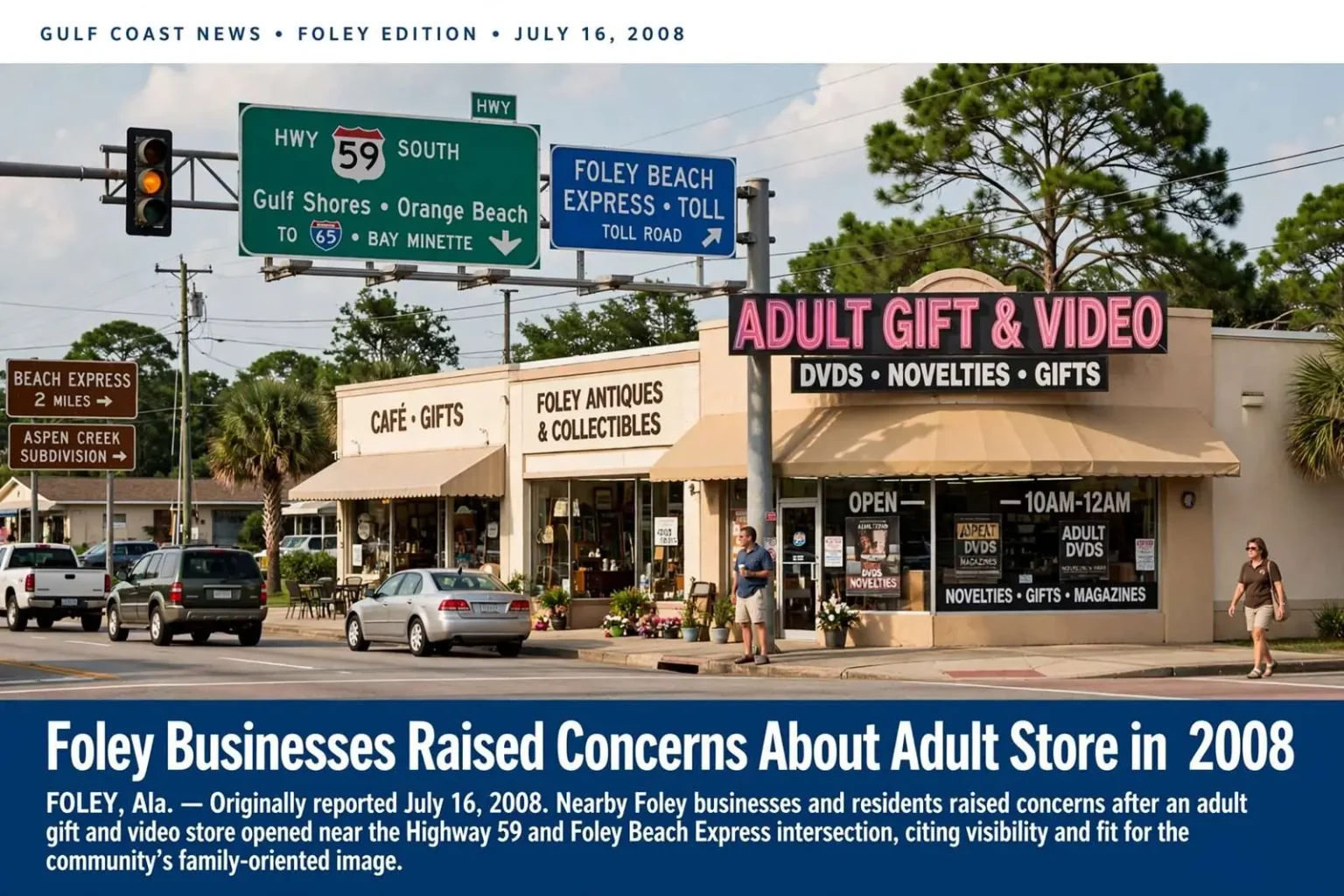
FOLEY, Ala. — Originally reported July 16, 2008. Nearby Foley businesses and residents raised concerns in 2008 after an adult gift and video store opened near Highway 59 and the Foley Beach Express, according to an archived local news report. The business was highly visible to drivers entering Foley, and owners of nearby businesses said they worried its presence did not fit the area’s image. Residents of the nearby Aspen Creek subdivision also expressed objections. This article records the community response and land-use debate reported at the time; it does not state current operations, ownership or zoning status.
The intersection of Highway 59 and the Foley Beach Express sits at one of the busiest crossroads in south Baldwin County. Highway 59 is the main artery carrying summer traffic from Interstate 65 down through Foley to Gulf Shores and Orange Beach, and the Beach Express was built as a fast, tolled shortcut around the worst of that congestion. The corner where the two routes meet is, in practical terms, a front door to the city: thousands of beach-bound drivers pass it every day in season, and any business located there gets an audience that few Foley addresses can match.
It was that visibility that animated the objections. Owners of nearby businesses told local reporters that the adult store’s presence at such a prominent gateway did not match the family-oriented image Foley had cultivated — a city known for its antique shops, its outlet-style retail along Highway 59, and its annual calendar of festivals and events that draw visitors from across the region. For merchants who had invested in the corridor, the concern was reputational as much as practical: what a driver sees from the road shapes what they think of everything around it.
The neighborhood’s concerns
Residents of the Aspen Creek subdivision, which sits near the highway corridor, also voiced objections. Their concerns followed a pattern common in communities where adult-oriented retail opens near residential areas: worry about traffic patterns, about the message the business sends, and about proximity to a neighborhood where families and children live. In Foley, where subdivisions have spread steadily south and west of the historic downtown as the city has grown, the boundary between commercial corridors and residential streets is often only a few hundred yards wide, making siting decisions along the highways immediately visible to nearby homeowners.
The debate fit into a broader pattern that Baldwin County municipalities navigated throughout the 2000s. The county was among the fastest-growing in Alabama during that period, and cities like Foley, Gulf Shores, Spanish Fort and Daphne were racing to manage growth that brought new retail, new subdivisions and new questions about what belonged where. Adult-oriented businesses are regulated across the country through a combination of zoning distance requirements — buffers separating them from schools, churches, parks and homes — and licensing rules, and municipalities typically rely on those land-use tools rather than outright bans, which courts have generally not allowed.
Foley’s retail identity
Foley in 2008 was in the middle of a deliberate effort to brand itself as a shopping destination. The city’s Historic Downtown district, centered on the old railroad depot and the trees of Heritage Park, offered antique stores and locally owned shops, while the highway corridors carried the larger retail that served both residents and the summer beach trade. The city had invested in events and attractions — the Foley Railroad Museum, annual festivals, sports tourism facilities — that were all aimed at presenting a welcoming, family-friendly face to the hundreds of thousands of travelers who passed through on the way to the coast.
Against that backdrop, the arrival of an adult gift and video store at a highly visible corner near Highway 59 and the Beach Express read to many residents as a challenge to the image the city was building. The objections reported by local news at the time came from business owners and residents rather than from city hall, and the archived report recorded a community conversation about land use and character rather than any city action or court case.
How such debates typically resolve
Across Alabama and the United States, disputes over adult-oriented businesses tend to center on zoning. Municipalities adopt ordinances that restrict where such businesses may locate — most commonly by requiring minimum distances from residential zones, schools, places of worship, parks and other sensitive uses — and courts have generally upheld those regulations so long as they leave lawful avenues for the businesses to operate. Licensing requirements, signage limits and operating-hour rules are additional tools cities use to manage the secondary effects that residents most often cite.
For Foley, the 2008 discussion was one episode in the longer story of a growing city shaping its commercial corridors. The businesses and residents who objected did so through the channels available to them — public comment, conversations with elected officials and press coverage — and the archived report preserves their concerns as they were voiced at the time. What the store’s later history was, and what zoning decisions or business closures followed, are not addressed in the original account.
What the episode does document is the importance Foley’s residents attach to their city’s gateway corners. The junction of Highway 59 and the Foley Beach Express is the first impression tens of thousands of summer visitors get of the city, and in 2008 the people who lived and worked nearby made clear that they considered that first impression worth defending. This article is a historical record of a 2008 land-use debate and does not describe current operations, ownership or zoning status.
The Beach Express and Foley’s growth
Understanding the 2008 objections requires understanding how much Foley’s geography was changing at the time. The Foley Beach Express, opened in the early 2000s, was conceived as a relief valve for Highway 59, the two-lane-and-growing artery that for decades funneled virtually all beach traffic from Interstate 65 through the heart of Foley and south toward Gulf Shores. The Express gave drivers a straight, high-speed route from the interstate to the beaches, crossing the Intracoastal Waterway at a toll bridge, and it quickly attracted its own cluster of commercial development at its interchanges and at its junction with Highway 59.
That development pressure transformed corners that had been fields and pine stands into retail pads within a few years, and with the transformation came decisions about which businesses would occupy the new visibility. For a growing suburb whose identity was still being written, each new storefront at a major intersection carried symbolic weight. The adult store’s opening near the highway junction became a flashpoint precisely because the corridor was new enough that residents still felt its character was being decided in real time.
Foley’s population growth in the 2000s was part of the larger Baldwin County boom, driven by the expansion of the Gulf Shores and Orange Beach tourism economy, retirees moving to the coast, and the commuter relationship with Mobile across the bay. New subdivisions such as Aspen Creek filled in around the highway corridors, placing residential streets closer to commercial development than older city plans had ever anticipated. When the two worlds touched — as they did at the corner near the Beach Express — the collision produced exactly the kind of community debate the archived report recorded.
How Foley residents made their voices heard
The concerns documented in 2008 came through the standard channels of local civic life. Business owners spoke as stakeholders in the corridor’s commercial image, framing their objections in terms of the customer base they had built and the reputation they wanted the gateway to project. Residents of Aspen Creek spoke as neighbors, raising the everyday concerns of people who live near a commercial use they did not choose: traffic, signage, lighting, and the values a community signals by what it permits along its main roads.
Local news coverage served as the amplifier. In a city of Foley’s size, an archived local report about a controversial business opening was also a record of the community talking to itself — a way for objectors to find one another and for elected officials to gauge sentiment. Municipal governments in Alabama cities like Foley operate under mayor-council forms with zoning powers delegated by state law, and public hearings before the planning commission and city council are the formal venues where such disputes get adjudicated. The original report did not document any specific city action, ordinance or vote, only the community response that preceded any such steps.
The wider south Baldwin context
Foley was not alone in wrestling with these questions. Across south Baldwin County in the 2000s, fast-growing cities were writing and rewriting zoning codes to manage the mix of uses that growth delivered to their doorsteps. Gulf Shores and Orange Beach, dominated by tourism, crafted ordinances aimed at protecting the family beach brand that underpins their economies. Inland cities like Foley, Robertsdale and Summerdale balanced the retail demands of a growing permanent population against the image concerns of communities that saw themselves as extensions of the coastal tourism region.
Adult-oriented businesses were a recurring point of friction in that process nationwide, and the tools cities developed — distance buffers, licensing, signage restrictions — became standard planning vocabulary. The 2008 Foley debate captured in the archived report shows those issues arriving at a specific crossroads: a visible corner at the junction of two highways that together carry the bulk of the region’s summer traffic, next to a subdivision whose residents had chosen Foley for its small-town image.
More than a decade later, the episode remains what the original report made it: a snapshot of a community conversation about land use, image and growth at a moment when Foley’s future character was actively being decided. The city’s gateways — the corners where Highway 59 and the Beach Express meet — continue to be among the most consequential real estate in south Baldwin County, and the 2008 objections stand as an early marker of how much their appearance matters to the people who live and work nearby. This article records a historical debate and does not state current operations, ownership or zoning status.