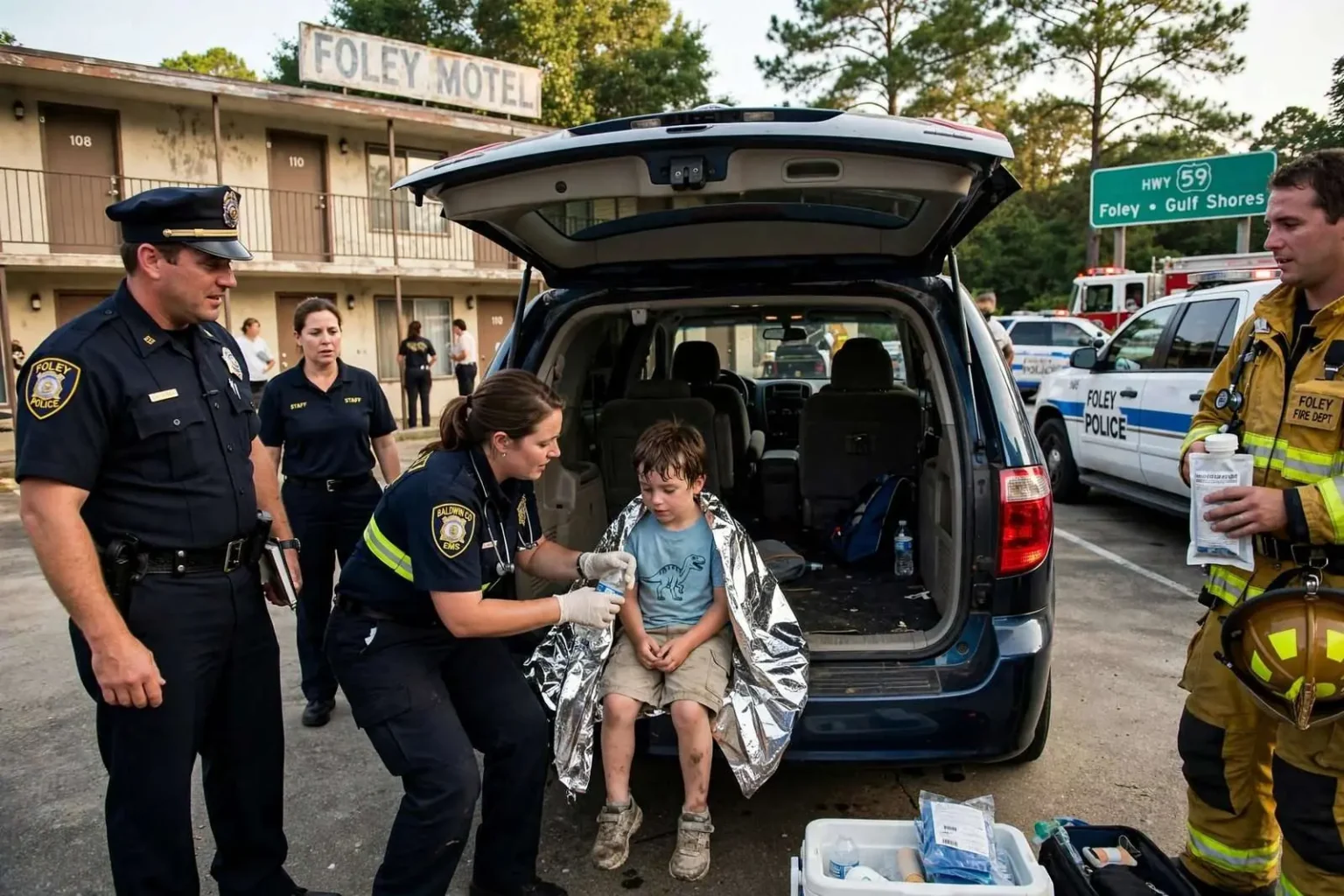
Historical report preserved from an archived 2008 local news story.
FOLEY, Ala. — A young boy who wandered away from a motel on Highway 59 in the summer of 2008 was found safe after a search that pulled in police officers, firefighters, motel employees and guests, according to an archived local news report from the time. The child’s parent said he had gone to look for a toy and did not return, setting off a search along and around one of Baldwin County’s busiest travel corridors.
The episode unfolded along Highway 59, the main artery that carries beach traffic through Foley toward the Gulf Shores and Orange Beach shoreline. In summer, the corridor is lined with motels, restaurants and outlet storefronts serving families passing through on vacation, and it hums with traffic from early morning until late at night. For a small child to slip away from a motel property in that environment is the kind of scenario that mobilizes a community fast, and that is what happened here.
Searchers combed the motel grounds and the surrounding area until the child was located — curled up on the floorboard of a van, apparently having climbed in and fallen asleep or hidden while the search was underway nearby. The discovery ended what could have been a far worse outcome, and the report noted the boy was found within reach of where the search had been concentrated.
Treated for heat exhaustion
The ordeal left its mark. The boy was treated for heat exhaustion, receiving oxygen, fluids and cold packs as responders worked to bring his temperature down. Anyone who has spent a July or August afternoon in south Alabama understands the danger: the combination of Gulf Coast humidity and full sun can push a small body toward heat illness quickly, and children are among the most vulnerable because they dehydrate faster than adults and often do not recognize the warning signs.
Firefighters and medical responders at the scene were able to stabilize the child without a trip becoming a graver emergency, a reminder of why fire departments in Baldwin County’s beach- corridor towns train and equip for heat emergencies as routinely as they do for fires. Fluids replace what the body has lost, cooling measures pull core temperature down, and oxygen supports a system strained by the effort of coping with the heat.
By the following Wednesday, the report said, the boy had returned to summer camp and was playing with friends as if nothing had happened. The quick recovery was the ending every searcher involved had been working toward, and it closed out an episode that could easily have read very differently.
A community response
Foley Deputy Police Chief Randy Bishop praised the response, saying the department’s work was to help and protect people in the community. The remark captured what made the search notable: the mix of people involved. Uniformed officers and firefighters handled the formal side of the operation, while motel employees and guests — people who happened to be on the property — joined the effort, checking vehicles, porches, and the kinds of hiding places only someone familiar with the layout would think to look.

Searches for missing children routinely depend on exactly that kind of cooperation. Officers bring structure, radios, and the ability to widen the net quickly; firefighters bring medical readiness; and employees and guests bring sheer numbers and local knowledge of the property. In Foley’s case, the motel strip along Highway 59 draws a transient population that changes week to week, which makes the willingness of strangers to join a search all the more meaningful.
Foley in the summer of 2008
The Foley of 2008 was a city in the middle of a decade of rapid growth. The expansion of the retail corridor along Highway 59 and the explosion of outlet shopping had turned a small agricultural town — historically rooted in farming and the rail line that gave it its start — into one of Baldwin County’s principal commercial centers. On any summer day, the traffic on the highway mixed locals and vacationers in roughly equal measure, and the motels near the highway did steady business hosting families bound for the beach.
Summer camps, too, were part of the season’s rhythm in the region, as the report’s note that the boy had returned to camp suggests. Camps across Baldwin County and the wider Gulf Coast hosted children through the summer months, and outings that included motel stays brought groups through towns like Foley on the way to and from the shore. That a child on such a trip could go briefly missing was a scenario every chaperone and parent dreads, and the happy resolution here was the exception searchers always hope for.
What parents and travelers can take from it
Incidents like this one endure as cautionary tales precisely because they resolve well. The basics they underline are simple: establish a meeting point when arriving anywhere unfamiliar, keep an eye on children around vehicles since parked cars and vans are among the first places searchers check, and act immediately when a child is unaccounted for rather than waiting to see if they turn up. In warm-weather states like Alabama, the urgency is compounded by the heat, since a missing child faces not only the dangers of the road but the danger of the temperature.
The medical response in this case — oxygen, fluids and cold packs for heat exhaustion — reflects the standard approach to heat illness in the field, and it worked as intended. Heat exhaustion, caught early, responds well to cooling and rehydration; allowed to progress, it can become heat stroke, a true emergency. The responders’ quick treatment of the boy was as important to the outcome as the search that found him.
The people who searched
Archived stories like this one preserve more than the facts of an afternoon; they record how a small city’s emergency network behaves under pressure. Foley’s police and fire departments in 2008, like today, operated in a city that swells with visitors each summer, and their routine work included exactly this blend of law enforcement, first aid, and community coordination. The deputy chief’s description of the department’s mission — to help and protect people in the community — was offered about an ordinary afternoon’s work, which is what makes it worth remembering.
For the motel employees and guests who joined the search, the afternoon ended with a child found asleep in a van and treated for nothing worse than heat exhaustion. For the boy’s family, it ended with a scare resolved and a child back at summer camp within days, playing with friends as the report noted. And for the record, it stands as a small piece of Foley’s history: a summer day in 2008 when a community along Highway 59 turned out to look for a child, and found him safe.
How searches for missing children work
When a child is reported missing from a motel or other public property, the first minutes follow a familiar choreography. The person who last saw the child is interviewed immediately, since the search area expands outward from that point. Officers establish a timeline, determine what the child was wearing, and begin checking the obvious locations — around the property, inside unlocked vehicles, near pools, and along any path the child might have taken toward something that caught their attention. In this case, the boy’s search for a toy was exactly the kind of motive that narrows a search: a child looking for a plaything does not go far, and does not think in terms of distance or danger.
Vehicles rank high on every checklist because children are drawn to them. A van with its door ajar is, to a young child, a fort or a hiding spot, which is apparently how a search that ranged across a motel property ended at a floorboard. Searchers are trained to look low and inside things — under beds, behind ice machines, in trunks and campers — precisely because that is where missing children are most often found.
The role of firefighters in a missing-child call
Fire departments respond to missing-child calls along with police for good reason. Crews carry the equipment needed for medical stabilization if the child is found overheated, injured, or in distress, and the extra hands speed a methodical search of a large property. Along the Highway 59 corridor, where fire stations sit minutes from the motel rows, that mutual response is built into the routine of a summer day. When the boy was found on the van’s floorboard, the transition from search to treatment was immediate — cold packs, fluids, and oxygen applied on the spot rather than after a delay.
The heat was not an incidental detail. A child curled in a closed vehicle in south Alabama’s summer heat faces rising temperatures within minutes, and the heat exhaustion that responders treated was the predictable result. The outcome underlines a message fire and EMS agencies across Baldwin County repeat each summer: in this climate, a child and a closed vehicle is an emergency even before the child is lost.
A small story that stayed good
Most archived news stories that begin with a missing child do not end well, which is part of why this one was worth preserving. The pieces that made it end well — a parent who noticed quickly, a motel full of people willing to help, emergency crews positioned nearby, and a child found before the heat did lasting harm — are the same pieces that fail in the stories that end badly. Foley in 2008 caught every one of those pieces in place.
The report’s closing image — a boy back at summer camp within the week, playing with friends — is the detail that gives the story its shape. Behind it stands a longer list of people: the officers who organized the search, the firefighters who treated him, the employees and guests who walked the property calling his name, and a deputy police chief who summed up the whole effort by pointing to the department’s basic purpose, helping and protecting the people of the community.