Foley City Council to Consider Data Center Moratorium, Nuisance Hearings Aug. 17
The Foley City Council meets Aug. 17 to consider a temporary moratorium on data center and cryptocurrency mining applications, along with nuisance hearings and other business.
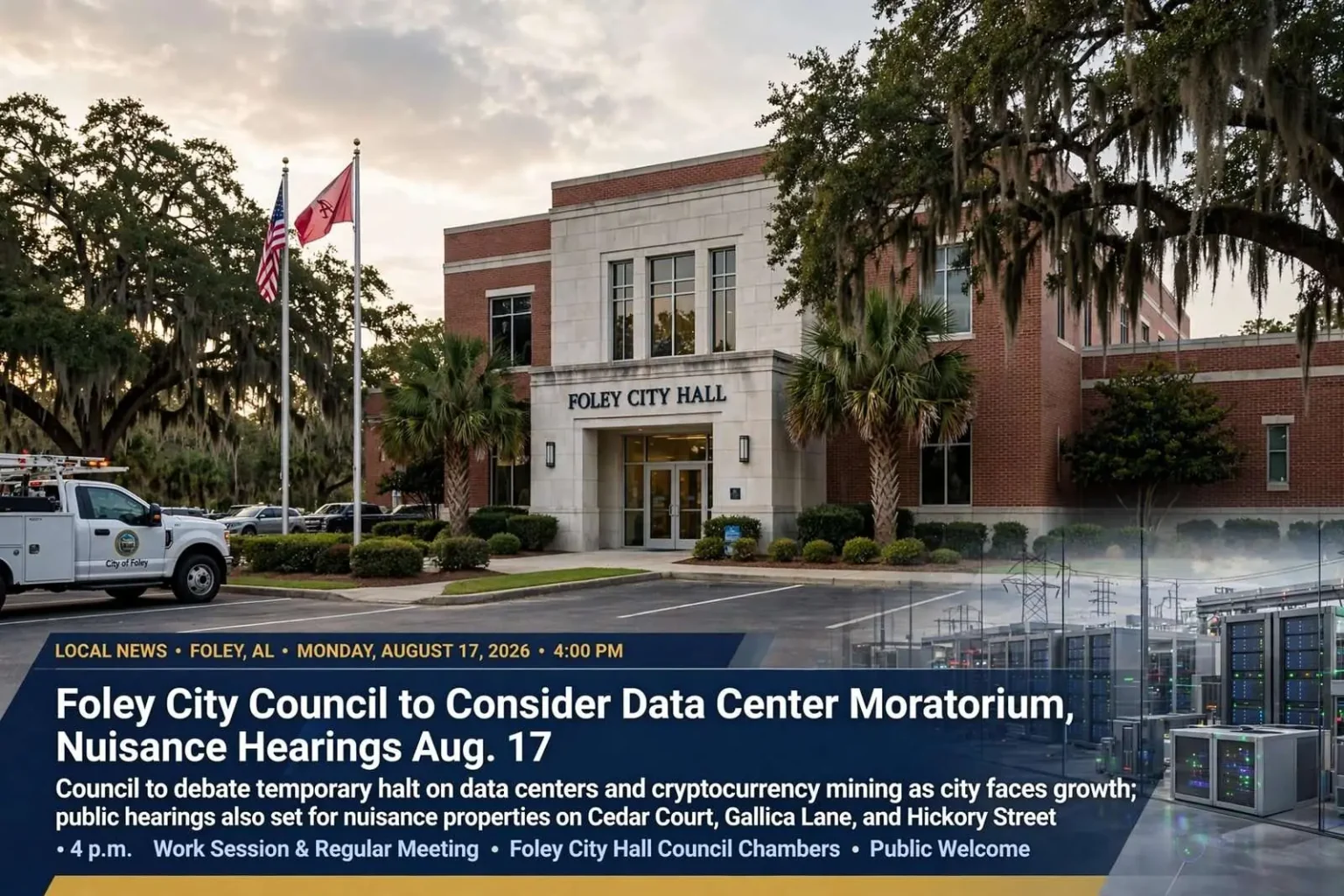
The Foley City Council will hold its regular work session and meeting Monday, Aug. 17, beginning at 4 p.m. in the council chambers at Foley City Hall.
Among the items on the agenda is the first reading of an ordinance that would impose a temporary moratorium on accepting, processing or approving applications for data centers, Bitcoin and cryptocurrency mining facilities, server farms and similar technology-focused operations characterized by high electrical demand or high water consumption. The council will also set a public hearing on that same proposed moratorium.
The moratorium, if adopted, would buy the city time to study a category of development that has swept across the country faster than most zoning codes can answer. Data centers — the warehouse-scale server facilities behind cloud computing and artificial intelligence — and cryptocurrency mining operations can consume electricity at the scale of a small city, and large cooling-dependent facilities can strain water supplies as well. Cities that welcomed them early have frequently discovered that the zoning rules on the books were written for retail, warehouses and light industry, leaving little control over noise from cooling arrays, substation construction or the load such facilities place on the local grid.
A temporary moratorium does not ban the use outright; it suspends new applications while the planning process catches up. Foley’s growth has made the question practical. The city’s population has climbed steadily for decades, its electric and water utilities have expanded with it, and its position along the Beach Express and Highway 98 corridors has put large tracts of land in play for regional-scale development. Setting standards now — on power load, water use, buffering and noise — is the kind of rule that is easy to write before the first facility files an application and far harder to write after.
Council members are also scheduled to consider the second reading of an ordinance setting fees and policies for the gymnasium at the Foley Activity Center, and the second reading of an ordinance establishing speed limits and traffic controls in the Bay Forest Estates and Wolf Bay Point subdivisions.
Second readings are the step at which an ordinance becomes law. Alabama’s municipal code requires ordinances to pass on two readings with an interval between them, giving residents the chance to see the final text before adoption. The gymnasium fee schedule will govern rentals and programming at the Activity Center, one of the recreation assets the city has expanded as its population has grown. The subdivision speed limits and traffic controls respond to the growth of the neighborhoods along the Wolf Bay corridor, where new streets require posted limits and controls set by ordinance rather than by staff decision.
Honoring Blankenship
Other business includes a proclamation honoring Alabama Conservation and Natural Resources Commissioner Chris Blankenship, and a proposed $10,000 contribution to the Blankenship Scholars Program at the University of South Alabama in his honor.
Blankenship, a Mobile native who rose through the department before being named commissioner, has overseen Alabama’s state parks, wildlife resources and marine resources division during a period of heavy investment on the Gulf Coast. Foley has a direct stake in that work: Gulf State Park, with its trails, campground, lodge and beaches, sits just south of the city and is one of the engines of Baldwin County’s outdoor tourism economy, and the county’s artificial reef programs and marine resources management shape the coastal economy that Foley’s businesses depend on. A scholarship at the University of South Alabama — the region’s public university — fits the hometown-public-service pattern of the honor.
The council will also consider approving ABC licenses for BJ’s Wholesale Club on Palm Beach Way, accepting Goodwyn, Mills, Cawood’s proposal to develop a Municipal Complex Master Plan, and accepting the Legislative Event Grant for the 2026 fiscal year.
Each of those items points at a different kind of growth. The ABC license — Alabama Alcoholic Beverage Control Board approval that every business selling alcohol must hold — signals the arrival of another national retailer in Foley’s commercial corridor. The Municipal Complex Master Plan by Goodwyn, Mills, Cawood, an engineering and architecture firm with deep municipal work across Alabama, will set out how the city’s civic campus develops over the coming years as city hall, public safety and community facilities strain under the growth of recent decades. The Legislative Event Grant for fiscal 2026 helps the city fund events that draw visitors and support local businesses.
Also on the agenda is accepting a donation of K9 Trauma Kits from Protecting K9 Heroes and unbudgeted donation funds for the Foley Fire Department, along with a proposal to declare Sgt. Randy Stallworth’s badge and service weapon as surplus property.
The K9 trauma kits carry medical gear designed for police dogs, who face the same hazards as their handlers but cannot be treated with standard human protocols in the field; departments across the country have added them after officers and dogs were injured in the line of duty. The surplus declaration for Stallworth’s badge and weapon is the routine mechanics of a career milestone — typically the first step in presenting a retiring officer’s service weapon and shield as a keepsake of their years on the force.
The council will also hold public hearings to declare weeds and accumulations of junk, trash and litter a public nuisance on Cedar Court, and set future public hearings on similar nuisance issues on Gallica Lane and at the intersection of South Hickory Street and Baldwin County 20.
Nuisance abatement is the least glamorous but most persistent work of a growing city. Under Alabama municipal law, a council may declare a property a nuisance after a hearing, order the cleanup, and place the cost on the property owner’s tax bill if the city does the work itself. The docket’s length usually tracks the season — summer growth plus storm debris produces the heaviest calendars — and the locations named span the city from its older neighborhoods to the unincorporated-fringe roads along Baldwin County 20.
Additional agenda items include purchasing a new commercial sanitation truck, authorizing the purchase of real property on East Rose Avenue, and adopting a transportation plan under the Rebuild Alabama Act.
The Rebuild Alabama Act, approved by voters in 2019, added a 10-cent-per-gallon fuel tax phased in over three years, with the proceeds — distributed through county and municipal shares alongside state projects — dedicated to roads and bridges. For a fast-growing city like Foley, the annual transportation plan adoption is how those dedicated dollars become paving, resurfacing and intersection work on the ground, and it is one of the few funding streams in Alabama that grows with construction costs rather than competing for general-fund dollars.
Community items and the year ahead
Council members are also expected to discuss a budget amendment to help host the 1st Annual Gulf Coast Equipment “Roadeo” Hospitality Night, and consider approving The Frazer Lanier Company, Incorporated, as an investment banker for upcoming general obligation warrants.
The Roadeo item reflects the city’s hospitality economy at work. Equipment rodeos — competitions where heavy-equipment operators test their precision on excavators, loaders and dump trucks — draw crews and spectators from across the region, and a hospitality night is the city’s way of converting a visiting event into restaurant and lodging business downtown. The investment banker item, meanwhile, is the finance side of growth: general obligation warrants are debt instruments backed by the city’s taxing power, and the city’s choice of underwriter governs the rates it will pay when it borrows for capital projects.
Other items include authorizing the mayor to sign a letter of intent for triaxle dump trucks for the Street Department, a contribution to the Kiwanis Club of Foley Foundation to purchase replacement reindeer for the Foley Christmas Parade, and waiving event and rental fees for the Women’s Care Medical Center Walk For Life Walk-A-Thon at Max Griffin Park and for the Foley Little Lions at the Foley Civic Center.
The reindeer line is less whimsical than it sounds. Foley’s Christmas Parade is a decades-old tradition on South Alabama’s holiday calendar, and the parade’s live reindeer display — a signature that draws families from across the lower Baldwin County area — requires periodic replacement of the animals as they age. The Kiwanis Club of Foley, one of the civic organizations that anchors the city’s volunteer life, maintains the tradition, and the city’s contribution keeps a signature event intact. The fee waivers for the Walk-A-Thon and the Little Lions are the council’s other standard form of community support: in-kind donations of park and civic space to causes that serve local families.
The council will round out the meeting with a review of departmental statistics, monthly permit reports, paid bills and monthly bid awards for July 2026.
Those closing reports are where a growing city’s pulse actually appears. Permit counts in a Baldwin County boomtown chart the pace of residential and commercial construction; departmental statistics show police, fire and public-works response loads climbing with the population; and the bid awards show which infrastructure contracts — paving, drainage, equipment — will shape the next fiscal year. Together with the moratorium ordinance at the top of the agenda, the meeting sketches a city managing the practical arithmetic of its own success: more residents, more traffic, more demand for power and water, and more decisions than ever that have to be made deliberately rather than by default.
The public is welcome at both the 4 p.m. work session, where the council discusses the agenda in detail, and the regular meeting that follows, where votes are taken. The proposed data center moratorium will return for its public hearing and eventual vote in the weeks ahead, giving residents of Foley time to weigh in on how — and how fast — the city’s next wave of development should be allowed to plug in.