Foley Honors Alabama Conservation Commissioner Chris Blankenship With Keys to the City
The Foley City Council presented Alabama Conservation Commissioner Chris Blankenship with a proclamation and the keys to the city, and approved a $10,000 donation to a marine sciences scholarship established in his honor.
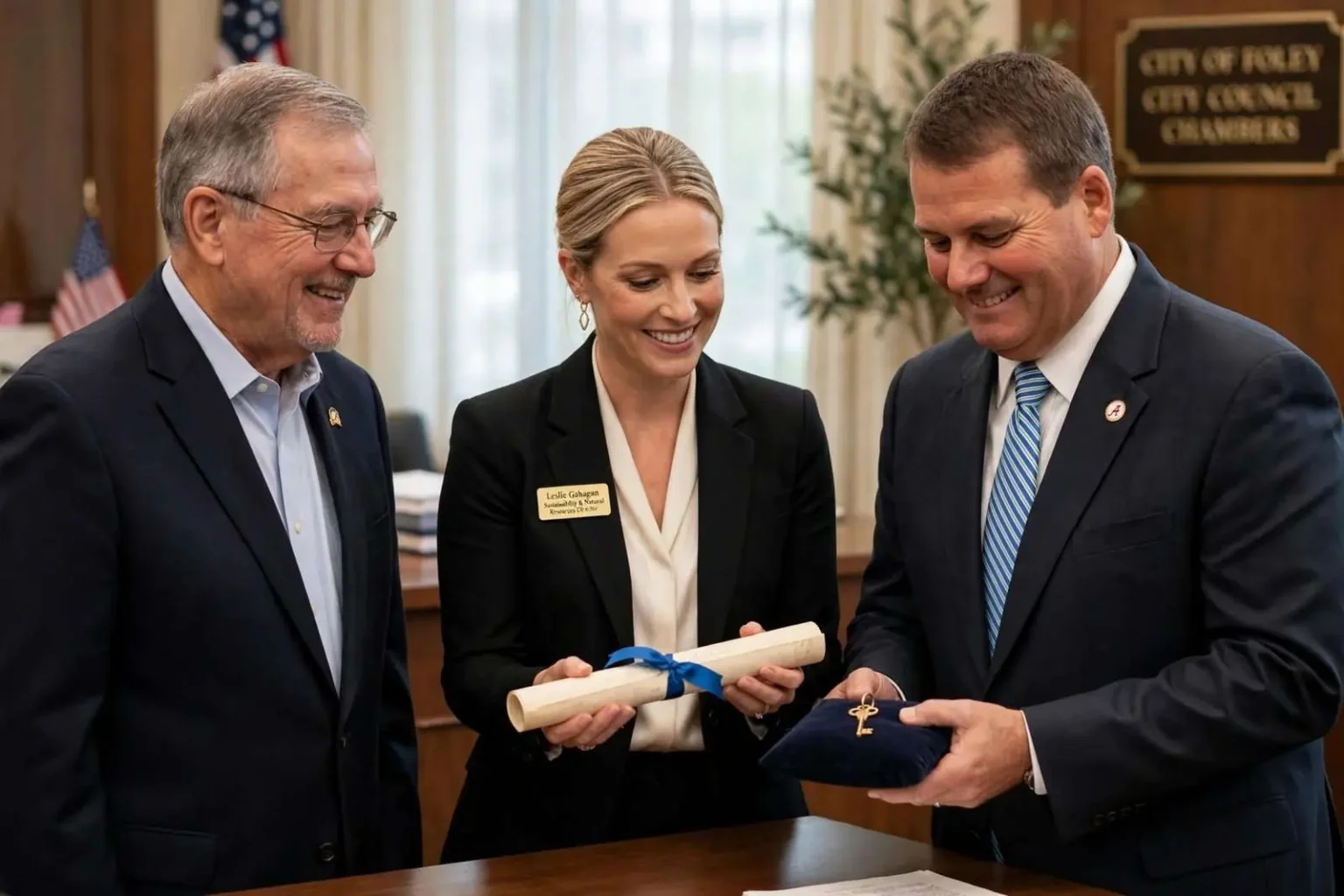
The Foley City Council honored Alabama Commissioner of Conservation and Natural Resources Chris Blankenship on Monday, presenting him with a city proclamation and the keys to the City of Foley in recognition of his years of work protecting the state’s natural resources. According to a news release from the city, the council’s Aug. 17 presentation thanked Blankenship for his role in “improving the environment and preserving and promoting the natural resources in the region.”
Foley Mayor Ralph Hellmich and Leslie Gahagan, the city’s sustainability and natural resources director, presented Blankenship with the proclamation during the ceremony, which brought one of the state’s most influential agency heads to the Baldwin County city he has worked alongside for much of his tenure. For a city of Foley’s size, the gesture was deliberate: the keys to the city are reserved for figures whose work has shaped the community itself, and city leaders framed Blankenship as exactly that kind of partner.
A Career Rooted in South Alabama
Blankenship has served as commissioner of the Alabama Department of Conservation and Natural Resources since Gov. Kay Ivey appointed him to the post in 2017. The agency oversees the state’s parks, wildlife, marine resources and other natural assets, giving the commissioner broad influence over how Alabama manages its coastline, forests and public lands. Blankenship has worked in state conservation for more than 30 years, a career that has carried him through the department’s ranks and given him an institutional memory few agency heads can match.
Mayor Hellmich noted that although Blankenship’s career began in the Mobile Bay area, his impact has extended well beyond South Alabama. “This proclamation talks about South Alabama, but your impact has been on the entire state of Alabama,” Hellmich said, according to the release. “During my 40 years of knowing various commissioners, I don’t know of another commissioner who has had such an impact on our state parks, and that’s not counting the partnerships with the cities and other things that you have accomplished.”
Hellmich’s comments underscored the scope of Blankenship’s tenure, which has touched not only state park improvements but also collaborative efforts with municipalities across Alabama, including Foley and other Baldwin County communities that rely heavily on natural resources for tourism and recreation. In a county where beaches, preserves, waterways and green space double as economic infrastructure, the conservation commissioner’s decisions ripple directly through municipal budgets and quality of life.
Hellmich also noted the rarity of the honor, saying that in his six years as mayor, only seven keys to the city have been presented. The arithmetic makes the point on its own: Foley’s council has been selective about the recognition, and Blankenship joined a short list of honorees whose contributions the city judged to be lasting rather than ceremonial.
The state park investments Hellmich referenced have been visible across Alabama during Blankenship’s tenure, from Gulf State Park’s continuing recovery and growth to improvements at parks across the state that local governments rely on as regional attractions. In Baldwin County especially, the state’s public lands — from the beaches at Gulf Shores and Orange Beach to inland preserves — form the foundation of a visitor economy that counties and cities market every day of the year.
Council Approves Scholarship Donation
Alongside the proclamation, the Foley City Council voted to donate $10,000 to the Blankenship Scholarship Program, a scholarship fund established at the University of South Alabama’s Stokes School of Marine and Environmental Sciences in honor of Blankenship and his work. The scholarship is intended to support students pursuing studies in marine and environmental sciences, fields directly tied to the conservation work Blankenship has overseen during his time as commissioner.
The donation reflects the close relationship between Foley and the state conservation agency, particularly given the city’s coastal location and its reliance on healthy natural resources to support tourism, fishing and outdoor recreation along the Gulf Coast. Foley sits in Baldwin County, home to some of Alabama’s most heavily visited beaches and state parks, making the partnership between local government and state conservation leadership especially relevant to residents.
The gift also points to the pipeline the university’s marine programs represent for the Gulf Coast. Students trained in marine and environmental sciences at South Alabama go on to careers in fisheries management, coastal restoration, environmental consulting and state agency work — the same disciplines that decide how the region’s coastline is managed. A scholarship bearing Blankenship’s name ties the commissioner’s legacy to the next generation of the workforce his department depends on, and Foley’s $10,000 seed makes the city a direct investor in that pipeline.
Gahagan’s role in the presentation was fitting as well. As Foley’s sustainability and natural resources director, she has been the city-side counterpart in many of the partnerships the evening celebrated, managing the local preserves, grant projects and habitat work that state and municipal agencies have built together. The ceremony was, in effect, a joint acknowledgment that conservation on the Gulf Coast happens through exactly this kind of layered cooperation.
Partnership at Graham Creek
In accepting the honor, Blankenship pointed to the city’s Graham Creek Nature Preserve as an example of the kind of collaboration he valued most. “I’ve appreciated our partnerships with Foley,” Blankenship said. “Y’all have been fantastic partners in the work at the Graham Creek Nature Preserve and other things that we’ve been able to work with you on. These are things that are going to have lasting impacts long after we’re all gone – what’s happening out there, the land that y’all preserved and the good things that have happened here, how y’all are managing growth and the good job that y’all are doing as a city.”
Graham Creek Nature Preserve has become one of Foley’s signature public assets, a working landscape of preserved habitat on the city’s rapidly growing outskirts where conservation and development planning have been deliberately run in parallel. In one of Alabama’s fastest-growing corridors, where rooftops and commercial projects press against wetlands and open space every year, the preserve represents a different model: land acquired and managed for habitat, recreation and flood protection before growth made such purchases impossible.
City officials framed the recognition as both a thank-you and an acknowledgment of the working relationships Blankenship has built with municipalities throughout his nearly decade-long tenure. As Alabama continues to balance growth along its coastline with the preservation of natural habitats, the collaboration between state conservation leadership and local governments like Foley is expected to remain a key part of how the region manages its resources going forward.
The commissioner’s approach to his job has been defined by exactly that local-first posture. Rather than treating state parks, marine resources and wildlife management as matters handled exclusively from Montgomery, Blankenship’s department has repeatedly worked through municipal partners — sharing expertise, grant funding and technical support while letting cities lead on the properties their residents use most. In Baldwin County, where tourism and growth press against the coast’s natural systems simultaneously, that model has produced the kind of results neither level of government could have achieved alone.
Foley’s own trajectory explains why the partnership matters so much to the city. Once a quiet agricultural crossroads on the way to the beach, Foley has grown into one of Baldwin County’s larger cities, with a commercial corridor, an expanding residential base and a tourism draw of its own in attractions and preserves. Growth of that speed puts pressure on water, habitat and green space, and the city’s decision to invest in preservation — Graham Creek foremost among those investments — has been a defining choice of its modern development. State conservation support helped make that choice practical.
The scholarship donation adds an educational thread to the relationship as well. By funding students at the University of South Alabama’s Stokes School of Marine and Environmental Sciences, the council’s $10,000 vote invests in the scientists who will inherit the coastline questions Blankenship’s generation has managed: fisheries health, habitat restoration, water quality and the effects of continued growth on the Gulf’s ecosystems. The commissioner who received the keys to the city now has his name attached to the training ground for the people who will carry that work forward.
For Blankenship, the evening in Foley brought together the themes of his tenure in a single room: state parks that cities depend on, partnerships that outlast administrations, and a conservation philosophy measured in land preserved rather than press releases issued. His own words at the ceremony captured it — the work at Graham Creek, he said, is “going to have lasting impacts long after we’re all gone.” The city’s proclamation and the keys in his hand were Foley’s way of saying it agrees, and of putting on record that when the history of the region’s conservation is written, the state’s commissioner will have his own chapter.