Forbidden Fruit and Red Right Hand Hit the Blind Mule Friday
Forbidden Fruit and Red Right Hand play the Blind Mule in downtown Mobile on Jan. 16, with a funk, rock, jazz and R&B set headlined by Isaac Jolly.
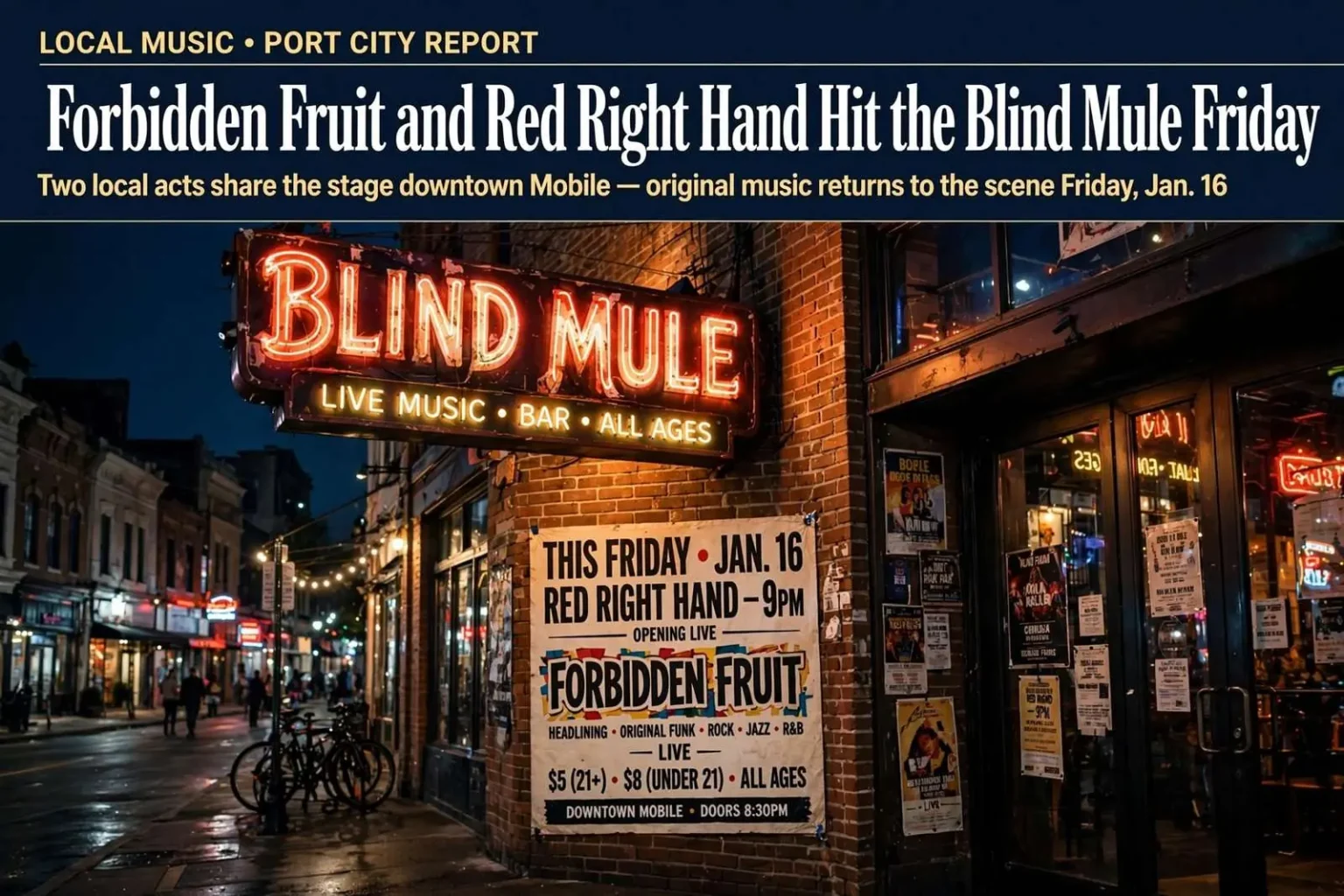
Two local acts share the stage at the Blind Mule in downtown Mobile on Friday, Jan. 16. Red Right Hand opens at 9 p.m., followed by headliners Forbidden Fruit, a group blending funk, rock, jazz and R&B into a live show that has become one of the more distinctive offerings on the Port City’s club circuit.
“Our sound is unique … I do know it gets you moving no matter who you are,” said Isaac Jolly, the multi-instrumentalist, composer and singer who assembles the rotating cast of musicians behind Forbidden Fruit’s live shows. Jolly writes every composition the group performs, making the band a genuine original-music project in an era when many local acts lean on covers to fill out a night.
The Blind Mule, tucked into Mobile’s downtown entertainment district, has built a reputation as a stage where local songwriters and bands get a real shot, and Friday’s bill pairs a rising opening act with a headliner built around entirely original material.
The Business of Original Music
Fellow band members have spoken openly about the difficulty of building an audience for original music in a small city, where closing venues can leave little room for original bands to grow. Every club that shuts its doors narrows the circuit of stages where a band can play its own songs to a crowd that might stay for more than a set.
“Original music cannot survive if music venues close,” drummer Johnathan Ashley and trumpet player Dennis Parker said. “Then the only way to make a buck would be to play a four-hour, 10-to-2 gig playing cover music at a normal bar that drunk people will not remember or thank you for.”
Their point is a practical one, made by working musicians who have watched the economics of the local scene from the stage. Cover gigs pay predictably, but they rarely build a following for a band’s own songs. Original acts need venues willing to book them, audiences willing to listen and enough of both to sustain a scene from year to year.
Forbidden Fruit’s Rotating Lineup
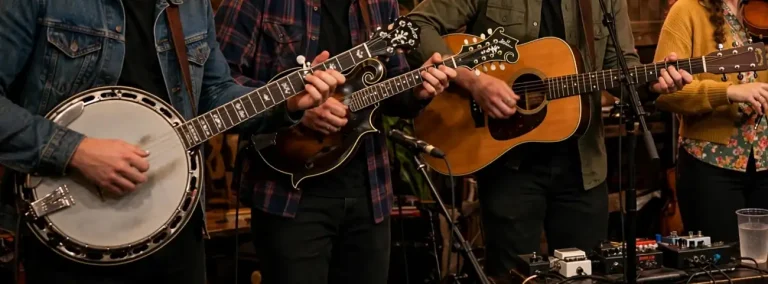
Part of what makes Forbidden Fruit unusual is its structure. Rather than a fixed band, the group operates as a rotating cast of Mobile musicians assembled by Jolly for each performance, an approach that draws on the city’s deep bench of players across genres. The result is a live show that can shift in texture from night to night while keeping the compositions at its center.
Jolly’s writing spans the territory between funk, rock, jazz and R&B — genres that share roots in the Gulf Coast’s musical history. The blend gives the band flexibility that covers-only acts rarely achieve, and it lets featured players stretch out in ways that keep the music honest and the crowd engaged.
The band’s rising profile reflects years of work in a market that does not make success easy. Building an audience one show at a time, in clubs of a few hundred capacity, requires persistence as much as talent, and Forbidden Fruit’s lineup has put in that time across Mobile’s stages.
Red Right Hand Takes the Opener’s Slot
Red Right Hand, the opening act, gets the 9 p.m. slot — an early start that works in its favor, putting the band in front of the crowd that arrives on time rather than the tail end of the night. Opening slots are how younger Mobile bands earn their followings, and a strong set at a respected venue can translate into bigger bills down the road.
For music fans, the pairing offers a full spectrum of local sound in one stop: an opening act building its catalog and a headliner with a deep book of original songs and a flexible cast of players. The all-ages booking widens the door further, allowing younger fans who are often shut out of bar shows to see both acts live.
Early set times also reward attentive listening. The 9 p.m. start means Red Right Hand plays to a room still filling up and still sober enough to focus on the music, while Forbidden Fruit takes the stage at the hour when downtown is at its liveliest. For bands trying to convert casual listeners into fans, those windows matter more than most audiences realize.
The Details
The all-ages Friday show is $5 for patrons 21 and older and $8 for younger attendees. The modest cover reflects the economics of the local scene: cheap enough to draw a curious crowd, priced to keep the venue and the bands paid. All-ages shows carry a small premium for younger fans, but the difference of a few dollars opens the room to high school and college audiences who are often the most enthusiastic supporters of local original music.
Doors open with Red Right Hand’s 9 p.m. set, and Forbidden Fruit’s headline performance follows. Downtown parking and the walkability of the entertainment district make the venue an easy stop, and the timing leaves the rest of the night open for anyone making a circuit of downtown Mobile’s stages and bars.
Supporters say turning out for independent venues is what lets distinctive local bands keep emerging. Every ticket and every drink bought at an original-music show is a vote for more of them, and every empty room makes the next all-original bill harder to book.
Why Local Venues Matter
Mobile’s music scene has always depended on its clubs. The city that produced the era of Mobile’s legendary R&B and soul recording history — and that hosts the annual music festivals drawing national attention — built that reputation in small rooms where bands learned their craft in front of live audiences. Venues like the Blind Mule carry that tradition forward, giving songwriters a stage and giving the city a sound of its own.
When original venues close, the losses ripple. Bands lose stages, fans lose gathering places and the city loses part of the cultural identity that makes downtown worth visiting on a weekend. Musicians like Ashley and Parker frame the stakes bluntly because they have watched the pattern play out: fewer rooms, more cover gigs, less original music.
Friday’s show is, in that sense, more than a night out. It is a chance for Mobile audiences to support two local acts, one independent venue and the idea that the city’s own music is worth hearing — performed live, written at home and priced at five dollars for anyone old enough to walk through the door.
Isaac Jolly’s Approach to the Band
Jolly’s role in Forbidden Fruit goes beyond writing and singing. As the band’s composer and organizer, he functions as something like a bandleader-conductor for each show, choosing the musicians whose strengths fit each performance and arranging the material to feature them. That model demands more of a leader than a fixed lineup does — every show is a new rehearsal cycle, every player brings new ideas — but it also keeps the music fresh and ties the band into the wider community of Mobile players.
The approach has an added benefit for the local scene: more musicians get paid gigs playing original material, and the band’s audiences meet a changing cast of the city’s best players. In a market the size of Mobile, that network effect matters. Musicians who play in one another’s projects build a scene rather than competing within one.
Jolly’s own description of the band’s sound — unique, and guaranteed to get you moving — captures the ambition. Funk, rock, jazz and R&B each demand different skills from players, and a group that genuinely spans them needs versatile musicians and a bandleader willing to hold it all together. Friday’s show will put that claim to the test in front of a hometown crowd.
The Blind Mule’s Role Downtown
The Blind Mule has become one of downtown Mobile’s reliable stages for local acts, and its willingness to book original music has made it a fixture for bands that play their own songs. Its location in the downtown district puts it within walking distance of other nightlife, which helps shows build momentum — audiences drift in from nearby bars, and early arrivals often stay for multiple sets.
Venue operators on the local scene describe a constant balancing act. Original-music nights draw passionate but unpredictable crowds, while cover bands and DJ nights fill the room on autopilot. A venue that hosts original bills is making an investment in the scene, betting that audiences will eventually grow to match the talent.
Friday’s $5-and-$8 pricing fits that philosophy. Low covers lower the risk for curious listeners — the passersby who might come for one set and stay for three — and every convert to a local original band is a customer for the next show, and the one after that.