Former Alabama Linebacker Ralph Staten Charged After Mobile Police Chase
Former Alabama and NFL linebacker Ralph Staten faces DUI and eluding charges after a police chase in downtown Mobile, authorities say.
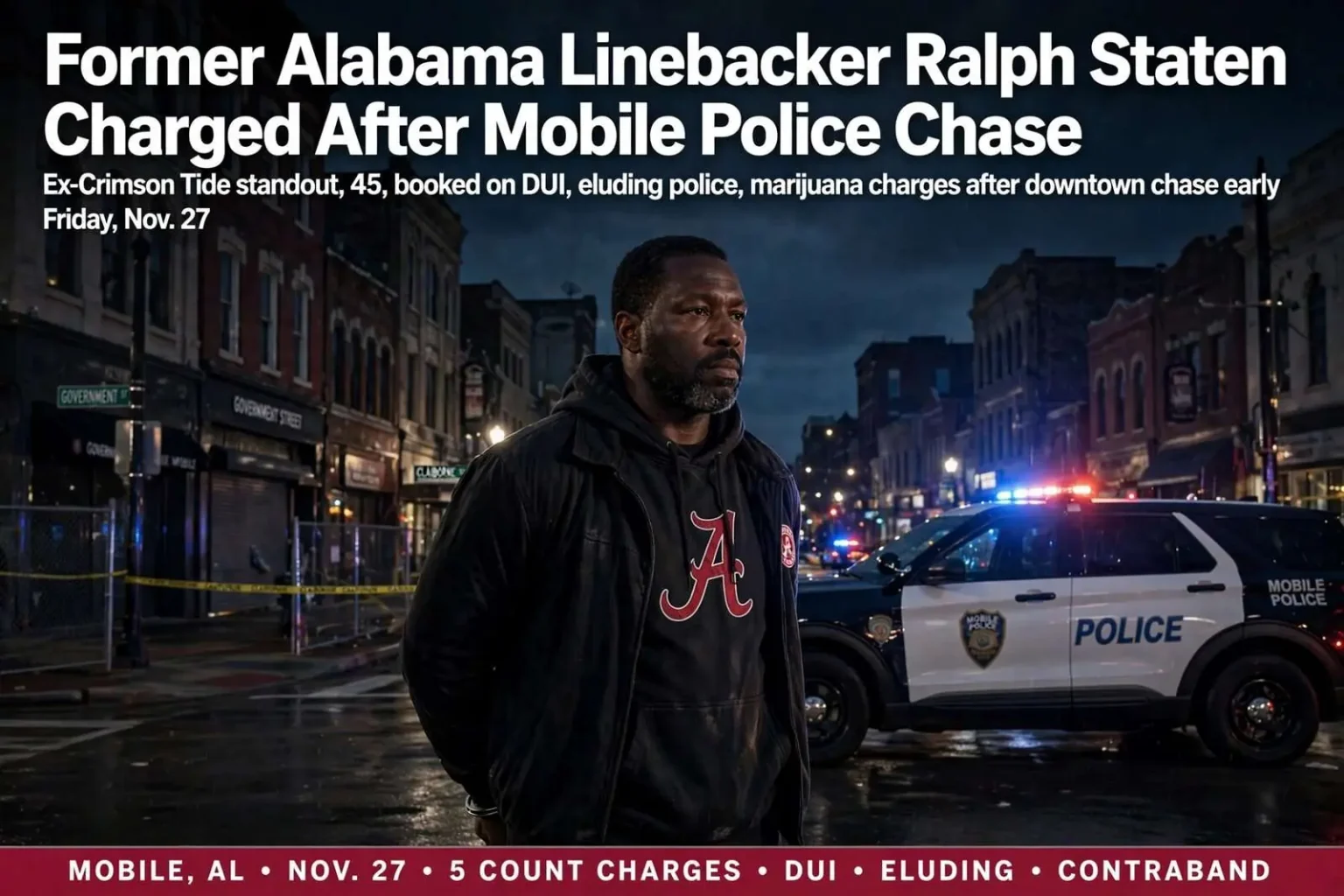
A former University of Alabama linebacker faces multiple charges after police accused him of driving drunk and leading an officer on a chase through downtown Mobile over the holiday weekend. Officers said they spotted Ralph Staten, 45, speeding and running stop signs near Government Street and Claiborne Street around 4:45 a.m. Friday, Nov. 27.
According to police, Staten refused to stop and led an officer on a short pursuit before pulling over and surrendering. The chase through downtown Mobile came in the pre-dawn hours of the day after Thanksgiving, when the streets were largely empty but officers were watching for exactly the kind of driving described in the report — a car moving fast through the Government Street corridor and ignoring stop signs along the way.
The arresting officer reported that Staten appeared intoxicated when he got out of the car. He was booked on charges of attempting to elude police, reckless driving, and driving under the influence. Mobile police say intake officers at Metro Jail then found a small bag of marijuana in his possession, adding counts of marijuana possession and promoting prison contraband.
The final charge is the one many defendants never see coming. Under Alabama law, bringing controlled substances into a jail — even a small amount discovered at intake rather than carried into a cell — is treated as promoting prison contraband, a separate felony from the possession itself. An arrest that might otherwise have produced three traffic-related counts became a five-count booking because of what was found during the search at the jail.
The Charges and How They Stack
Each of the traffic charges carries its own weight. Driving under the influence is Alabama’s baseline drunk-driving offense, typically a misdemeanor for a first offense but one that brings license consequences, fines, and mandatory evaluation. Reckless driving covers the manner of operation — the speeding and running of stop signs officers reported. Attempting to elude covers the refusal to stop: in Alabama, fleeing or attempting to elude a police officer who signals a stop is itself a criminal offense, and the short pursuit through downtown gave police that count in addition to everything else.
The marijuana possession count and the promoting prison contraband count compound the exposure. Possession of a small amount of marijuana is treated as a misdemeanor under Alabama’s current statutes, while promoting prison contraband is classified more severely because of the institutional danger contraband poses inside a correctional facility. The combination means Staten’s case will involve both municipal-style traffic charges and felony-level exposure, moving through the Mobile County court system.
Bookings of this kind are processed at the Mobile County Metro Jail, the primary intake facility for arrests in the city. Intake searches are standard procedure for every person booked, and discovery of contraband during that search is documented by the officers who find it — which is how the bag of marijuana allegedly discovered there became its own charge rather than a footnote.
A Standout on the Tide’s Mid-90s Defense
Staten was a standout for the Crimson Tide in the mid-1990s, earning All-SEC honors at linebacker during his senior year in 1996. He played in the heart of Alabama’s era under Gene Stallings, when the program was among the nation’s most prominent and Tuscaloosa rosters were stocked with players who went on to professional careers. Linebackers of that period anchored defenses that faced some of the Southeastern Conference’s best offenses, and All-SEC recognition marked Staten as one of the conference’s better players at his position.
The Baltimore Ravens drafted him in 1997, and he spent two seasons in the NFL. The Ravens were a young franchise at the time — the 1997 season was only their second in Baltimore after the franchise’s move from Cleveland — and Staten was part of the roster-building years that preceded the team’s championship run a few years later. For a Mobile-area player, reaching the league through the University of Alabama remains one of the most well-traveled paths in football.
Staten’s post-football life, like that of many former players, has now intersected with the court system in a way his college and professional records never did. Former athletes who run into legal trouble draw attention precisely because their playing careers were public — fans remember the player, and the news of an arrest travels quickly. What the courts will weigh, however, is the conduct of the early morning of Nov. 27: the driving, the refusal to stop, and the contraband found at intake.
DUI enforcement in Mobile follows the pattern familiar across Alabama. Officers look for the indicators — speed, lane violations, ignored signals — and a stop near Government Street and Claiborne Street at 4:45 a.m. fits the profile of the hours when impairment is most often detected. A driver who refuses to stop converts a traffic case into a pursuit case, and prosecutors treat eluding as a serious matter even when the chase is short, because of the risk it creates on city streets.
What Comes Next in the Case
The charges will now move through arraignment and the early stages of the Mobile County court process. DUI cases typically involve evidence such as field sobriety observations and chemical test results, and the defense will have the opportunity to challenge each element. The promoting prison contraband count will be examined on its own facts — what the intake search found, how it was documented, and how the substance was handled after discovery.
Sentencing exposure depends on Staten’s prior record, which prosecutors will assemble as the case develops. A first DUI conviction in Alabama carries mandatory minimums including fines and license suspension, and any priors escalate the consequences substantially. The eluding and reckless driving counts each carry their own penalties, and the felony-level contraband charge carries the gravest potential exposure of the five.
For the former teammates and Alabama fans who remember Staten’s career, the case is a familiar and sobering genre: a player whose athletic résumé includes All-SEC honors and two NFL seasons now facing charges in the city where he lives. The courts will handle the facts of Nov. 27 the way they handle any defendant’s — charge by charge, hearing by hearing — and the outcome will rest on the evidence rather than the name.
What the record already establishes is the night’s sequence: a 45-year-old man driving fast through downtown Mobile before dawn, running stop signs near Government and Claiborne, refusing an officer’s signal to stop, pulling over after a short pursuit, and ultimately booked at Metro Jail on five counts — attempting to elude, reckless driving, DUI, marijuana possession, and promoting prison contraband — after intake officers said they found a small bag of marijuana in his possession.
The case joins the long list of reminders, in football and out of it, that the years after a playing career ends bring their own challenges. For Staten, the next dates are in a Mobile courtroom, where the state will be required to prove each of the five counts it has charged.
Staten’s arrest came during one of the busiest driving weekends of the Mobile year. The night after Thanksgiving typically brings heavy traffic downtown and along the bay, and police departments across Alabama staff extra patrols for the holiday period, when impaired-driving arrests reliably spike. A 4:45 a.m. stop on the Friday after the holiday falls at the tail end of that enforcement window, when officers are still watching for the same violations they have been citing all night.
The pursuit itself was measured in blocks rather than miles, according to the police account — a refusal to stop, a short chase through the downtown grid, and a surrender. Officers involved in pursuits must weigh the seriousness of the underlying offense against the danger created by the chase itself, and short pursuits that end quickly are the outcome agencies prefer when a stop does go wrong. That Staten pulled over and gave himself up ended the incident without injury, according to the report.
For Alabama fans of a certain age, the mid-1990s era Staten played in remains one of the program’s most storied stretches. The Tide won national and conference titles in the decade’s early years, and by the time Staten’s senior season arrived in 1996, Alabama football occupied a place in the state’s culture that few institutions match. Linebackers from that era — the position Staten earned All-SEC honors at — were often the defensive captains and leading tacklers, the players around whom coordinators built their schemes.
The draft that followed his senior year sent him to Baltimore, where the Ravens were assembling their first sustained rosters. Two seasons in the NFL placed him among the small fraction of college players who reach the league, and his path from an Alabama linebacker room to an NFL roster followed the route many of the program’s defenders have taken since. The next chapter of his story will unfold not on a field but in Mobile County’s courts, where five charged counts now await arraignment and the hearings that follow.