
Former Mobile BayBears pitcher Wade Miley named to All-Time BayBears team
Former Mobile BayBears pitcher Wade Miley, now with the Houston Astros, has been named to the franchise's All-Time BayBears Team as the club nears its.
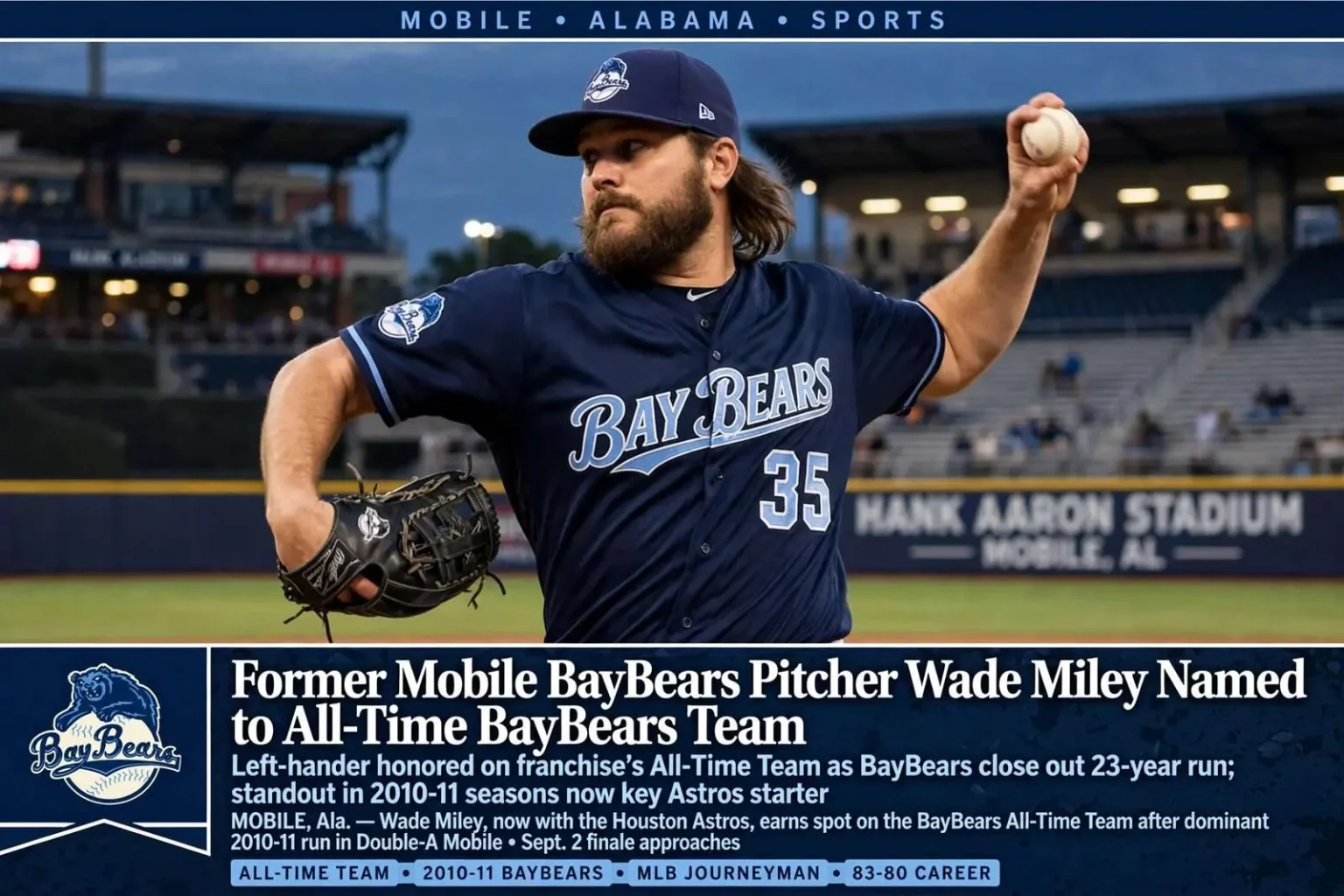
MOBILE, Ala. — As the Mobile BayBears prepare to wrap up a 23-year run, the organization is looking back at the best players to wear the uniform, and a familiar name from the majors has earned a spot on the franchise’s All-Time Team. Wade Miley, now a starter in the Houston Astros rotation, spent parts of two seasons in Double-A Mobile on his way to a long big league career.
The left-hander’s selection adds one of the steadiest arms of his era to a list that will stand as the franchise’s final word on its best players. For fans who watched him pitch at Hank Aaron Stadium, the honor confirms what the box scores from a decade earlier already suggested.
From First-Round Pick to Mobile
Miley was a first-round pick of the Arizona Diamondbacks in 2008 out of Southeastern Louisiana University, and his climb through the minor leagues brought him to Double-A Mobile in 2010. The stop was a productive one: he went 5-2 with a 1.98 ERA in 13 starts for the BayBears, holding Southern League lineups to a pace that made his promotion to the majors feel like a matter of when, not if.
He followed with a 4-2 mark in 14 starts for the BayBears in 2011, again showing the command and durability that would define his professional career. Across his two Mobile seasons, Miley established himself as one of the most advanced pitching prospects in the Arizona system.
Double-A is where organizations traditionally send the prospects they believe are closest to contributing — the level where hitters have major league-caliber patience and pitchers learn to survive without overpowering everyone. Miley’s numbers in Mobile reflected a pitcher already past the development stage, biding time until the phone call.
The Breakout
The call came soon. Miley’s breakout arrived in 2012, when he earned a full season in the Arizona rotation and made the most of it: he was named to the MLB All-Star Game and went 16-11, one of the finest rookie-to-sophomore jumps any pitcher produced that year. The National League took notice, and Miley finished among the top rookies in the circuit.
For BayBears fans, the 2012 season read like a graduation announcement. The pitcher they had watched baffle Southern League lineups was now carving through lineups in Phoenix, and Mobile’s place on his resume became part of the local baseball conversation.
Miley spent three solid seasons with the Diamondbacks, establishing himself as an innings-eater in a rotation filled with bigger names. His value was never flashy; it was consistency — the ability to take the ball every fifth day and give his club a chance to win, year after year.
A Journeyman’s Route Through the Majors
After his Arizona tenure, Miley was traded to Boston, where he went 11-11 for the Red Sox in 2015. The move to the American League began the journeyman chapter of his career, the kind of route most major leaguers travel: productive seasons in changing uniforms, with each spring bringing a new city and a new coaching staff to learn.
He later spent time with Seattle and Baltimore, going 8-15 for the Orioles in 2017, and pitched for the Milwaukee Brewers before joining the Astros’ rotation this season. Along the way he compiled the kind of service time and pitch-by-pitch experience that turns a left-hander into a craftsman — sequencing, deception and the willingness to throw any pitch in any count.
His career record stands at 83-80, a mark that reflects both his longevity and his consistency. In an era when starting pitchers rarely log the workloads of previous generations, Miley’s accumulation of seasons, starts and innings put him in select company among his draft class.
The Astros role reunited him with one of baseball’s most analytically sophisticated organizations, in a rotation built for October. For a pitcher whose career began with a first-round call a decade earlier, pitching meaningful late-season games in Houston represented the second act of a career many had written off in its middle chapters.
The All-Time Team
The BayBears are revealing members of the All-Time Team one at a time ahead of the franchise’s final game on Sept. 2, turning the closing season into a rolling celebration of the players who defined the franchise. Each reveal gives longtime fans a reason to dig out old programs and argue the merits of their own favorites.
Selections were based on each player’s or coach’s overall career, not just their time in Mobile — a criterion that favors players like Miley, whose brief but excellent stint here foreshadowed a decade and a half of major league work. The approach treats the All-Time Team as a celebration of everyone who passed through, measured by where the journey ended.
The BayBears’ Place in Mobile Baseball History
The franchise’s final season closes a chapter that stretches back decades. Mobile’s professional baseball roots run far deeper than the BayBears themselves — this is the city that produced Hank Aaron, Willie McCovey, Ozzie Smith, Satchel Paige and a remarkable share of baseball royalty, a legacy reflected in the name of the team’s own ballpark, Hank Aaron Stadium.
The BayBears arrived in Mobile in the late 1990s and became a fixture of the Southern League, the Double-A circuit whose member clubs dot the Southeast from Tennessee to Florida. For a generation of local fans, summertime meant taking in a BayBears game, watching tomorrow’s major leaguers develop a few miles from home.
That prospect-watching tradition is what makes players like Miley resonate. Fans who sat behind the third-base line in 2010 were watching a future All-Star without knowing it, and the reveal of the All-Time Team invites them to take credit for their foresight.
The final game on Sept. 2 will end the franchise’s 23-year run, but the names on the All-Time Team — Miley among them — will keep Mobile on the map of every minor league history discussion. The stadium’s future and the city’s next chapter in professional baseball remain open questions that the closing season has kept alive in local conversation.
What Miley’s Selection Says
Miley’s spot on the All-Time Team is a reminder that a minor league stop is measured in more than statistics — it is measured by the careers that followed. The BayBears’ roll call includes players who went on to All-Star appearances, championship rings and long big league tenures, and Miley’s path through all three fits the franchise’s proudest pattern.
It also honors the scouting side of the game. The Diamondbacks saw enough in a left-hander from Southeastern Louisiana to spend a first-round pick on him, and the player who reached Mobile in 2010 validated that decision at every level. Mobile fans got a front-row view of the beginning of that validation.
As the final weeks of the season tick toward Sept. 2, each All-Time Team announcement gives the BayBears’ last home stand a retrospective feel — a chance for the franchise and its city to say a proper goodbye by remembering the players who made 23 years worth remembering. Miley’s name will be on that list, right where Mobile fans always believed it belonged.
The View From the Left Side
Part of what made Miley such a prospect — and such a durable major leaguer — was the simple fact that he threw left-handed. Left-handed starting pitching is perennially among the scarcest commodities in baseball, and clubs around the league spent years cycling through left-handers in search of someone who could give them 30 reliable starts. Miley built a career out of being that pitcher.
His style evolved with age. The pitcher who overmatched Southern League hitters in 2010 could not simply blow fastballs past major league lineups forever, so he reinvented himself as a location artist, mixing speeds and arm angles and leaning on a changeup that became one of the better weapons in his arsenal. The adjustment extended his career by years and turned potential mid-career releases into renaissance seasons.
Players who survive that long tend to become clubhouse assets as well. Younger pitchers arriving in Houston found in Miley a working example of how to prepare between starts, how to study opposing lineups and how to bounce back from the rough outing that visits every rotation at least a few times a season.
Mobile’s Double-A Legacy
Miley’s two seasons in Mobile also say something about the quality of baseball the Southern League brings to cities like this one. Double-A is widely regarded by scouts and executives as the most telling level in the minors — the point where tools either develop into skills or don’t, and where the future major leaguers separate from the future releases.
For 23 years, Mobile fans had access to that proving ground without leaving the city. The list of players who wore a BayBears uniform and later appeared in a World Series, an All-Star Game or a postseason rotation is long, and each new All-Time Team reveal adds another name to the roll.
That access was never taken for granted by the organization’s longtime staff, who spent two decades promoting the product through school-day games, postgame fireworks and the small-neighborhood touch that minor league baseball does better than any other level of the sport. The BayBears’ final homestand is, in part, a thank-you tour for that connection.
One Last Nod to the Regulars
The fans who will remember Miley most fondly are the ones who saw him in person during those 2010 and 2011 seasons, when a future 16-game winner was shutting down Southern League lineups in front of modest weeknight crowds. Minor league baseball’s unique promise is precisely that kind of surprise in hindsight — the memory of watching a star before anyone knew he was one.
As the franchise counts down to Sept. 2, those memories are what the All-Time Team series is really curating. Statistics fade, rosters turn over and stadiums age, but the recollection of a summer night at Hank Aaron Stadium — and a left-hander dealing his way toward the majors — is the kind of thing a city keeps long after the final out.


