
Former Padres shortstop Greene named to All-Time Mobile BayBears Team
As the Mobile BayBears prepare to end a 23-year run, the club is naming its All-Time Team, and former San Diego Padres shortstop Greene has made the list.
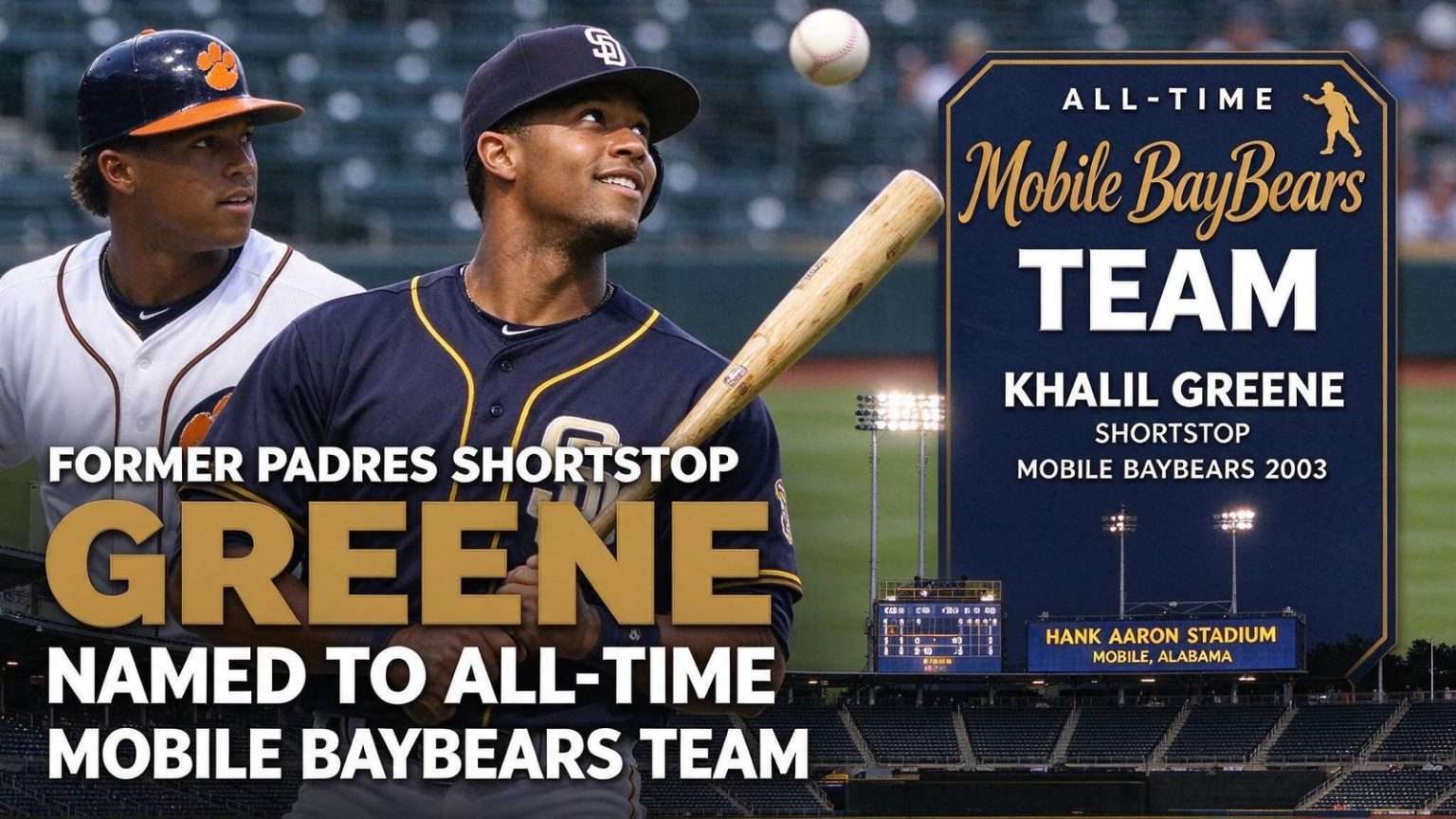
As the Mobile BayBears prepare to wrap up a 23-year run of minor league baseball on the Gulf Coast, the team is unveiling its All-Time BayBears Team, and one former San Diego Padres shortstop who honed his skills in Mobile has made the list. The honor roll, assembled from more than two decades of players and coaches who passed through the organization, is being revealed one selection at a time ahead of the BayBears’ final game on Sept. 2.
The selections are based on each player’s or coach’s overall career, not just their time in Mobile — a criterion that opens the door to stars whose BayBears days were brief but whose careers afterward burnished the franchise’s history. That is precisely the case with shortstop Khalil Greene, whose single season in a BayBears uniform preceded six years as the Padres’ starting shortstop and one of the best power totals ever recorded at the position.
Greene, the 2002 College Baseball Player of the Year at Clemson, began the 2003 season in Mobile. He hit .275 in 59 games before a promotion to Triple-A, a quick rise that showed how far ahead of his competition he already was. He debuted with the Padres later that year and spent six seasons in San Diego, mostly as the team’s starting shortstop.
His 84 home runs are the most ever by a Padres shortstop, a record that speaks to the power Greene carried to a position where offense was traditionally an afterthought. He also played for St. Louis before his career was cut short by social anxiety disorder. He finished with a .245 career batting average — numbers that, combined with his defensive play at a premium position, made him one of the more memorable major leaguers to develop in Mobile.
Greene’s Path Through Clemson and Mobile
Greene arrived at Clemson as a lightly recruited in-state player and left as the best amateur in America. His junior season in 2002, when he won the Golden Spikes Award as the nation’s top college player and earned recognition as College Baseball Player of the Year, made him a first-round draft pick. Clemson’s program, long one of the Atlantic Coast Conference’s powers, gave him a stage against elite competition, and he delivered numbers that made scouts see a middle infielder with legitimate offensive upside.
San Diego selected him and sent him to Mobile, the Padres’ Double-A stop in the Southern League, for his first full professional season. The BayBears of that era played at Hank Aaron Stadium in Mobile, a ballpark named for the city’s most famous baseball son, and Greene’s 59 games there gave Gulf Coast fans an early look at a player who would soon be a major league regular. His .275 average in that stretch, combined with the defensive polish that had made him a celebrated college player, confirmed he had little left to prove at the level.
The promotion to Triple-A came mid-season, and by September he was in the major leagues. Taking over the shortstop job in San Diego, Greene became a fixture — the kind of player a franchise builds its defense around. He handled the position’s demands in a park, Petco, that was famously hard on hitters, and his 84 career home runs as a Padre shortstop remain the standard for the franchise at the position.
His time in St. Louis came later, after a trade, and it was there that his career reached its tragic turn. Social anxiety disorder, a condition far more common than most fans realize among elite athletes, eroded his ability to play, and he stepped away from the game at an age when many shortstops are entering their prime. His openness about the struggle afterward helped bring conversations about mental health in professional sports into the open.
The End of an Era on the Gulf Coast
The All-Time Team announcement comes as the BayBears’ franchise reaches its final innings in Mobile. Twenty-three years of baseball on the Gulf Coast have produced rosters full of future major leaguers, championship teams, and thousands of summer nights at Hank Aaron Stadium, and the franchise’s decision to honor its best players one at a time in the season’s closing weeks has given fans a running conversation about the players who mattered most.
The BayBears began play in Mobile in 1997 and spent most of their run as a Southern League franchise, serving as the Double-A affiliate of major league clubs that included the Padres — the team that sent Greene through Mobile — and, in the final years, the Los Angeles Angels. Double-A is the level where prospects with real futures test themselves against seasoned veterans, which is why Mobile’s rosters over the years have read like a who’s-who of players who went on to significant big league careers.
The city’s connection to baseball runs far deeper than the BayBears’ two decades, of course. Mobile has produced more Major League Baseball players per capita than almost any city in America — a list crowned by Hank Aaron, the home run king who grew up in the Toulminville neighborhood, and extended through Ozzie Smith, Satchel Paige, Billy Williams, and Willie McCovey. The stadium bearing Aaron’s name was meant to honor that heritage, and for 23 seasons it hosted the generation of players following in those footsteps.
Greene’s inclusion on the All-Time Team fits the selection criteria exactly. His Mobile season was a brief stop on a career that included a national college award, six years as a big league regular, and a franchise record — the kind of trajectory that, measured over a whole career, earns a place on any team’s all-time list. He is not the only All-Time BayBears honoree whose Mobile stay was short, but he may be the one whose subsequent career did the most to advertise the quality of the players who came through.
What the Honor Means
All-time teams serve a purpose beyond nostalgia. They compress a franchise’s history into a roster fans can argue about, and they give newer supporters a compressed history lesson in the players who defined the organization. For the BayBears, whose run is ending as Minor League Baseball restructures and the franchise relocates, the selections amount to a final accounting — a way of saying this is who we were.
The reveal-one-at-a-time format has turned the final weeks of the season into a rolling tribute, with each announcement sparking memories among fans who watched the honorees play in Mobile. For players like Greene, whose Mobile chapter lasted a single season, the honor is also a reminder that minor league alumni carry their stops with them: a player’s path to the majors is built in places like Hank Aaron Stadium, in front of crowds that remember him first.
When the final game arrives on Sept. 2, the All-Time BayBears Team will stand as the franchise’s last major gesture to its fans — a roster of the best careers ever connected to the club, judged by everything those players did, not just what they did in Mobile. Greene’s story, from Clemson national player of the year to Padres shortstop and franchise record-holder, is exactly the kind of career that roster was designed to honor, and it gives Mobile fans one more reason to be proud of the players their city sent to the big leagues.
The 23-year run ends, but the record remains: two decades of prospects, one national list of the best of them, and a franchise record at shortstop belonging to a player who learned his trade on the Gulf Coast. For a city that has given baseball more greats than any of its size, that is a fitting final chapter.
Mobile’s Baseball Legacy in Context
The BayBears’ departure closes the latest chapter in Mobile’s long baseball story rather than the story itself. The city’s producing of major league talent stretches back over a century, from Paige’s legendary career to the generations of players who came out of sandlots, high school programs, and American Legion teams across the city. Baseball scholars have long noted Mobile’s remarkable yield of Hall of Famers, a distinction rooted in the sport’s deep local culture and the industrial league and sandlot systems that flourished through the mid-20th century.
Minor league baseball’s role in that legacy has been to give the next generation a nearby professional standard — a place where local fans could watch future stars before they were famous. The BayBears carried that role in Mobile for 23 years, and players like Greene show the connection running both ways: the city watched a future Padres record-holder develop for a season, and the player carried Mobile’s stop on his resume all the way to the majors.
For the honorees already revealed and those still to come, the All-Time Team will endure as the franchise’s legacy statement long after the final out on Sept. 2. And for Mobile, a city whose baseball history needs no embellishment, the honor roll simply adds names to a tradition that began generations before the BayBears took the field and will continue long after they play their last game at Hank Aaron Stadium.