Frank Brown International Songwriters’ Festival Set to Fill Gulf Shores and Perdido Key Stages
The Frank Brown International Songwriters' Festival returns for five days of performances across Gulf Shores and Perdido Key, featuring songwriters-in-the-round, an open mic session and a closing all-star jam at the Flora-Bama.
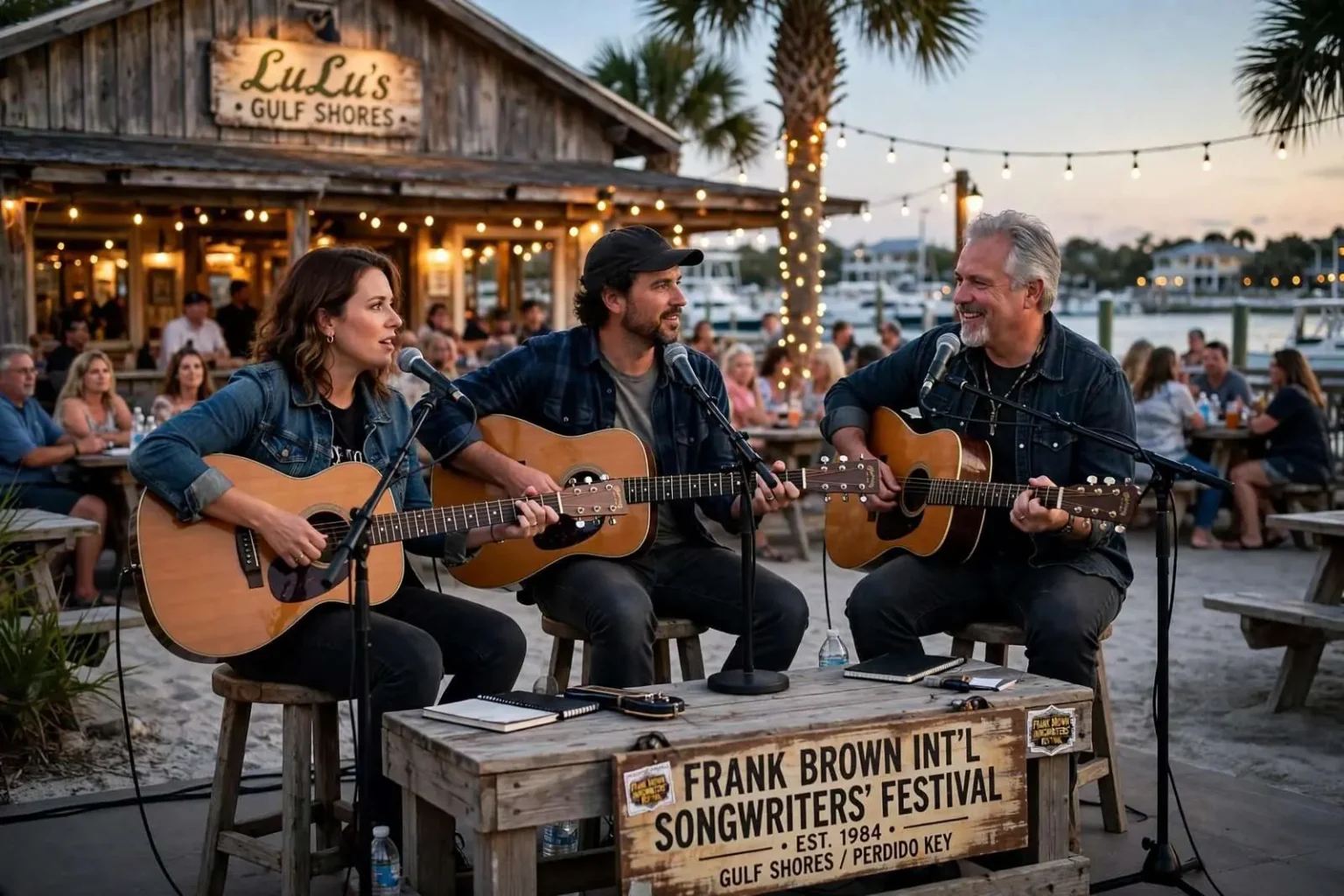
Music fans across the Alabama Gulf Coast are gearing up for one of the region’s longest-running live music traditions, as the Frank Brown International Songwriters’ Festival returns for five days of performances spanning venues in Gulf Shores and Perdido Key. The festival, which has been held every year since 1984, draws touring and local songwriters alike for a mix of intimate acoustic sets, songwriter-in-the-round showcases and open jam sessions.
The event takes its name from a longtime security guard at the Flora-Bama Lounge who became a beloved fixture of the beach music scene before his death. Frank Brown was known to generations of Flora-Bama regulars as the quiet, watchful presence at the door of the famous roadside bar, and honoring his memory has given the festival a spirit that organizers say still shapes it: unpretentious, welcoming, and centered on the songs themselves rather than the celebrity of the people who perform them.
The Flora-Bama, straddling the line between Perdido Key, Florida and Alabama, has been the festival’s spiritual home from the beginning. The landmark lounge — part bar, part music hall, part Gulf Coast institution — has hosted songwriters’ rounds for decades, and it remains the anchor venue of the multi-day event even as the roster of participating stages has grown to spread across two states.
What began as a small gathering of songwriters swapping songs has grown into a multi-day celebration that pulls in performers from Nashville, the Gulf Coast and beyond, all sharing stages across several restaurants, bars and outdoor venues along the state line. For working writers, the festival offers something almost no other event can: rooms full of listeners who have come specifically to hear the stories behind the songs, performed acoustically by the authors themselves.
The format that sets it apart
Organizers say the appeal of the festival lies in its format. Rather than a single headliner playing to a crowd, most sets are built around songwriters-in-the-round performances, where several artists take turns playing their own material and trading stories about how the songs came to be.
The in-the-round style traces its roots to Nashville’s writer nights, where publishers and music row veterans gathered to hear new material in its rawest form. Brought to the beach, the format transforms restaurants and bars into listening rooms. One artist plays, another follows with a song of their own, and the connections between the songs — the co-writes, the near-misses, the night a hit was born — come out in the talk between them.
That structure gives audiences a rare, up-close look at the creative process behind the music, and it means festival-goers often have to plan carefully to catch as many acts as possible across the many simultaneous shows. With multiple venues running at the same time across Gulf Shores and Perdido Key, no attendee can hear everything, and veterans of past festivals arrive armed with schedules, circled lineups and a strategy for moving between stages as the evening wears on.
Opening night at LuLu’s
The festival kicks off with an opening night lineup at LuLu’s, the Gulf Shores restaurant and entertainment venue founded by Lucy Buffett. Songwriters including Lauren Murphy of The Krickets, Ross Newell of the Mulligan Brothers and Tanya Gallagher are scheduled to perform in a songwriters-in-the-round format, bringing a modern Americana sound to the evening.
The opening bill blends some of the Gulf Coast’s best-known rising acts. The Krickets, fronted by Murphy, have built a following on a swampy, harmony-rich blend of Americana and coastal soul, while Newell’s Mulligan Brothers have become one of the region’s most traveled independent bands. Gallagher’s writing adds a third voice to the round, and the shared stage format means the three will trade songs and stories across the evening rather than performing separate sets.
Later in the night, blues songwriter Johnny Barbato takes the stage alongside country writer T-Bone Montgomery and songwriter H. Jack Williams. Barbato, a longtime figure in the Pensacola-area music scene, anchors the late-night portion with a blues-rooted catalog, giving the opening night a full sweep of the Gulf Coast’s musical styles before the festival spreads to its wider roster of venues.
Woodside and the park’s quieter side
The following evening shifts to Woodside Restaurant at Gulf State Park, where the mood turns lighter and the setting changes with it. Gulf State Park has become one of the Alabama Gulf Coast’s signature destinations in its own right — a sprawling preserve of beaches, lakes, trails and campgrounds that draws families, anglers and outdoor enthusiasts year-round — and its restaurant venues give the festival a setting no bar stage can match. Songwriters performing there play to listeners who arrive for the park and stay for the music, an audience mix that has become one of the festival’s quiet strengths.
The rotation among venues is deliberate. By moving the music from night to night — a waterfront restaurant one evening, a park pavilion the next, the Flora-Bama and its neighbors throughout — organizers spread the festival across the coast and pull audiences into towns and businesses they might otherwise never visit. Restaurants that participate see dinner crowds unlike any other week of the year, and the music itself benefits from rooms of very different shapes and sizes.
A boon for coastal tourism
The festival lands in a shoulder-season window that coastal businesses have learned to prize. After the summer crowds thin, the songwriters’ festival brings a wave of visitors who fill hotel rooms, condominiums and restaurants across Gulf Shores, Orange Beach and Perdido Key, stretching the tourism economy deeper into the fall and spring calendars. For a region whose hospitality industry lives and dies by the number of weeks it can keep visitors coming, an event with nearly four decades of history and a devoted following is an economic anchor as much as a cultural one.
It is also a showcase for the region’s own musical identity. The Alabama and northwest Florida coast has produced songwriters and performers for generations — artists whose writing is steeped in beach bars, bayous, shrimp boats and barrier-island nights — and the festival gives those writers the same stages as the Nashville professionals who come down to play. The mingling of the two worlds, hit writers and local favorites sharing rounds, is the atmosphere regulars describe when they explain why they come back every year.
The songs behind the songs
Veterans of the festival often say the same thing about their first songwriter-in-the-round: they came for songs they knew from the radio and stayed for the ones nobody had ever heard. The format rewards writers who can hold a room with a story, and many of the performers who appear each year have spent their careers writing for other artists rather than performing on their own behalf. The festival is where their authorship becomes visible, and where audiences learn how many familiar songs trace back to writers they have never heard of.
That education is part of what the event’s namesake represented. Frank Brown’s quiet watchfulness at the Flora-Bama door made him a symbol of the bar’s unhurried, hospitable spirit, and the festival built in his memory has carried that spirit across decades of changes in the music business — through the decline of the Nashville song-plugging era, the rise of digital distribution, and the resurgence of acoustic performance as a live draw. The songs keep changing; the format keeps working.
The opening round of names illustrates the festival’s range. Murphy, Newell and Gallagher represent a younger generation of coastal and Southeastern writers whose followings were built on the road and on streaming playlists rather than radio, while Barbato, Montgomery and Williams carry the blues, country and traditional songcraft that have anchored the event since its earliest days. Together they set the tone for the week that follows: familiar forms, new songs, and the stories in between.
Planning the week
For attendees, the practical advice from past festivals is consistent: buy wristbands where offered, arrive early for the popular rooms, and expect to move. Venues fill quickly for the most anticipated rounds, particularly the opening night showcase and the Flora-Bama’s signature sessions, and the simultaneous schedule means every choice to stay put is a choice to miss something happening across the bridge or across the state line. Shuttle routes and parking fill too, especially on weekend nights when the largest crowds turn out.
For the songwriters, the week offers its own rewards — new co-writing connections, royalties from fans discovering their catalogs, and the rare pleasure of performing for listeners who hang on the story as much as the chorus. For the coast, it offers five days each year when the music industry turns its attention to the white-sand stretch between Gulf Shores and Perdido Key, and when the songs that soundtrack the beach are performed by the people who wrote them.