Franklin ‘Baby’ Seals: The Mobile-Born Pianist Who Helped Create the Blues
Born in Mobile, Alabama, H. Franklin 'Baby' Seals published one of the first blues compositions in history in 1912, predating W.C. Handy's Memphis Blues.
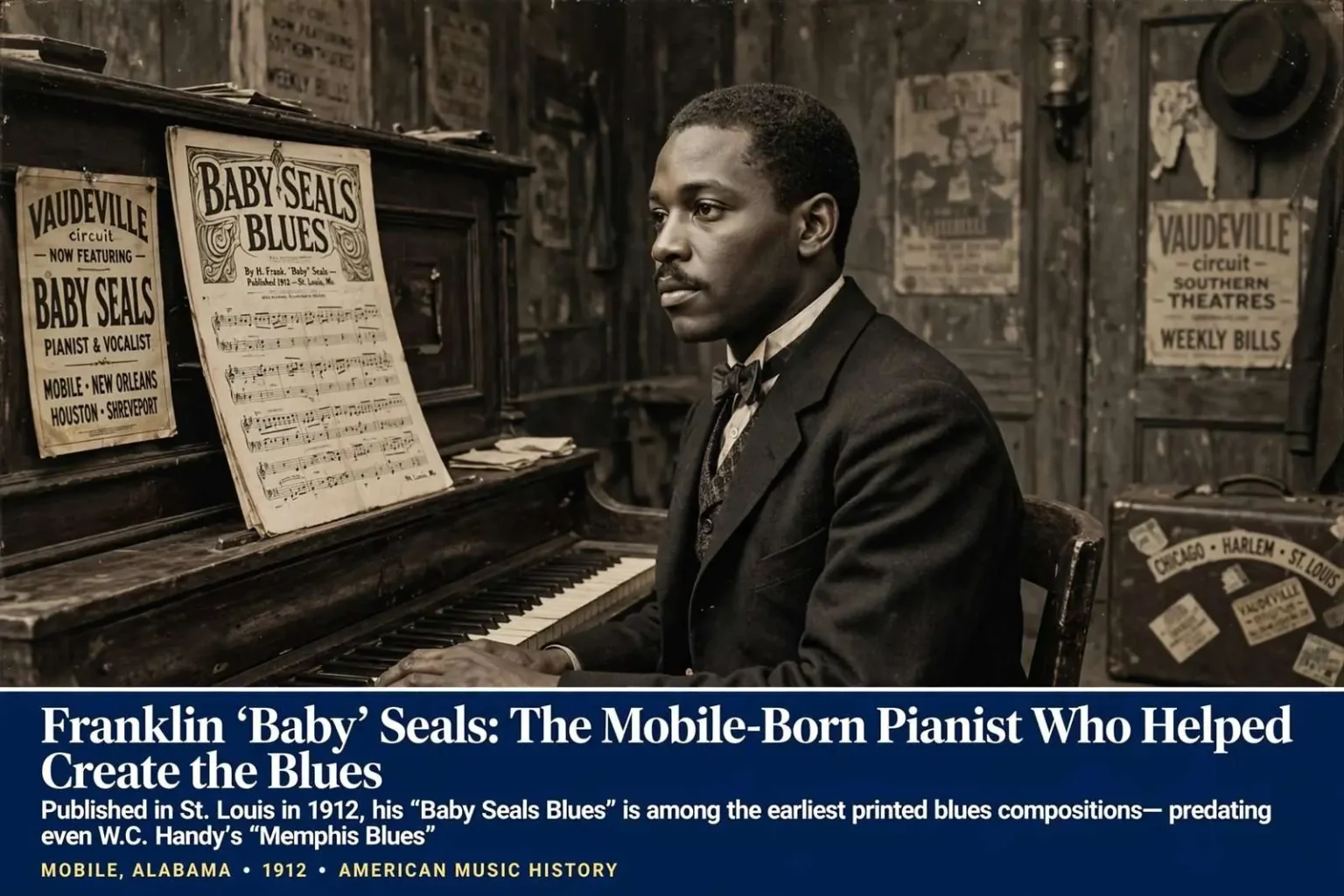
Long before the blues became one of America’s most recognized musical traditions, a pianist from Mobile, Alabama, was helping to define the genre in its earliest days. H. Franklin “Baby” Seals, born in Mobile, would go on to make a lasting mark on American music history by publishing one of the very first blues compositions ever put to paper.
His story belongs to a vanished era of American entertainment — the age of vaudeville, when popular music traveled by rail and sheet music was the industry’s currency. In that world, a published composition was how a song claimed its place in history, and it was in exactly that form that the blues first appeared to the American public, printed on paper with a composer’s name at the bottom of the page.
From Mobile to the vaudeville stage
By 1910, Seals had established himself as a vaudeville singer and performer, working stages across the South in cities including Shreveport, New Orleans, and Houston. The circuit he worked connected Gulf Coast and Southern cities through a network of theaters that booked performers week to week, sending acts up and down the rail lines that bound the region together.
Vaudeville in that era was the training ground of American popular performance. Theaters in New Orleans and Houston ran continuous bills of singers, comedians, dancers and instrumentalists, and performers who could hold a room night after night built reputations that traveled ahead of them. Mobile-born performers who made that circuit carried the musical culture of the Gulf Coast with them into every theater that booked them.
The life was itinerant and demanding. Performers moved town to town on weekly contracts, learning to read an audience quickly and to adapt an act to rooms that ranged from grand theaters to modest hall stages. For a pianist and singer, the circuit demanded versatility — comic numbers, ballads and the newest popular styles — and it rewarded the performers who could absorb what they heard in each city and carry it to the next.
His talent eventually carried him far beyond the Gulf Coast region, with tours taking him to the bustling entertainment scenes of Chicago and New York’s famed Harlem neighborhood. The trajectory was a familiar one for Black performers of the era: build a following on the Southern circuit, then chase the bigger stages and publishing opportunities of the Northern entertainment capitals.
Chicago and Harlem in the 1910s were becoming the centers of gravity for African American popular music, the cities where performers found the theaters, publishers and record men who could turn a stage act into a published song. That a pianist from Mobile worked his way into those rooms says much about both his talent and the musical pipeline that ran from the Gulf Coast to the national stage.
A groundbreaking blues composition
It was in St. Louis in 1912 that Seals made what is arguably his most significant contribution to American music. That year, he published “Baby Seals Blues,” a composition that scholars and music historians have identified as one of the earliest — if not the earliest — published blues compositions in history.
St. Louis occupied a strategic position in early blues history. Sitting at the junction of rail lines and river traffic that carried musical styles north from the Mississippi Delta, the city supported a vigorous sheet music publishing trade, and it was there that the blues — until then a living performance tradition passed player to player — began appearing in printed form that could be sold, played and copied in parlors across the country.
The work notably predates W.C. Handy’s celebrated “Memphis Blues,” which has long been popularly associated with the birth of published blues music. Handy’s role in the blues’ commercial breakthrough is secure, but the timeline places Seals’ publication first, a fact that reshapes the story of who first committed the blues to paper.
The significance of this timeline cannot be overstated. While Handy is often credited as the “Father of the Blues,” the existence of “Baby Seals Blues” demonstrates that the genre’s development involved multiple pioneering artists working across different cities in the early 20th century, with Mobile-born Seals among the very first to commit the blues to published form.
History’s popular memory tends to compress into single names, and Handy’s nickname — earned through decades of advocacy for the music he transcribed — has crowded out contemporaries who reached print at the same moment or before. Seals’ publication is the kind of archival fact that music historians work to restore: not a diminishment of Handy, but a fuller picture of a genre that emerged in many places at once, shaped by performers whose names never attached themselves to the music’s origin story in the popular mind.
The blues that Seals published was, at the time, a young and unsettled form. Rooted in the work songs, field hollers and spiritual music of the African American South, it had circulated for years as an oral tradition before publishers recognized a commercial market for it. Composers like Seals served as translators between the living tradition and the printed page, fixing rhythms and chord patterns into notation that pianists far from the music’s birthplace could reproduce.
That translation work carried consequences. Published blues spread the form far beyond the Delta and the Gulf Coast, and within a decade of Seals’ 1912 publication the blues had become a national phenomenon, recorded by artists across the industry and absorbed into jazz, vaudeville and eventually popular music of every kind. The early published compositions — “Baby Seals Blues” among them — were the first documents of that expansion.
A brief but influential life
Seals’ life was cut short when he died in Anniston, Alabama, in 1915. He was young by any measure of a performing career, and his death came just three years after the publication that secured his place in music history.
Despite the brevity of his career, his contribution to American music endures. His published work serves as important evidence of the blues’ complex origins and the role that Gulf Coast musicians played in shaping one of the nation’s most enduring art forms.
The sheet music itself functioned as more than a souvenir of a stage act. In 1912, a published composition was the only way most Americans could hear a new style of music — home pianists bought the notation and played it in their own parlors, and other performers learned it from the printed page. Each copy of “Baby Seals Blues” that circulated carried the Mobile-born pianist’s take on the form into homes and theaters far from any stage he ever played.
The brevity of his arc makes the 1912 publication all the more remarkable. Seals went from working the vaudeville circuits of Shreveport, New Orleans and Houston to publishing a historically pivotal composition in St. Louis inside roughly two years, then was gone before the blues revolution he helped start had fully arrived. Other pioneers of the genre lived long enough to see the music recorded, monetized and canonized; Seals’ claim rests on the paper he left behind.
Seals’ story is documented in scholarly works including “Ramblin’ on My Mind: New Perspectives on the Blues” by David Evans, which examines the broader history and development of blues music across the American South. Evans, a longtime researcher of Southern musical traditions, is among the scholars who have worked to establish the documentary record of the blues’ earliest published history — the record in which Seals’ name appears.
The distinction that scholarship preserves is a precise one. Handy’s “Memphis Blues” introduced the blues to a mass market and gave the genre its most famous early advocate, but “Baby Seals Blues” appeared on the same commercial landscape first, and music historians weigh both facts when they reconstruct how the form moved from performance to print. That Seals accomplished it as a vaudeville performer rather than a bandleader or publisher makes the achievement rarer still.
For Mobile, the story adds a name to the city’s musical lineage. The Port City’s contributions to American music are usually told through later eras — the R&B and soul recordings cut in Gulf Coast studios, the jazz and carnival traditions of the central Gulf — but Seals places Mobile at the very beginning of the blues’ written history, years before the music had a national audience.
Anniston, where his life ended in 1915, sits in the east Alabama hills far from the Gulf Coast stages where he built his name — a reminder of how widely vaudeville performers moved in an era when the rail lines, not the highways, defined a career’s geography. The routes that carried him from Mobile through New Orleans, Houston, Shreveport, St. Louis, Chicago and Harlem traced the full reach of the entertainment world as it existed in his short lifetime.
The recovery of stories like Seals’ is an ongoing project of American music scholarship. Sheet music, theater advertisements and city directories are the raw material, and each documented career adjusts the map of where the blues came from and who carried it. In that map, a Mobile-born pianist stands at the head of the line: the man who published “Baby Seals Blues” in St. Louis in 1912, among the very first to put the blues on paper, three years before his death in Anniston closed a career that had barely begun.