Free Health and Wellness Fair Set for Fairhope Rotary Youth Club This Weekend
Hope Community is hosting a free Health and Wellness Fair at the Fairhope Rotary Youth Club on Oct. 18, offering health screenings, eye care, and family resources.
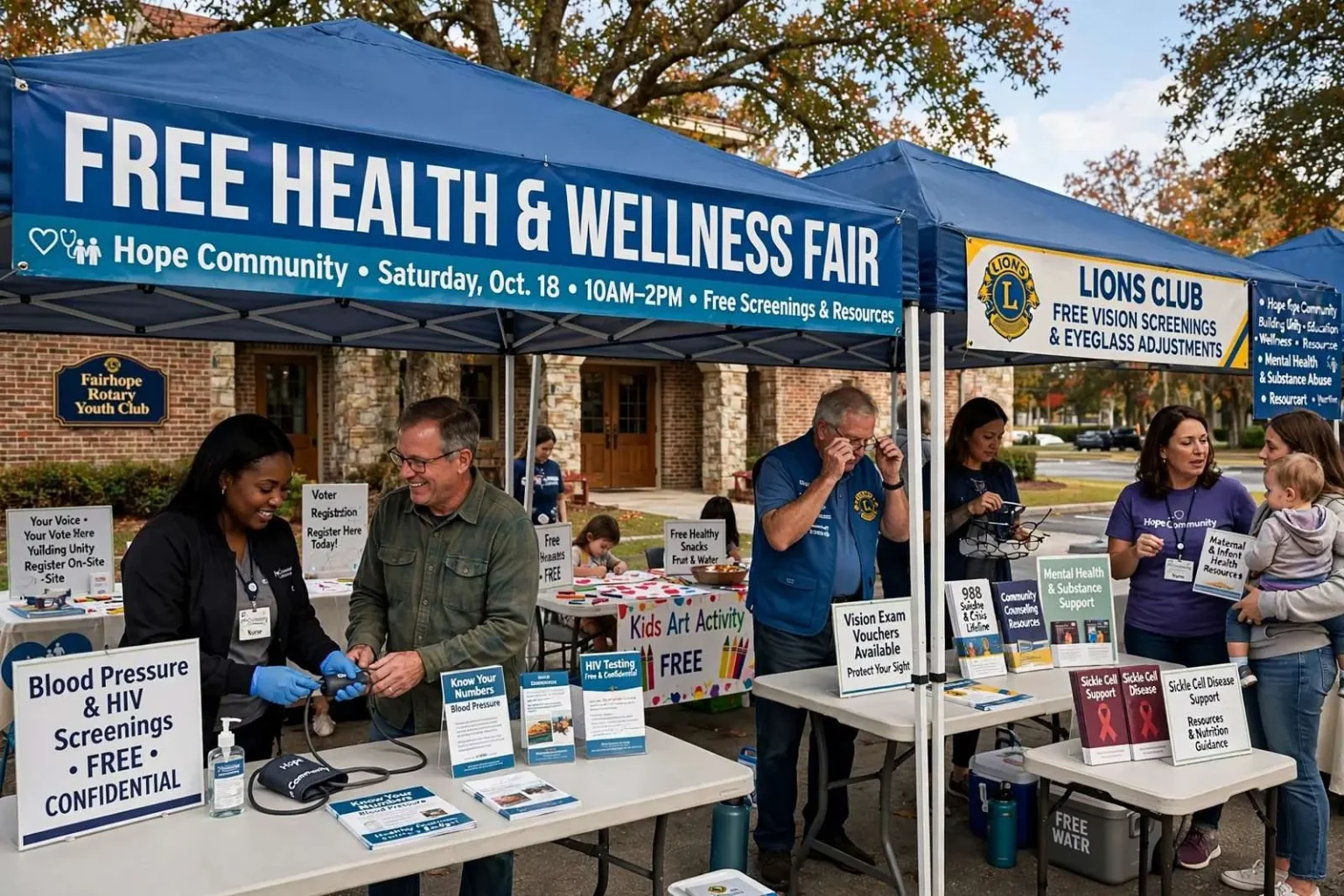
Baldwin County residents will have a chance to check on their health for free this weekend, as Hope Community hosts its Health and Wellness Fair at the Fairhope Rotary Youth Club.
The free event runs from 10 a.m. to 2 p.m. on Saturday, Oct. 18, and organizers are billing it as a one-stop opportunity to connect with local groups focused on improving community health. Rather than requiring families to schedule separate appointments across multiple agencies, the fair gathers screenings, information and support services under one roof for a single four-hour window.
Attendees can take advantage of a wide range of no-cost services, including blood pressure checks and HIV screenings. Free blood pressure checks address one of the most common and consequential health issues on the Gulf Coast, where hypertension often goes undetected until it contributes to far more serious conditions. HIV screenings, offered confidentially and at no cost, remove two of the most common barriers to testing — cost and logistics — that keep people from knowing their status.
The Lions Club will be on hand offering free eyeglass adjustments and exam vouchers for those in need of vision care. Vision problems frequently go uncorrected in households without insurance or the ability to take time off work for an appointment, and the voucher approach lets the club extend help beyond what can be accomplished in an afternoon — residents who need a full exam can receive one through follow-up care arranged after the fair.
The fair will also provide information and resources on mental health, substance abuse support, women’s health, and programs aimed at supporting mothers and babies. Mental health and substance abuse resources have become an increasing focus of community health efforts across Alabama, where rural and small-town residents often face long waits and long drives to reach treatment providers. Putting those providers in front of families at a local, familiar venue lowers the threshold for a first conversation that can lead to care.
Additional resources will cover nutrition guidance and support services for people living with Sickle Cell Disease. Sickle Cell Disease, an inherited blood disorder that affects thousands of Alabamians and requires lifelong management, is an area where community-based support services play an outsized role for families navigating treatment, pain management and the costs associated with the condition.
A family-friendly afternoon
Families are encouraged to attend together, with art projects planned for children along with free healthy snacks. The design reflects a practical understanding of how health events actually draw crowds: parents are far more likely to stop in — and to linger long enough to complete a screening or have a real conversation with a provider — when children have something to do and something to eat.
Voter registration will also be available on-site for anyone looking to register. With election season underway, organizers added the registration table as a civic complement to the health services, giving attendees one more errand they can complete during a single visit. The addition fits the broad mission Hope Community has embraced: strengthening the community’s capacity to take care of itself, whether the need is medical, social or civic.
The venue itself matters to the event’s accessibility. The Fairhope Rotary Youth Club is a known gathering place for families on the city’s south side, and hosting the fair there puts services in a location residents already visit rather than a medical campus that can feel intimidating to people who have not seen a doctor in years.
For Baldwin County, the fair arrives at a moment when access to affordable care remains uneven across the county’s mix of growing suburbs and smaller communities. Free screening events do not replace primary care, but organizers view them as a bridge — catching warning signs like elevated blood pressure, connecting residents to programs they did not know existed, and building the trust that brings people back for follow-up care.
Hope Community’s broader mission
The event is organized by Hope Community, a Baldwin County nonprofit dedicated to preserving the area’s African American history while building a hub that supports residents through education and career training. The organization says its mission centers on fostering unity and nurturing relationships to bring about lasting change in the community.
That combination — historical preservation alongside practical services — defines the organization’s approach. Hope Community’s work on African American history in Baldwin County ties present-day residents to the generations whose labor and enterprise shaped the area, while its education and career training programs aim at the economic groundwork that families need now. The health fair extends the same model into wellness: meet people where they are, remove the cost barrier, and connect them to resources that already exist in the community.
Community health fairs of this kind depend on partnerships, and the range of participants at this one — from the Lions Club’s vision services to public health screenings to social service providers — reflects the network Hope Community has built across Baldwin County and the broader Gulf Coast. Each partner brings a piece of the safety net, and the fair assembles the pieces in one place for a single afternoon.
More information about the fair and Hope Community’s ongoing programs is available through the organization’s Facebook page. Organizers encourage residents who cannot attend Saturday to follow the page for future events, as the organization plans to continue its mix of community programming throughout the year.
The timing of the fair — a mid-October Saturday — places it in the stretch of the Gulf Coast calendar when outdoor heat finally relents and community events draw their best crowds of the fall. Organizers of free health events along the Eastern Shore have learned that turnout rises sharply when the event coincides with the season’s festivals and school activities, and the four-hour midday window keeps the fair accessible for families juggling weekend schedules.
For residents without a regular doctor, events like this one often serve as the entry point into the health system. A blood pressure reading that comes back elevated, for example, becomes the trigger for a referral — a concrete next step that a person might never have taken without the chance encounter at the fair. Public health workers describe these screenings as the low-cost front line of prevention: cheap to deliver, easy to staff, and capable of surfacing conditions years before they become expensive emergencies.
The same logic applies to the fair’s information tables. Many of the programs represented — substance abuse support, maternal and infant health services, nutrition assistance — exist to serve exactly the residents least likely to know they exist. A family navigating a new diagnosis of Sickle Cell Disease, or a mother unsure what prenatal resources she qualifies for, may discover the right program not through a search engine but through a conversation at a folding table on a Saturday afternoon.
Fairhope itself provides a distinctive setting for the event. The city on Mobile Bay’s eastern shore is one of Baldwin County’s best-known communities, but its reputation for shops, parks and waterfront charm coexists with real pockets of need, particularly in the neighborhoods surrounding the Rotary Youth Club. The club, a longstanding community institution on the city’s south side, serves young people and families year-round, making it a natural host for an event aimed at reaching residents who might not otherwise connect with health services.
Baldwin County’s rapid growth adds urgency to the community health picture. The county has been among the fastest-growing in Alabama for years, drawing new residents to its suburban communities and coastal towns, and that growth has strained the availability of affordable services relative to population. Nonprofits like Hope Community fill the space between what public agencies provide and what residents can access on their own — and health fairs are among the most efficient tools they have for reaching large numbers of people at once.
Why partnerships make the difference
None of the services at the fair would be possible without the participating organizations donating their time and expertise. The Lions Club’s vision program represents a national service tradition — club chapters across Alabama have provided eyeglass assistance and vision screenings for generations, funded through local fundraising — and its presence at a Baldwin County event reflects the club’s continuing commitment to hands-on service in the communities where its members live.
HIV screening at no cost likewise depends on public health infrastructure that residents rarely see up close. Community-based testing events are a staple of outreach efforts because they reach people who avoid clinical settings, and the confidential, judgment-free format of a fair screening lowers the barrier considerably compared with a doctor’s office visit.
The mental health and substance abuse resources on display connect to a broader push across Alabama to expand community-based treatment. For years, state and county officials have worked to shift care away from emergency rooms and jails and toward community programs — a shift that depends heavily on organizations willing to make their services visible and approachable at neighborhood events like this one.
Hope Community’s Facebook page serves as the central hub for information about its programming, reflecting how small nonprofits along the Gulf Coast now reach their audiences. The organization uses the platform to announce events, share historical content tied to its preservation mission, and keep supporters informed between fundraisers and programs.
For attendees, the math of the afternoon is straightforward: free screenings, free information, free snacks and activities for the kids, and — for those who need it — a voter registration table, all within a short drive for families across the county. Organizers hope the fair does more than fill a Saturday; each connection made at the event, whether to a screening, a program or a provider, is the kind of small link that their mission of lasting community change is built on.