Free Summer Film Series Pairs Book Classics With Bernheim Hall — Starting With an Alabama Author’s Own Story
The South Alabama Film Festival screens free book-to-film classics monthly at Bernheim Hall in downtown Mobile, starting with Alabama author William.
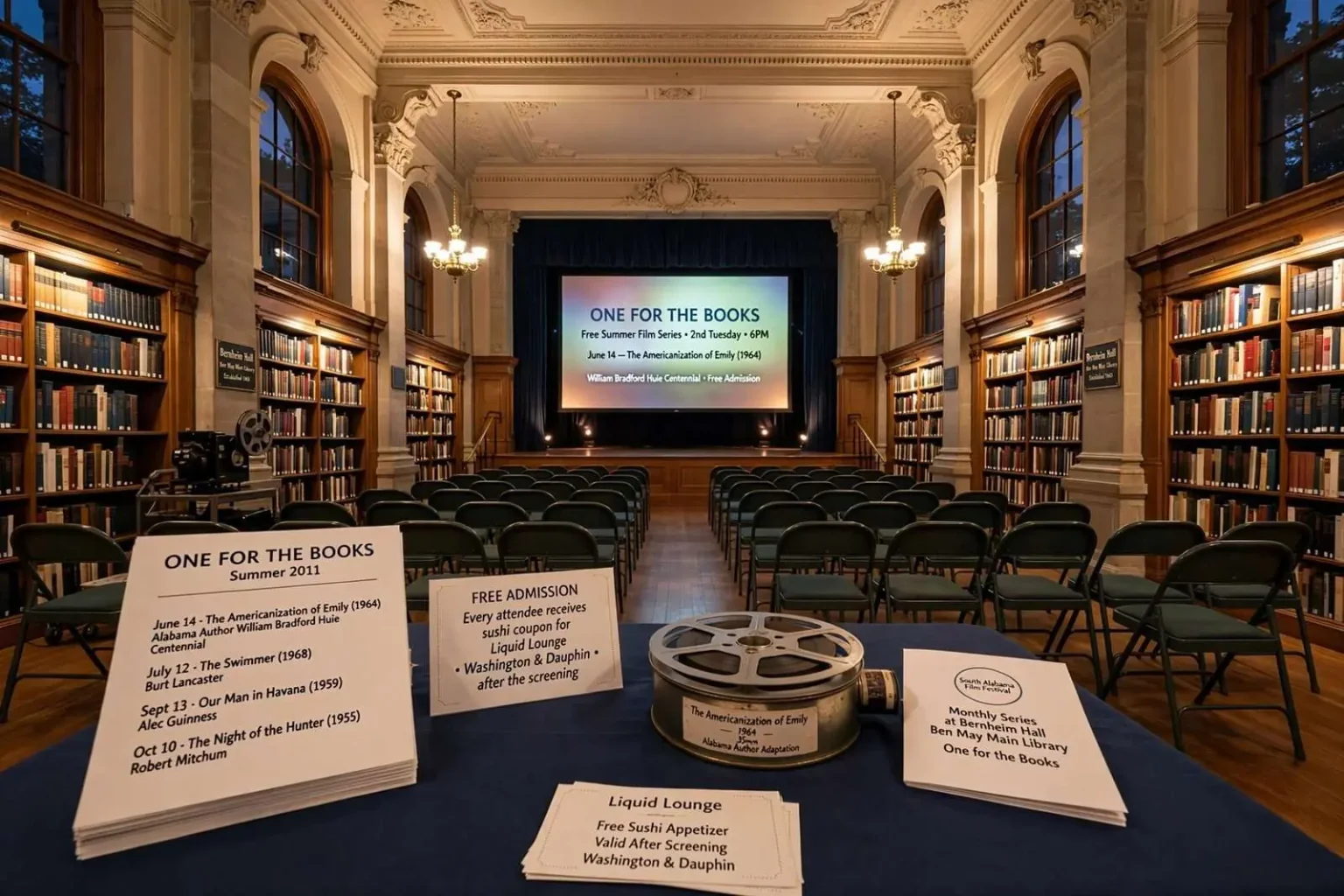
The South Alabama Film Festival launched a free monthly screening series in June 2011, turning Bernheim Hall at the Ben May Main Library into a summer movie house built entirely on literary adaptations. The “One for the Books” series runs the second Tuesday of each month, with shows at 6 p.m. — and every attendee leaves with coupons for sushi at the Liquid Lounge around the corner at Washington and Dauphin, to keep the post-film conversation going.
The pairing of a historic library hall with classic cinema is a natural one. Bernheim Hall, with its high ceilings and formal proportions, offers the kind of room that modern multiplexes cannot: intimate, architectural and framed by bookshelves, so that an evening of film based on the printed page takes place quite literally among the books. The Ben May Main Library downtown has long served as one of Mobile’s civic living rooms, hosting lectures, meetings and cultural programming, and the film series extends that tradition into the summer evenings when downtown streets otherwise quiet down.
Programming director Gideon C. Kennedy, a local filmmaker, curated the lineup around adaptations that have faded from circulation but hold up for modern audiences. That curatorial instinct — avoiding the obvious classics everyone has streamed a dozen times in favor of films that deserve rediscovery on a big screen — gives the series its identity. Each screening doubles as a small act of film preservation, introducing viewers to titles that rarely appear on television schedules and that many film lovers have only read about.
Bernheim Hall itself adds weight to the screenings. The room sits inside the Ben May Main Library, the flagship of the Mobile Public Library system and one of downtown’s most recognizable civic buildings. Its stage, seating and acoustics have made it a favorite venue for lectures and performances for generations, and its location places it within easy walking distance of downtown restaurants and bars. For the festival’s organizers, the hall solved the perennial problem of repertory cinema — finding a screen with character — while reinforcing the library’s role as a place where the community encounters stories in every form.
The free admission matters as much as the programming. In an era when a night at the movies for a family can easily cost more than a dinner out, a monthly series with no ticket price removes every barrier to trying something new. Attendees can walk in on a Tuesday evening, sit in a landmark hall, watch a restored classic and walk out with a coupon for the neighborhood restaurant around the corner — a complete downtown evening for nothing but the time it takes to attend.
The lineup
June 14 — The Americanization of Emily (1964). The inaugural screening doubled as a William Bradford Huie centennial tribute: the novel’s author was an Alabama native, and his widow Martha Huie wrote a special introduction for the festival about watching her husband’s book become a film. Huie, born in Hartselle, Alabama, built a remarkable career as a journalist and author whose books repeatedly found their way to Hollywood, and the centennial of his birth gave the festival a reason to celebrate a native son whose work most Alabamians know only through its screen versions.
James Garner stars as a Navy officer whose comfortable wartime life is upended by an English war widow (Julie Andrews) and the approaching D-Day invasion, in a controversial script adapted by Paddy Chayefsky and directed by Arthur Hiller. The film remains one of the sharpest anti-war comedies of its era, a movie that wears a romantic surface over a scalding critique of military public relations. Chayefsky, fresh off his reputation as television’s fiercest dramatist, filled the script with monologues that Garner delivers with perfect cynicism, and the film’s reputation has only grown among cinephiles in the decades since its release.
July 12 — The Swimmer (1968). Burt Lancaster swims home through his neighbors’ backyard pools in John Cheever’s suburban fever dream. Adapted from Cheever’s famous short story, the film follows its protagonist’s increasingly surreal journey across an entire county by way of private pools, each stop peeling back another layer of his carefully constructed life. It is one of the strangest major-studio releases of the 1960s — part drama, part nightmare, with a performance from Lancaster that grows more harrowing by the minute — and it has been reappraised over the years as a genuine American oddity worth seeking out.
The choice to build a summer series around literary adaptations rather than festival premieres was a deliberate one for the South Alabama Film Festival. Adaptations give an audience two works to discuss instead of one: the book that came first and the film that reimagined it. That built-in conversation suits a library setting perfectly, and it lets the series serve as informal literary criticism for people who might then pick up the source material — a Cheever story, a Greene novel, a Grubb gothic — the following week. In that sense, “One for the Books” functions as both a film program and a reading program, with each screening pointing back to the shelf.
The Swimmer also carries an unexpected Gulf Coast connection for local audiences: its star, Burt Lancaster, spent much of his career playing men whose confidence masks something broken, and the film’s pool-by-pool structure — each backyard a small stage set for suburban delusion — turned a simple premise into one of the most unsettling films of its decade. Watching it on a big screen, with an audience reacting to each new encounter along the swim, is an entirely different experience from catching it on a small television, and that difference is precisely the point of the series.
September 13 — Our Man in Havana (1959). Alec Guinness leads Graham Greene and director Carol Reed’s comic spy story about a vacuum-cleaner salesman recruited into British intelligence. The film unites two of British cinema’s most celebrated figures — Greene, whose novels supplied the genre with its moral complexity, and Reed, whose The Third Man remains a touchstone of the espionage film — with Guinness at the height of his comedic powers. Shot partly on location in Havana just as Castro’s revolution reached the city, the movie offers an accidental documentary of pre-revolutionary Cuba wrapped inside a satire of the intelligence business, in which a decent, hapless man invents intelligence reports to pay his daughter’s bills and watches his fabrications become lethally real.
October 10 — The Night of the Hunter (1955). Robert Mitchum’s terrifying preacher hunts two children who know where a stolen fortune is hidden, in Charles Laughton’s sole directing effort, adapted from Davis Grubb’s novel by Pulitzer winner James Agee. The film’s afterlife is one of the great second acts in cinema history: dismissed by critics and audiences on its release, so discouraging that Laughton never directed again, it was reappraised over the following decades and now stands among the most admired American films ever made. Its expressionist shadows, its ominous score and Mitchum’s loves-and-hates tattooed knuckles have been quoted by generations of directors, from the French New Wave onward.
Why it matters locally
The schedule itself also deserves a note: by spacing the screenings from June through October, the series bridged the summer gap when festivals and touring acts thin out downtown, giving filmgoers a standing appointment through the hottest months. A second-Tuesday rhythm is easy to remember, and monthly spacing gives each selection room to breathe — attendees have weeks to hear about a screening from friends, check out the source novel and arrive with expectations of their own.
For Mobile, the series represents something the city’s cultural calendar had lacked: a regular, free, film-focused evening with real curatorial ambition. Gulf Coast audiences have never wanted for festivals — music, food and heritage events fill the calendar — but a sustained monthly film program built around serious repertory programming is a different kind of institution, the sort that usually only larger cities sustain. Anchoring it at the main library sends its own message about where cinema belongs: alongside the books it came from.
The Liquid Lounge coupon tie-in also knits the series into the downtown economy. Sending attendees around the corner to Washington and Dauphin after each screening turns a two-hour film into a full evening in the neighborhood — conversation over sushi, discovery of a restaurant some attendees might not otherwise visit, and a small but real flow of customers to a nearby business on a weeknight. It is the kind of collaboration between cultural programming and local commerce that downtown revitalization efforts spend years trying to engineer.
The series’ formula — a literary adaptation, a historic hall, a Tuesday evening and a post-film plate of sushi — gave Mobile filmgoers a summer habit worth keeping. For anyone who had only ever read about Huie’s Alabama roots, Cheever’s dark suburbs, Greene’s Havana or Laughton’s cursed masterpiece, the “One for the Books” series offered what streaming never can: a room full of neighbors, a screen the size of a wall, and the collective experience of an old film made new.